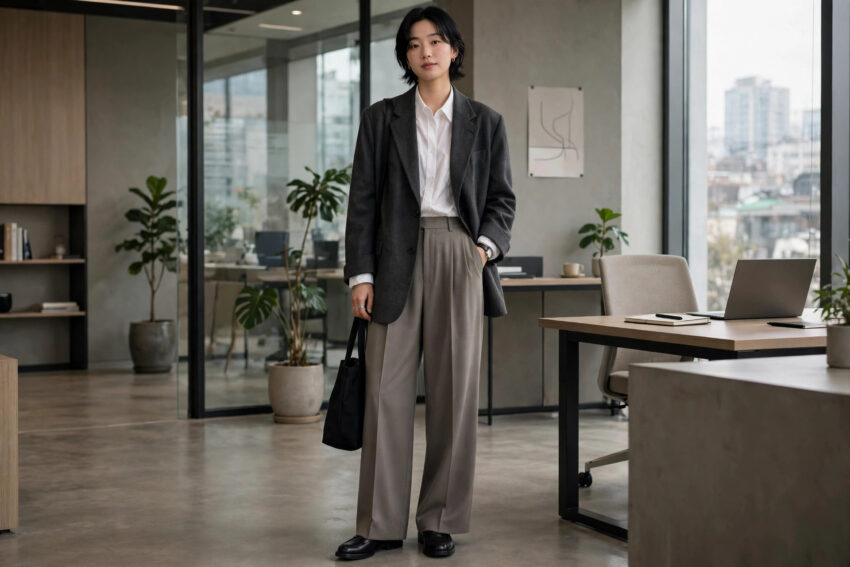
Korean streetwear looks relaxed in photographs and precise in person, and that precision is exactly why so much of it can go to work. The Seoul version of oversize is not sloppy. It is a controlled silhouette, a blazer with room in the body but a clean shoulder, trousers that fall wide and full length, a palette that stays quiet while the proportions do the talking. An office dress code asks for almost the same things, structure, restraint and clothes that look deliberate by nine in the morning and still look deliberate at six. The problem is translation. Worn unedited, the street version reads as off duty. Edited with a dress code in mind, the same pieces become some of the most comfortable office clothes you can own. This guide does that editing, code by code and piece by piece, so the Seoul silhouette survives the office instead of being left at the door.
Start Here
For the full men’s version of the silhouette this guide translates, start with Korean streetwear for men and the outfit formulas in Korean street style for women. The wider aesthetic behind both is set out in Korean streetwear style, where the proportion rules used below come from.
Key Takeaways
- Read your office code first, then translate the silhouette into it, never the other way round.
- The oversized blazer is the bridge piece, roomy in the body, clean at the shoulder, worn over a shirt or a fine knit.
- Wide-leg tailored trousers carry the Seoul proportion into work, full length, with one light break over the shoe.
- Keep the palette muted, black, charcoal, navy, stone and cream, and let proportion provide the interest.
- Loafers and clean minimal shoes finish the office version, chunky sneakers belong to the casual end of the code.
- One street piece per outfit is the safe ratio in most offices, two in a creative office, none of them ripped, cropped or logo led.
Contents
- Reading Your Office Code First
- The Blazer Translation: Oversize With a Clean Shoulder
- Wide-Leg Tailored Trousers: The Foundation Piece
- Shirts, Knits and Turtlenecks: The Layer Underneath
- The Muted Palette at Work: Quiet Colour, Strong Proportion
- Shoes, Bags and Finishing: Closing the Outfit
- What Fails, and a Week of Translated Outfits
- Our View
- Frequently Asked Questions
- Sources
- Recommended
Reading Your Office Code First
Every office already has a dress code, written or not, and the first job is to name yours honestly before a single Korean piece is chosen. A dress code sets expected standards for a setting, and workplaces run on a spectrum from formal business dress through business casual and smart casual to genuinely creative dress. The same oversized blazer passes at three points on that spectrum and fails at the fourth, not because the blazer changed but because the expectation around it did. So the translation starts with observation. Look at what the people one level above you wear on an ordinary Tuesday, not on presentation day and not on Friday. That ordinary outfit is your real code, whatever the handbook says, and it is the standard your Seoul pieces have to meet.
The second step is to understand what each code actually permits, because the labels are used loosely and the details decide everything. Business casual relaxes formal dress without abandoning it, usually dropping the tie and the matching suit while keeping the shirt, the tailored trouser and the closed shoe. Smart casual sits one step looser, allowing knitwear, clean minimal trainers in some offices and more personal proportion, provided the outfit still looks considered. Formal offices keep the full structure. Creative offices allow the most Seoul volume, but even they read effort, and an outfit that looks accidental fails there too. The table below translates each level into Korean streetwear terms, piece by piece, so you can find your row and dress to it.
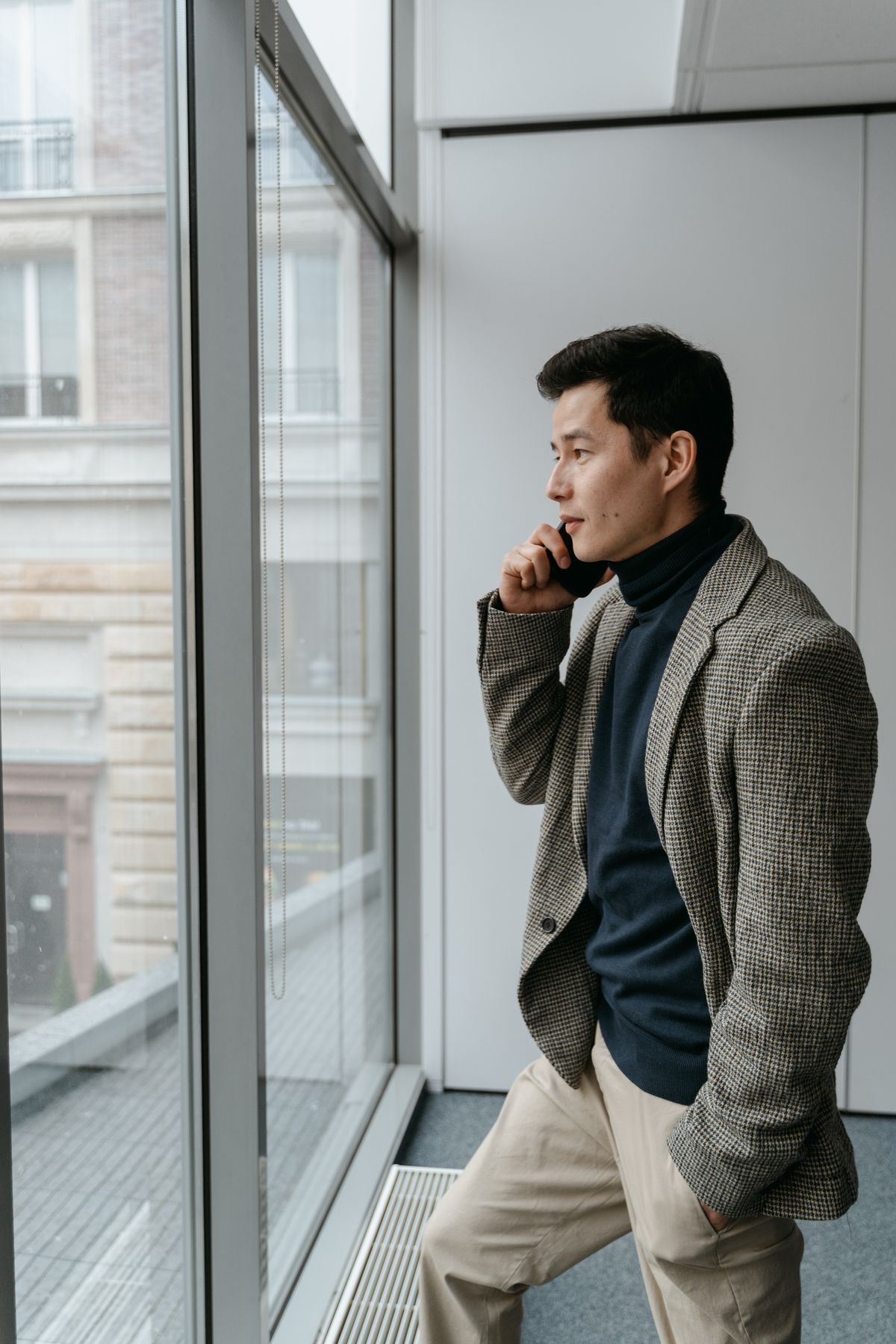
| Office code | Top half | Bottom half | Shoes |
|---|---|---|---|
| Formal office | Oversized blazer over a buttoned shirt | Wide-leg tailored trousers, full length | Loafers or clean dress shoes |
| Business casual | Blazer or fine knit, no tie needed | Wide-leg trousers or clean dark chinos | Loafers, minimal leather shoes |
| Smart casual | Shirt, knit or turtleneck, one tailored piece | Wide-leg trousers, neat and pressed | Loafers or very clean minimal sneakers |
| Creative office | More oversize allowed, still one structured piece | Widest leg the office will accept | Loafers, boots or chunky shoes in moderation |
Read your row as a ceiling, not a target, and dress one notch inside it while you test the water. Offices judge new proportions socially before they judge them formally. A wide leg that arrives alongside a pressed shirt, a clean shoe and tidy hair is read as a style choice. The same wide leg arriving with a graphic tee and worn sneakers is read as a dress code problem, and once that reading sets, every later outfit is judged against it. The Seoul reference districts make the same distinction themselves. The contrast in our guide to Hongdae vs Gangnam style is useful here, because Gangnam polish is the office end of Korean dressing and Hongdae volume is the street end, and work outfits should borrow Gangnam restraint first and Hongdae proportion second. Start conservative, earn the room, then widen the silhouette gradually as the office gets used to it.
The Blazer Translation: Oversize With a Clean Shoulder
The oversized blazer is the single piece that does most of the translation work, because it carries streetwear volume on top of a garment every office already trusts. A blazer is a tailored jacket with a long history in formal and semi-formal dress, so its presence signals intent before anyone registers its proportions. The Korean cut adds room through the body, drops the shoulder slightly and often lengthens the body, and each of those changes needs an office check. The shoulder can sit a little past your natural shoulder, but it should still sit, in a clean line, not slide down the arm. The body can be roomy, but the front should still close without pulling and hang straight when it is open. Length should cover the seat of the trousers or stop cleanly at it, never hover in between.
Fabric decides whether an oversized blazer reads as tailoring or as a borrowed coat. Choose a cloth with some body, a wool blend, a firm twill or a structured knit that holds the lapel shape through a working day. Soft, collapsing fabrics lose the lapel, lose the shoulder line and take the whole outfit down with them, because the blazer is the structure the rest of the outfit borrows. Colour does the same quiet work. Charcoal, navy, black and stone are the office colours of Seoul dressing, and they let the oversize read as proportion rather than personality. A check or a texture is fine at the business casual level and below, kept small and tonal. A loud colour in an oversized cut is two statements at once, and most offices will only accept one.
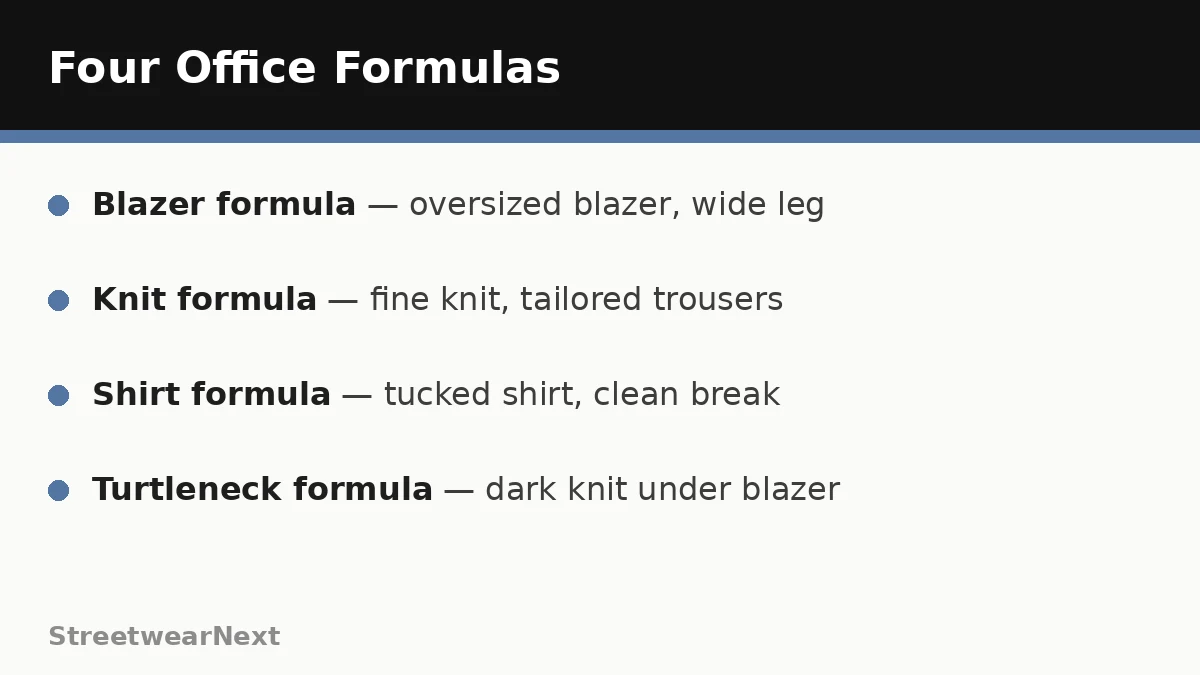
Wear the blazer as the outfit’s one street piece in stricter offices, and let everything under and below it be straightforward. A plain shirt, a fine knit or a dark turtleneck underneath, wide-leg tailored trousers below, loafers to finish. That arrangement is the core formula of this whole guide, and it works because the eye reads the blazer first, the clean lines second and the volume last, as ease rather than rebellion. In creative offices the blazer can be bigger, longer and paired with a wider trouser, but keep the same order of reading. The moment the blazer is joined by a hoodie underneath, a graphic layer and a chunky shoe, the outfit has crossed back into street dress, and no dress code translation survives that crossing in a formal or business casual room.
A note on sizing the blazer, because office oversize is a smaller oversize than street oversize. On the street the blazer can swallow the shirt and reach toward the knee. At work it should carry perhaps one size of extra room, enough that the body falls straight and the sleeves end at the wrist with a sliver of shirt showing. That sliver matters more than it sounds. A visible shirt cuff is one of the oldest signals of deliberate dressing, and it tells the room the extra room was chosen, not inherited from a rail of wrong sizes. If the cuff disappears and the sleeve covers the hand, the blazer has crossed from translated to unedited, and a tailor shortening a sleeve is a small price for the piece you will wear most often in this entire system.
Wide-Leg Tailored Trousers: The Foundation Piece
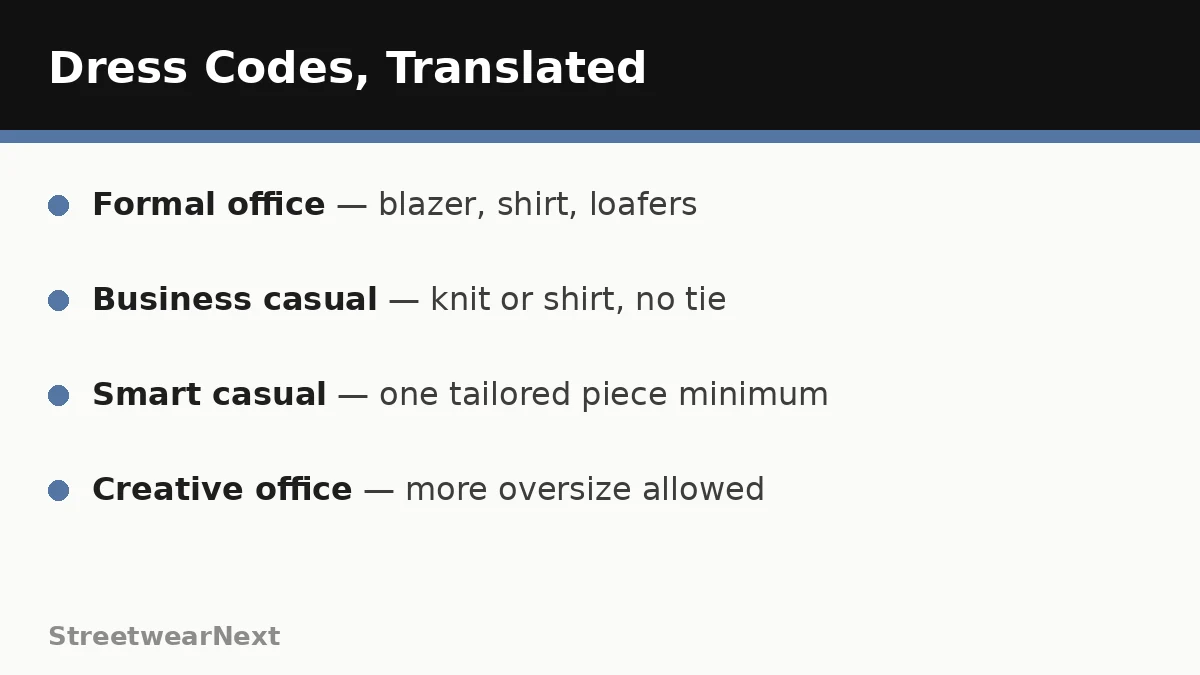
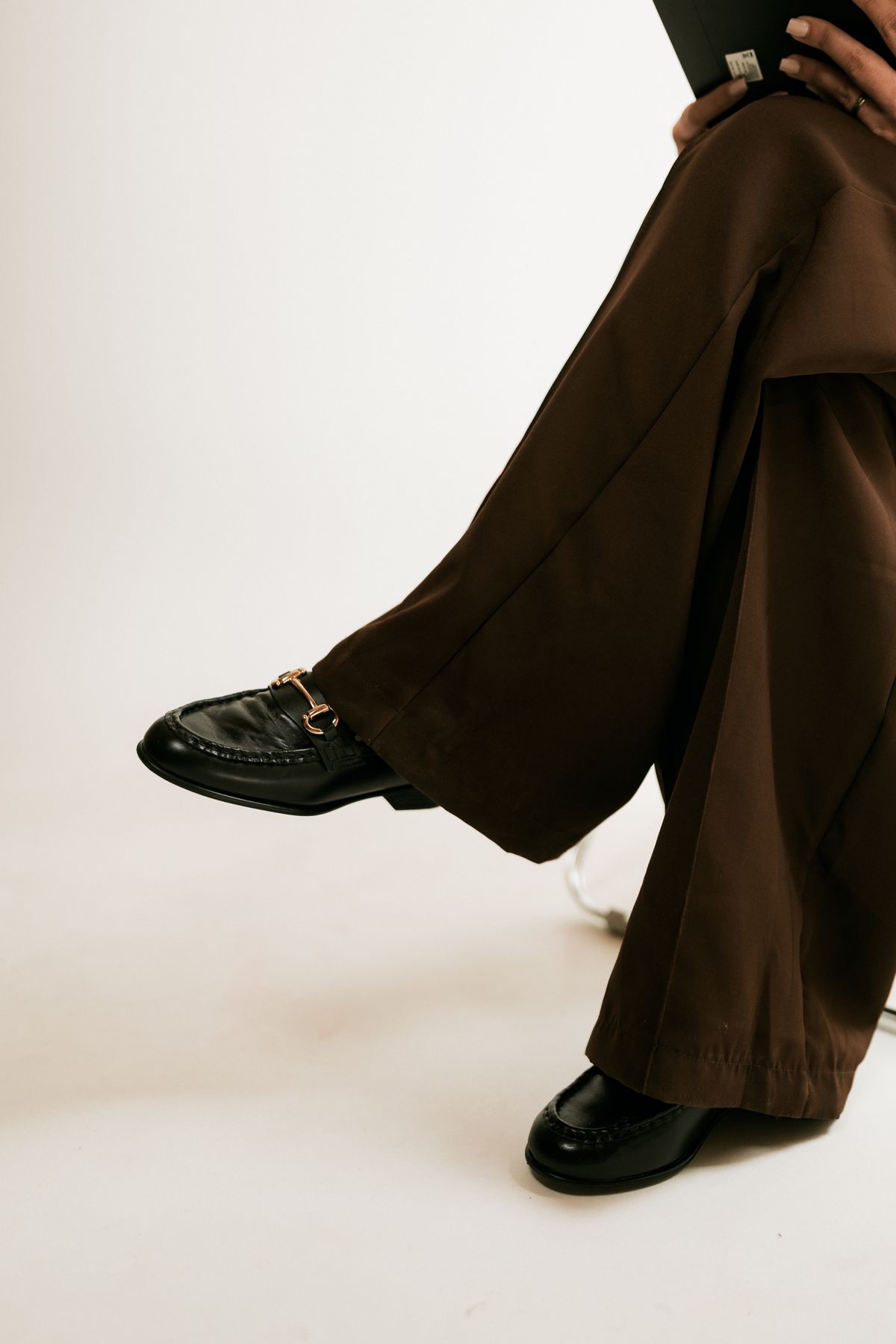
If the blazer is the bridge, the wide-leg tailored trouser is the foundation, and it is the piece Seoul dressing hands office wearers almost unchanged. The category is broad, since trousers cover many cuts, but the Korean office version has a specific shape, a high or mid rise, a clean front, a leg that falls straight and wide from the hip, and a hem that reaches the shoe. That shape does three jobs at work. It keeps the proportion unmistakably Korean. It is more comfortable across a desk day than any slim cut. And it reads as tailoring, because width in a pressed, full-length trouser is a deliberate style that offices across Asia have worn for years, not a casual signal.
The fit checks are about length and finish, and they are not negotiable in an office setting. The hem should meet the shoe and break once, lightly, or rest just on top of it. Pooling cloth reads as untidy, and a hem that hovers above the ankle turns a tailored trouser into a cropped casual one, changing the register of the whole outfit. The waist should sit at the natural waist and stay there without a belt doing structural work. The front should be clean, no cargo pockets, no drawstrings, no elastic cuffs, because each of those details is borrowed from sportswear or utility dress and pulls the trouser out of the office column. A centre crease, kept pressed, is the cheapest formality upgrade in this guide. It costs one pass of an iron and moves the same trouser up a full dress code level.
Colour and cloth follow the blazer rules. Black, charcoal, navy, stone and cream cover the working week, and a tonal outfit, charcoal trouser under a black blazer, or stone under navy, is the most recognisably Seoul arrangement of all. Wool blends and firm cotton twills hold the wide fall and the crease. Thin, shiny or overly soft cloth collapses the leg into something closer to loungewear, which is the one comparison a wide trouser at work cannot afford. Denim, for offices that allow it, belongs at the smart casual level only, in a dark, clean, wide cut with no fading or distressing, and even there the tailored trouser is the safer default while you are establishing the look.
Shirts, Knits and Turtlenecks: The Layer Underneath
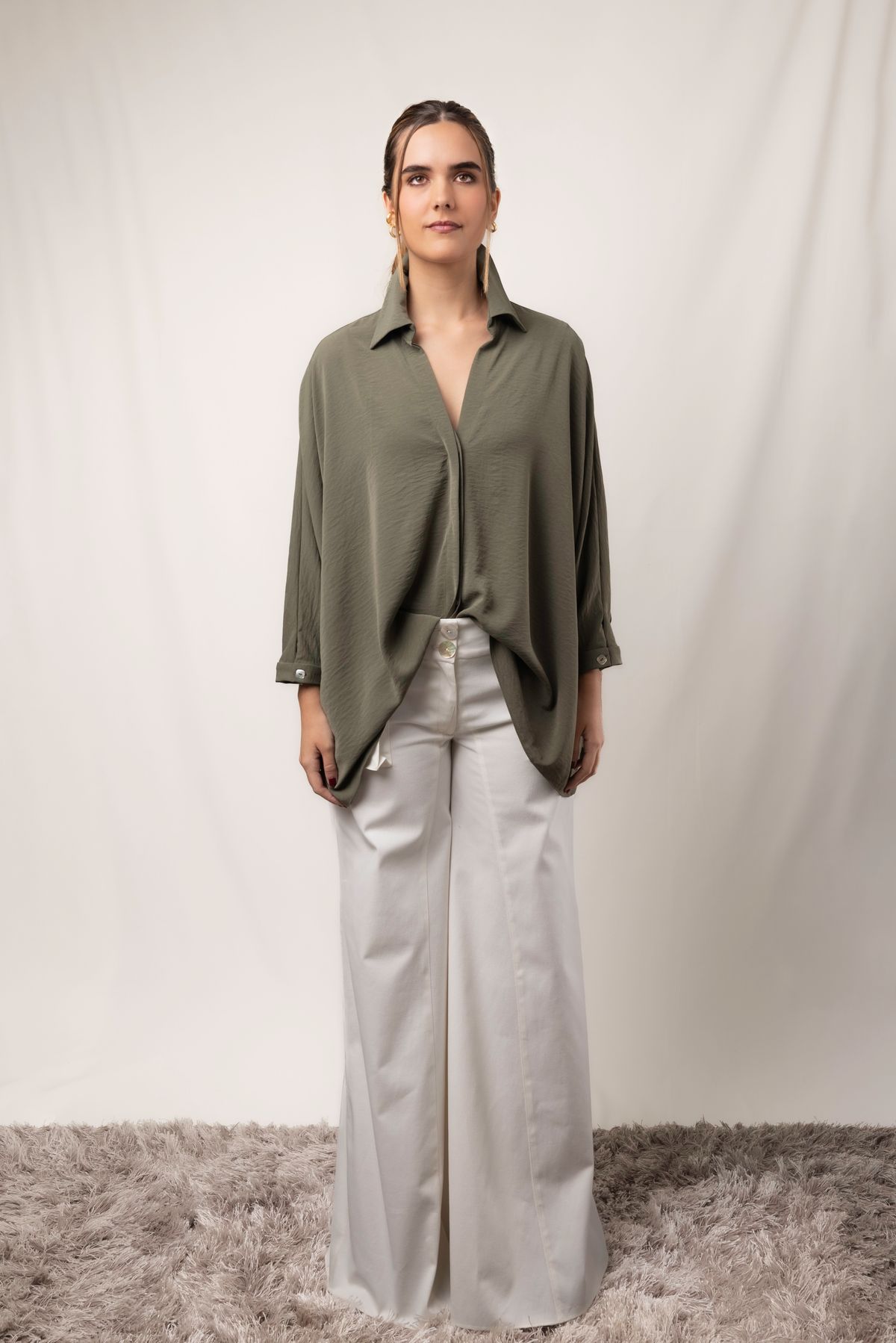
Under the blazer, the office layer is a shirt, a fine knit or a turtleneck, and the choice between them is how you set the outfit’s formality for the day. The shirt is the formal anchor. A button-down shirt signals office dress immediately, and the Korean way to wear it is relaxed but tidy, tucked into the high rise of the trouser, collar neat, sleeves ending at the wrist. Untucked shirts break the waist line that makes wide trousers look tailored, so the tuck is doing real work, not following a rule for its own sake. White, pale blue and fine tonal stripes cover most offices. The oversized shirt worn as the top layer, without a blazer, works at smart casual level provided it is tucked, pressed and paired with the tailored trouser and a clean shoe.
Knitwear is the business casual workhorse, and its texture is what keeps a simple outfit from looking bare. Knitwear covers knitted garments from fine crew necks to cardigans, and the office versions are the fine-gauge ones, smooth enough to sit under a blazer and neat enough to stand alone when the blazer comes off. A fine crew or a half-zip in charcoal, navy or cream over a collared shirt is a complete business casual top half. The turtleneck adds a clean high neck that Seoul dressing uses constantly in cooler months, and in black or dark navy under a blazer it is one of the most polished combinations in this guide, formal enough for most meetings while carrying no tie and no collar to manage.
What this layer must never be, in a formal or business casual office, is the hoodie as the main event. That is a different question with its own full treatment, and our guide to how to style a hoodie for work owns it, including the narrow conditions under which a hoodie passes at all. Here the rule is simpler. The under layer should have a collar, a clean neckline or a fine knit surface, something that looks finished at the neck when the blazer opens or comes off. A sweatshirt or tee can appear at the creative and smart casual end, plain, heavy and logo free, but it is borrowing formality from everything around it, and the loan only holds if the trouser, the shoe and the grooming are impeccable.
The Muted Palette at Work: Quiet Colour, Strong Proportion
The muted palette is not a limitation on Seoul office dressing, it is the mechanism that makes the proportions acceptable to an office in the first place. Fashion in South Korea at its polished end runs on black, charcoal, navy, stone, cream and white, with colour used sparingly and deliberately. That restraint travels directly into the workplace. When the colours are quiet, a wide leg and an oversized shoulder read as design. When the colours are loud, the same proportions read as costume, because the eye has two novelties to process and files the outfit under neither tailoring nor streetwear. One statement per outfit is the working rule, and in an office the statement should almost always be the silhouette, not the colour.
Build the week tonally and the dressing gets easier as well as safer. A tonal outfit, shades of one family worn together, is the signature Seoul arrangement, all black with different textures, charcoal over grey over stone, navy with a white shirt as the single break. Tonal dressing lengthens the body, hides the join between street pieces and office pieces, and photographs as intentional in the way meetings and presentations quietly reward. Readers who follow Gangnam USA’s Korean fashion coverage will recognise this as the district’s everyday polish, suits and sets in quiet colours where the cut carries the status. That is precisely the register an office outfit should borrow, because it signals seniority rather than novelty.
Texture replaces colour as the interest inside a muted outfit, and this is where Korean pieces earn their place over standard office wear. A matte wool blazer over a smooth shirt, a fine ribbed knit against a flat twill trouser, a slight sheen on a loafer against matte cloth, these small contrasts keep a grey outfit from going flat without adding a single bright colour. Pattern follows the same discipline. A small check, a fine stripe or a subtle herringbone is welcome at business casual and below, kept tonal so it reads at arm’s length as texture rather than print. Graphics, logos and slogans do not have a tonal version. They are the street register speaking at full volume, and they stay out of the office translation entirely.
Shoes, Bags and Finishing: Closing the Outfit
Shoes finish the translation, because an office reads an outfit from the ground up more often than wearers realise, and the wrong shoe undoes a correct blazer and trouser in one glance. The loafer is the natural Seoul office shoe. A loafer is a slip-on shoe with a low profile and no laces, and in black or dark brown leather it sits exactly between sneaker ease and formal shoe structure, which is the same in-between ground this entire style occupies. It takes the wide hem cleanly, works with or without a visible sock, and stays comfortable across a commuting day. Chunkier Korean loafers and platform soles exist and can work in creative offices, but in formal and business casual rooms the sole should stay slim and the leather smooth.
Minimal sneakers are the conditional option, and the conditions are strict. They belong at smart casual level and below, in clean white or black leather, low profile, no visible branding, no trail sole, and they must be genuinely clean, because a worn sneaker under tailored trousers reads as giving up rather than dressing down. Our guide to Korean streetwear shoes covers the full range from loafers to the chunky end, and the office rule when using it is to shop from the quiet end of that range only. Boots, a clean Chelsea or a plain lace-up, earn a place in winter and in creative offices, again with the volume kept moderate. What never translates is the statement sneaker, the oversized runner or the skate shoe. They are excellent street shoes and they announce, instantly, that the outfit started on the street and never made the crossing.
Bags and small details close the outfit, and they should be as quiet as the palette. A structured tote, a clean crossbody worn short, or a simple brief style bag in black or dark brown keeps the office register. Backpacks are accepted in many offices now, but the Korean street versions with straps, clips and patches pull the look back, so choose a plain, structured one if you carry one. The finishing pieces in our guide to Korean streetwear accessories translate selectively, a plain watch, small silver jewellery, a neat belt and tidy socks all cross over, while caps, beanies and visible chains stay on the street side of the line. Grooming is the last accessory. Seoul office dressing assumes neat hair and a pressed garment, and no proportion trick compensates for a creased trouser or an unwashed knit.
Commute reality deserves one line in the shoe rules, because office outfits are judged after the journey, not before it. Wide hems pick up wet pavements and dust, so a hem that truly meets the shoe needs a shoe that can be wiped clean in ten seconds at the door, another quiet argument for smooth leather over suede or canvas on wet days. Keep the trouser hem off the ground by that single light break and it stays clean. Let it pool and by the second week the hem carries the evidence of every pavement it crossed, and no blazer, however clean its shoulder, fully recovers an outfit whose edges look travelled rather than arrived.
What Fails, and a Week of Translated Outfits
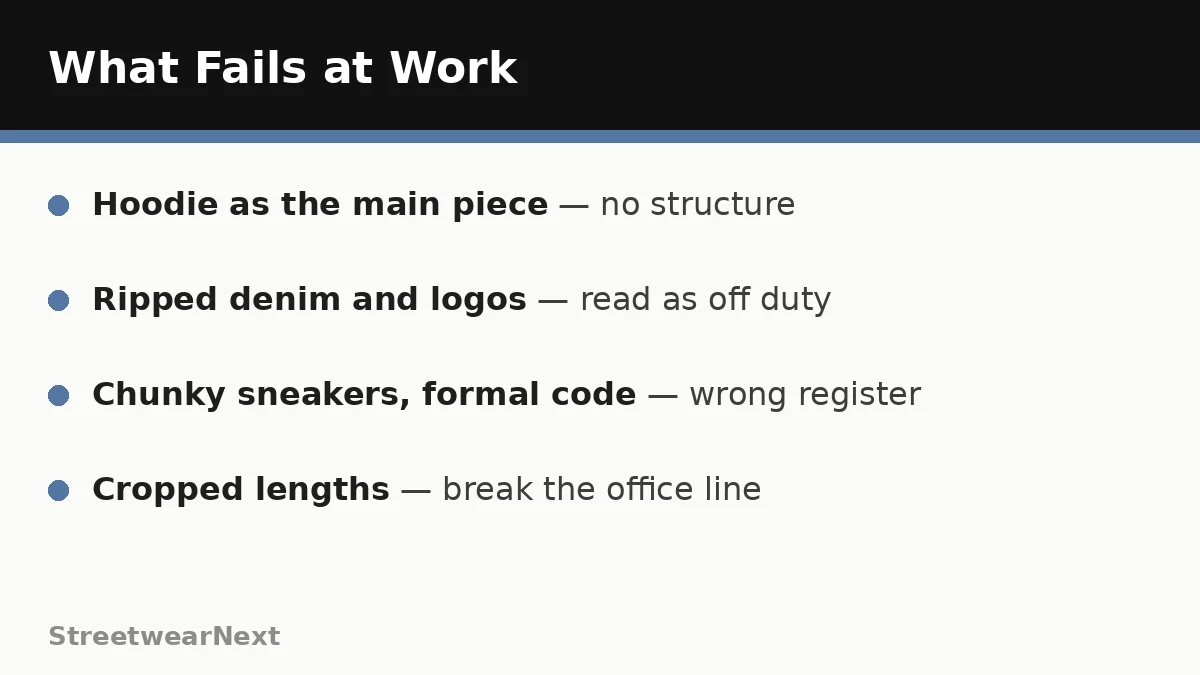
The failures are consistent enough to list plainly, and every one of them is a piece crossing into the office without its register changed. At its root streetwear blends casual uniform codes from sport, skate and workwear, and the office problem pieces are the ones that keep those codes fully visible, the hoodie worn as the main top layer, ripped or heavily faded denim, cargo pockets and drawstring hems, cropped tops and trousers that end mid-calf, oversized graphics and logos, and the chunky statement sneaker in a formal room. None of these is a bad garment. Each is a garment still speaking street language in a room that asked for office language, and the translation project fails one piece at a time, usually at the piece the wearer thought was the personality of the outfit.
The working week shows the translation running at different levels without repeating itself. Monday, the formal anchor, charcoal oversized blazer, white shirt tucked, black wide-leg trousers, black loafers. Tuesday, business casual, navy fine knit over a pale shirt, stone wide-leg trousers, dark loafers. Wednesday, the tonal day, all black, turtleneck under a black blazer, black trousers, black shoes, texture doing the work colour usually does. Thursday, smart casual, an oversized shirt tucked into charcoal trousers with a clean minimal sneaker where the office allows it. Friday, the creative end, the longest blazer and the widest leg of the week, a plain heavy tee or knit underneath, boots or loafers, still no graphics and nothing ripped. Five outfits, one small set of pieces, each piece earning its place across several days.
The habit that keeps all of this working is a thirty-second check before leaving, run in a fixed order. Shoulder line clean. Waist tucked or deliberately closed. Hem meeting the shoe properly. Shoe clean and quiet. One street piece only, or two in a creative office, and nothing ripped, cropped or branded across the chest. That check is the whole method in miniature, because translating Seoul silhouettes into office dress codes was never about owning special clothes. It is about taking proportions that Korean dressing does better than anyone, and presenting them inside the expectations of the room you work in, so the outfit is read the way it was meant, deliberate, comfortable and quietly ahead of standard office dress.
Our View
Our view is that Korean streetwear is closer to office dress than either side usually admits. Seoul dressing already values a clean shoulder, a full-length trouser, a quiet palette and an outfit that looks considered from across a room. Translate those values into your dress code, keep one street piece per outfit, finish with a loafer and a pressed crease, and you are not dressing down for work or dressing up streetwear. You are wearing the same discipline in both places, and that is why the look holds up from the commute to the last meeting of the day.
Do not ask whether a Seoul outfit is too relaxed for your office. Ask whether its shoulder, its hem and its shoes are right, because those three answers are the dress code.
— Brian Ka
Frequently Asked Questions
Can Korean streetwear really work in a formal office?
Yes, in its tailored form. An oversized blazer with a clean shoulder over a buttoned shirt, full-length wide-leg tailored trousers and loafers meets most formal codes. Keep the palette muted, allow only one street proportion at a time, and leave hoodies, graphics and chunky sneakers out.
What is the safest first Korean piece to wear to work?
The wide-leg tailored trouser in black or charcoal. It carries the Seoul proportion, pairs with the shirts and knitwear you already own, and reads as tailoring in almost every office. Add the oversized blazer second, once the trouser has been accepted.
Are hoodies part of Korean streetwear for work?
Not in this translation. A hoodie as the main top layer has no structure for a formal or business casual room. It has a separate, narrower set of conditions in smart casual and creative offices, covered in our dedicated hoodie-at-work guide.
Which shoes work with wide-leg trousers at the office?
Loafers are the default, in black or dark brown leather with a slim sole. Clean, low, minimal leather sneakers can work at smart casual level and below. Chunky and statement sneakers stay out of formal and business casual offices.
How many streetwear pieces can one office outfit carry?
One in a formal or business casual office, usually the blazer or the wide-leg trouser, with everything else straightforward. Two in a creative office. Ripped, cropped, logo-led and drawstring pieces do not count as translatable at any level.
Questions About Wearing Korean Streetwear to Work?
Not sure whether a Seoul piece will pass in your office, or how to translate an outfit you already own? Send us your questions and we will point you in the right direction.
Sources
- Wikipedia — Dress Code
- Wikipedia — Business Casual
- Wikipedia — Smart Casual
- Wikipedia — Blazer
- Wikipedia — Trousers
- Wikipedia — Button-Down Shirt
- Wikipedia — Knitwear
- Wikipedia — Turtleneck
- Wikipedia — Fashion in South Korea
- Wikipedia — Loafer
- Wikipedia — Streetwear