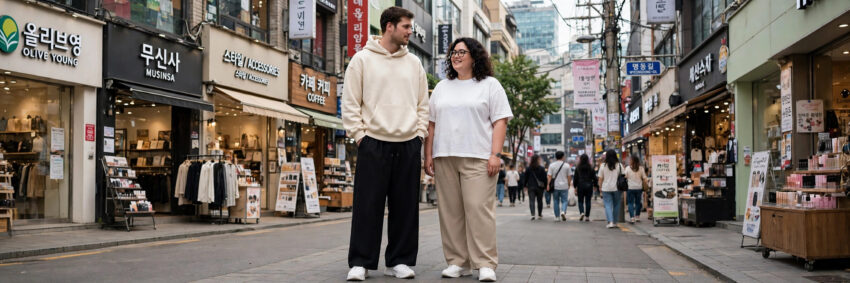
Korean streetwear is built on an oversized silhouette, and that should be good news for tall and plus-size wearers, because a style that starts with extra room sounds like a style that has already done half the fitting work for you. In practice the translation is less automatic than it looks. The Seoul oversize is cut for a particular set of proportions, with dropped shoulders, long bodies and generous legs arranged around a standard Korean size run that often stops where taller and larger frames are only just getting started. Wear the silhouette without adjusting it and the results are familiar: trousers that break in the wrong place, sleeves that end halfway up the forearm, a boxy top that reads as a tent on one body and as a crop on another. Wear it with the proportion rules in this guide and the same silhouette becomes one of the most forgiving styles available to you. This guide is about fit adaptation only, how the cuts behave on tall and plus-size bodies, which pieces help, which ones hurt, and the centimetre checks that tell you the truth before a garment ships.
Start Here
For the base silhouette this guide adapts, start with our lookbook of Korean streetwear for men and the outfit formulas in our guide to Korean street style for women. The single most useful piece for both tall and plus-size frames is worked through in our guide to the oversized hoodie outfit, Korean style, where the drape and shoulder rules below are shown in complete outfits.
Key Takeaways
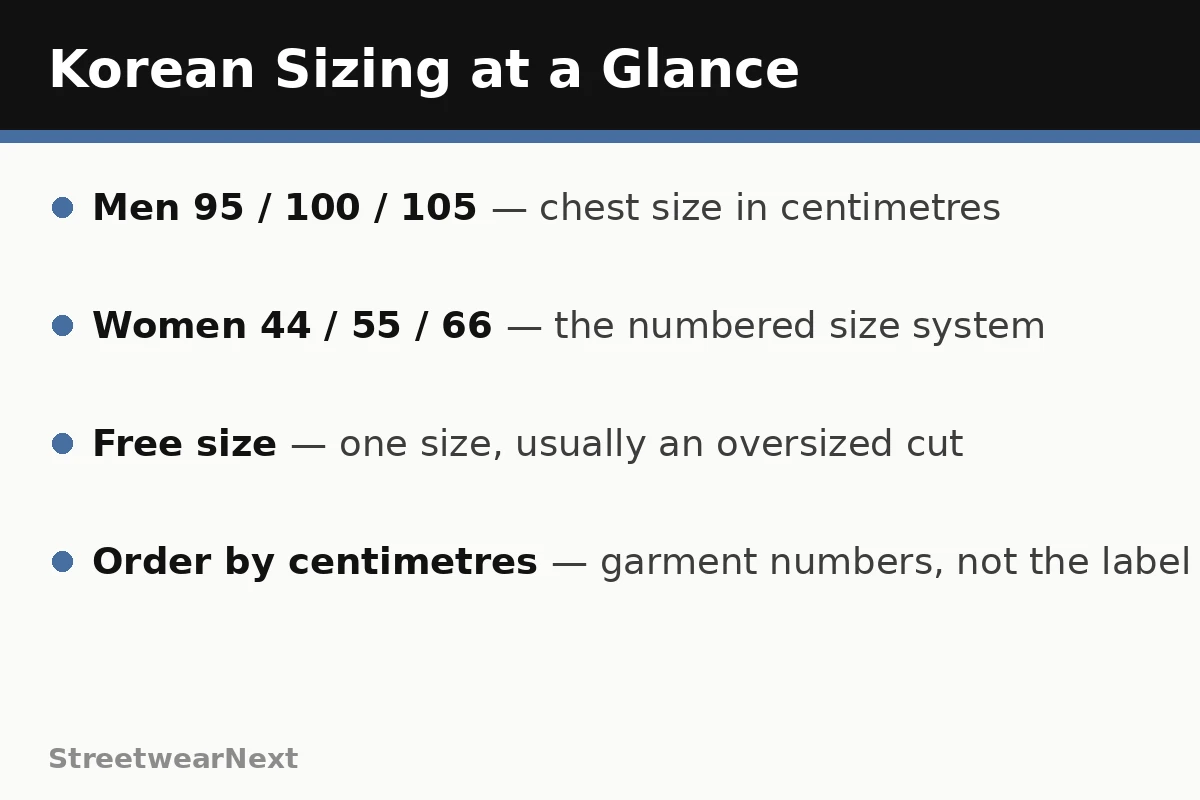
- Korean men’s sizes 95, 100 and 105 track chest in centimetres, and women’s 44, 55 and 66 are a numbered system, not bust inches.
- Tall frames need an inseam of 32 inches or longer, a sleeve that ends at the wrist bone, and a hem that breaks once, lightly, over the shoe.
- Plus-size fit is decided at the shoulder seam and by fabric drape, not by how much extra width a garment carries.
- Wide legs, boxy tops and long padding translate best to taller and larger frames; cropped, slim and stiff cuts translate worst.
- Order by the garment’s own centimetre measurements used as a fit tool, comparing them against a piece you already own that fits.
- Oversize helps when it falls in a clean column and hurts when it adds width without length or structure.
Contents
- Reading Korean Sizes as a Fit Tool
- Proportion Rules: Translating the Seoul Silhouette
- Cuts That Help: Wide Leg, Boxy and Long Padding
- Tall-Frame Checks: Inseam, Sleeve and Hem
- Plus-Size Checks: Shoulder, Waist and Room Where It Counts
- Drape vs Structure: Fabric Behaviour on Larger Frames
- Cuts That Hurt and What to Choose Instead
- Our View
- Frequently Asked Questions
- Sources
- Recommended
Reading Korean Sizes as a Fit Tool
The Korean size label is a measurement wearing a disguise, and once you read it that way it becomes the most useful fit tool in this entire guide. Korean men’s sizes 95, 100 and 105 track chest in centimetres, so a 100 is built around a chest of roughly 100 centimetres and each step up adds about five centimetres around the body. That is a different logic from a letter size, which hides the number it is based on, and it is why the same shopper can be a large in one system and lost in another, since clothing sizes vary by country in both their units and the body they were drafted for. Women’s sizing runs on its own track. The women’s 44, 55 and 66 number system is a Korean convention in which the numbers step upward with the size of the garment; they are not inches, not dress sizes in the Western sense, and not a direct conversion of the men’s chest figures. Alongside both systems sits the free size, the one-size garment that Korean brands cut generously and expect the oversized silhouette to absorb. For a standard frame that often works. For a tall or plus-size frame, free size is a question, not an answer, because it tells you nothing about the two dimensions that decide your fit, the length of the garment and the placement of its shoulder.
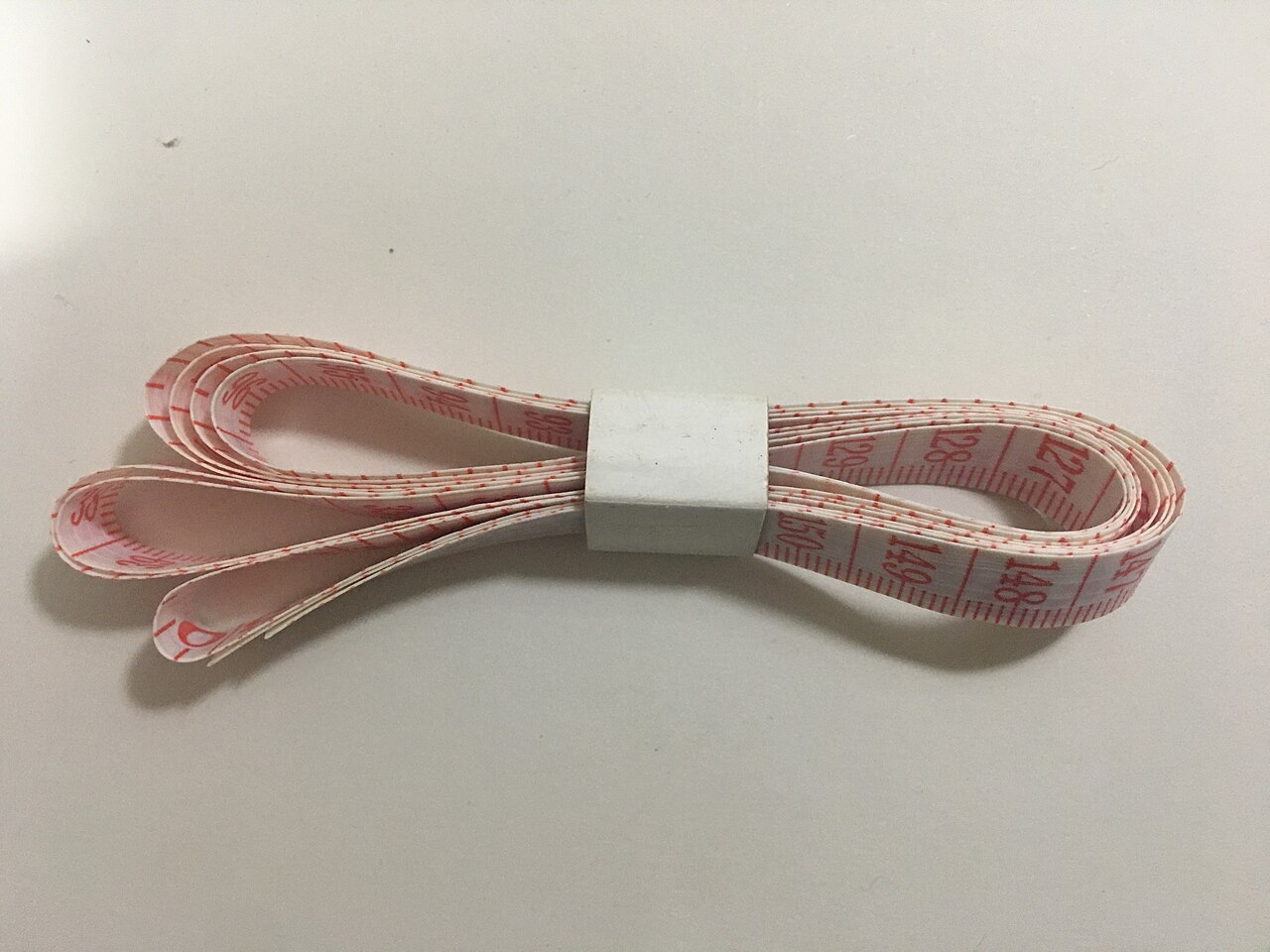
The working method is to treat every listed centimetre measurement as a fit prediction and to test it against your own clothes before you test it against your body. Brands publish garment measurements, chest width laid flat, shoulder width, sleeve length, total length, waist, rise and inseam, and those flat numbers describe the actual object that will arrive. Your body measurements describe you, and the gap between the two is where fit lives, which is the practical, wardrobe-level use of anthropometry, the measurement of bodies that tailors have always relied on. Lay a top you already own that fits the way you want, measure it flat, and compare its numbers line by line with the listing. If the listing’s shoulder is narrower than your good top’s shoulder, the garment will pull no matter what its chest number promises. If its total length is shorter, it will sit shorter on you, full stop. This is also the point where this guide deliberately stops. The mechanics of ordering, accounts, shipping and returns on Korean platforms are a separate job, and our guide to Korean streetwear brands and Musinsa owns that buying process in full. Here, the centimetres matter only as a fit tool, the means of knowing whether a Seoul cut will land on a taller or larger body the way the photograph suggests it lands on the model.
| System | What the number means | Tall-frame check | Plus-size check |
|---|---|---|---|
| Men’s 95 / 100 / 105 | Tracks chest in centimetres, stepping about 5 cm per size | Total length and sleeve length at the largest size | Flat chest width and shoulder width, not the label alone |
| Women’s 44 / 55 / 66 | Korean numbered system stepping up with garment size | Skirt, dress and trouser length against your own inseam | Waist and hip garment measurements at 66 and above |
| Free size | One generous cut, no graded sizes | Published total length; no length, no purchase | Published shoulder and chest width; drape of the fabric |
| Garment measurements (cm) | The flat dimensions of the actual piece | Inseam 32 in or longer; sleeve to the wrist bone | Shoulder seam placement; room at waist and hip |
Read the table as a triage grid. The label gets you into the right neighbourhood, the garment measurements decide the house. Tall shoppers should scan a listing in a fixed order, length first, sleeve second, body width last, because width is the dimension Korean oversize gives away freely and length is the one it rations. Plus-size shoppers should scan in the opposite order, shoulder and chest width first, waist and hip second, length last, because a garment that fits the shoulder and falls freely from it can survive a modest length compromise, while a garment that binds at the shoulder fails everywhere at once. Both orders share one rule: a listing that publishes no garment measurements at all is a listing you cannot fit from, whatever your size, and for bodies outside the standard run that missing table is not a minor inconvenience. It is the difference between buying a garment and buying a guess, and guesses are how wardrobes fill up with beautiful Korean pieces that are worn once, photographed never, and quietly given away.
Proportion Rules: Translating the Seoul Silhouette
The Seoul silhouette is a ratio before it is a set of garments, and translating it to a taller or larger body means keeping the ratio while changing the scale. The classic arrangement pairs a wide, long top half with a wide, full-length bottom half, broken by a visible waist point or a deliberate column of cloth from shoulder to hem. On the bodies the style was drafted around, that ratio reads as relaxed and intentional. On a tall frame the same garments arrive with the ratio quietly altered, because the top that was meant to end at mid-thigh ends at the hip, and the trouser that was meant to pool slightly ends above the shoe. Nothing about the clothes changed. The proportions did. This is why copying a Korean outfit piece for piece so often disappoints taller wearers even when every item technically fits. The discipline behind the look, visible across fashion in South Korea from campus dress to the polished Gangnam end of the spectrum, is proportion management, and proportion is the one part of the outfit you have to rebuild for your own frame rather than import.
Three rules do most of the rebuilding. First, lengthen one axis at a time. If the top is long and wide, the bottom should be full length and clean rather than also cropped or also broken into layers, because the eye reads one long line as height and two interrupted lines as bulk. Second, keep the volume in one direction. Korean oversize adds width horizontally through dropped shoulders and wide legs, and on a plus-size frame that horizontal addition works when the garment still falls vertically past it in an unbroken fall. The moment width is added and the fall is cut short, the garment becomes a box sitting on the body instead of a column moving with it. Third, place the break deliberately. Every outfit breaks somewhere, at a waistband, a hem, the end of a jacket, and on taller and larger frames that break should sit where you choose it, at the natural waist or below the knee, never drifting to mid-thigh or mid-calf by accident of a garment’s standard length. Readers who follow Gangnam USA’s Korean fashion coverage will recognise the same polished Seoul proportions from the district end of the style, and the translation principle is identical there: the more tailored the reference outfit, the more exactly its break points have to be re-placed on your frame.
Underneath all three rules sits a plainer truth about how this style travels. At its root streetwear blends casual uniform codes, sportswear, workwear and skate dress, into garments designed to be mixed rather than matched, and that mixing is what gives tall and plus-size wearers room to manoeuvre. You are not obliged to wear the whole Seoul formula at once. A tall wearer can take the wide leg and the long padding and leave the cropped boxy tee to shorter frames. A plus-size wearer can take the boxy top and the clean column of a long coat and leave the skinny trouser behind. The silhouette survives the editing because it was never a uniform. It is a set of proportion decisions, and decisions can be remade for the body actually wearing them, which is the entire premise of this guide and the reason Korean streetwear, handled this way, flatters frames it was never originally drafted for.
Cuts That Help: Wide Leg, Boxy and Long Padding
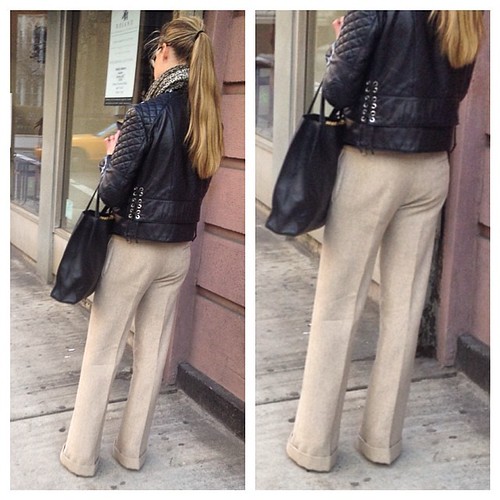
Three Korean cuts do the heavy lifting for tall and plus-size frames, and they help for mechanical reasons you can check in a fitting room rather than for vague promises about flattery. The wide leg comes first. A wide, full-length trouser gives a tall frame the inseam it needs and gives a larger leg a straight fall from hip to hem with no point at which the cloth has to change direction around the calf. The category is broad, since trousers cover many leg shapes, but the Korean wide leg has a specific character: a high or mid rise, a clean front with minimal pocket detail, and volume that is even from thigh to opening rather than flared at the bottom. That even volume is what makes it forgiving. It does not announce where the leg underneath is widest, it does not taper into a narrow ankle that shortens a tall leg visually, and it pairs with the substantial footwear that long legs need to finish the line. For plus-size wearers the same even fall skims rather than clings, and the high rise holds the waistband at the point where the trouser can hang from it instead of sliding below it.
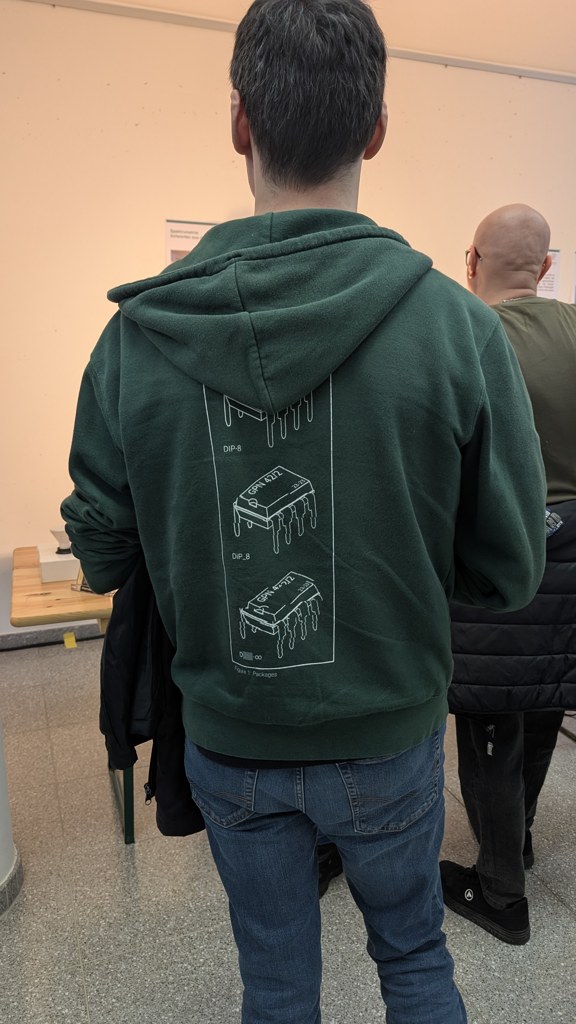
The boxy top is the second helper, and its mechanism is the dropped shoulder. A boxy Korean tee, sweatshirt or overshirt moves the shoulder seam off the natural shoulder and down the arm, which removes the single most common failure point for larger frames, the seam straining at the joint. The body of the garment then hangs from that lowered point in a square, even shape. The hoodie is the boxy cut in its most useful form, and although the hoodie began as workwear for cold warehouses, the Korean version is longer in the body, wider through the chest and cut to layer, which is precisely the specification a tall or plus-size wearer would write for themselves. Long padding is the third helper and the most distinctly Korean. The floor-skimming padded coat that defines a Seoul winter adds length as its main design gesture, and length is the scarcest resource for tall shoppers in every other category. Our guide to Korean streetwear in winter covers the layering system around it, and for larger frames the long padding has a second virtue: worn open, it draws two long vertical lines down the front of the body, the strongest column effect in this entire guide.
Padding deserves one honest qualification, because the insulation itself adds volume. The physics is unavoidable, since puffer jackets insulate with loft, trapping air in quilted chambers, and loft worn closed and belted by its own bulk can widen a larger frame. The fix is in the quilting and the closure. Choose long padding with narrower horizontal channels rather than wide, pillowy ones, wear it open over a slimmer column of clothing whenever the weather allows, and let its length do the visual work while its front edges draw the lines. Tall wearers should check that the coat still reads as long on them, ending below the knee at minimum, because a long padding coat that stops at mid-thigh on a tall frame has quietly become a regular jacket with extra bulk and none of the benefit. When all three helpers are combined, wide leg below, boxy layer at the top, long line over everything, the result is the full Seoul silhouette rebuilt at your scale, and it is the outfit formula the rest of this guide keeps returning to.
Tall-Frame Checks: Inseam, Sleeve and Hem
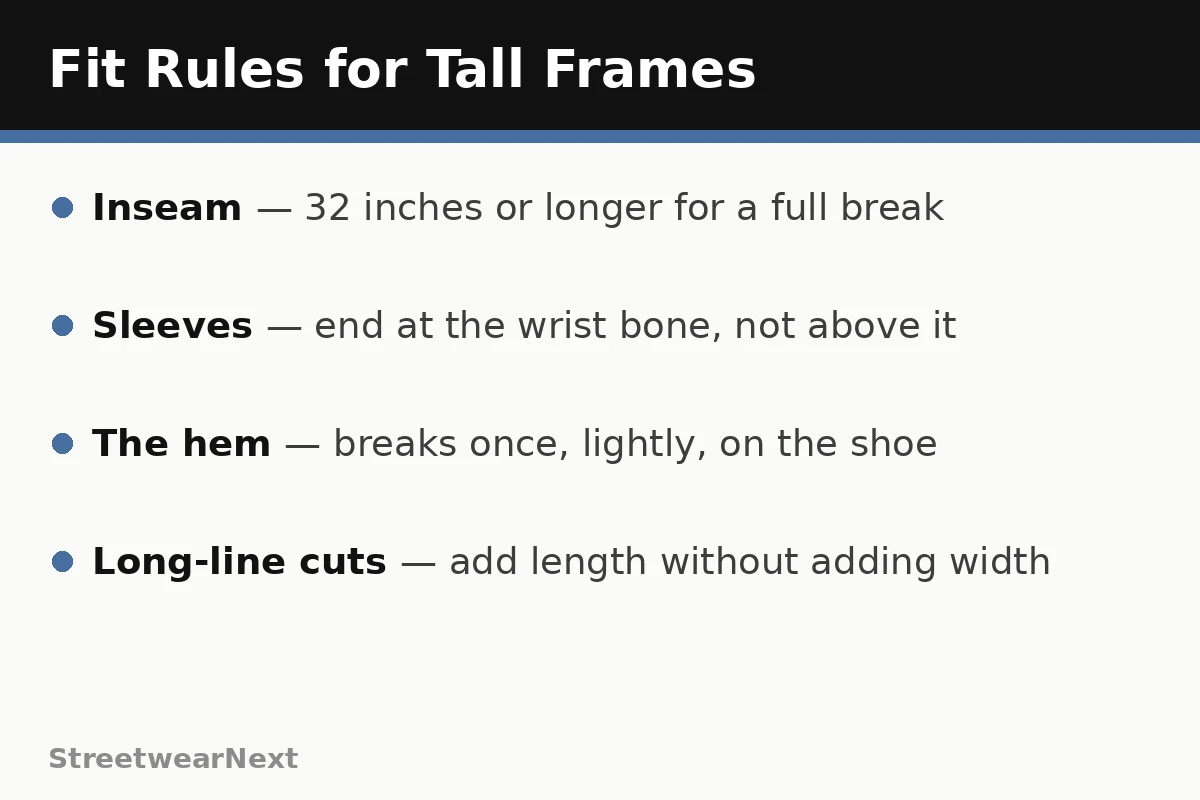
Height is a length problem before it is anything else, and three checks, inseam, sleeve and hem, will tell a tall shopper more than any size label on the rail. Start at the leg. Look for an inseam of 32 inches or longer, and treat anything shorter as a cropped trouser whether the brand calls it one or not. The measurement is unforgiving because inseam is measured inside leg from crotch to hem, so a 30-inch inseam on a long leg does not sit slightly short, it sits two full inches of ankle short, and no styling trick returns that length once it is gone. Rise interacts with inseam in a way tall shoppers learn the hard way. A high rise consumes some of the garment’s total length above the inseam’s starting point, so two trousers with the same inseam can land at different points on the shoe depending on their rise. For tall frames the high-rise Korean wide leg is usually the safer arithmetic, because the rise sits at the natural waist instead of sliding down and stealing effective length through the day. When a listing gives total length instead of inseam, use it, and compare it against the total length of the longest trouser you own.
The sleeve check is simpler and more often skipped. A sleeve should end at the wrist bone, that small bony point where hand meets arm, with the cuff resting there or a finger’s width past it when your arm hangs naturally. On tall frames Korean tops frequently pass the chest and shoulder checks and fail this one, because grading a garment up in width does not always grade it up in arm length. The consequence is not subtle. A sleeve ending halfway up the forearm makes the whole top look borrowed, shortens the apparent length of the arm, and breaks the long line the outfit is built on. This is where the construction detail matters, because sleeve length decides cuff position in combination with the shoulder: a dropped Korean shoulder adds effective length, since the seam starts further down the arm, so a boxy top with a modest listed sleeve can wear longer than a fitted top with the same number. Measure from the seam, on the garment, against your own best-fitting top, and let that comparison overrule the size label.
The hem break rule ties the leg and the outfit together. A full-length trouser hem should meet the shoe and break once, lightly, a single soft fold where the cloth lands, or rest just on top of the footwear with no fold at all. Two or more folds stacking at the ankle mean the trouser is too long even for a tall frame, and a hem hovering above the shoe with a band of ankle showing means the wide leg has become a cropped leg and the proportion has changed without your consent. Tall wearers have one advantage here worth using: you can buy the longest version of a trouser and have it hemmed to a perfect single break, an alteration that costs little and that shorter shoppers, forever hunting for length that is not there, would envy. Finish the check at the shoe itself. A longer leg needs footwear with enough presence to close the line, and our guide to Korean streetwear shoes covers the sneakers, boots and loafers that carry a full-length hem convincingly. Pass all three checks, inseam, sleeve and break, and a Korean garment stops being a gamble on length and becomes what it should have been from the start, a long, clean column of cloth that happens to be exactly your height.
Plus-Size Checks: Shoulder, Waist and Room Where It Counts
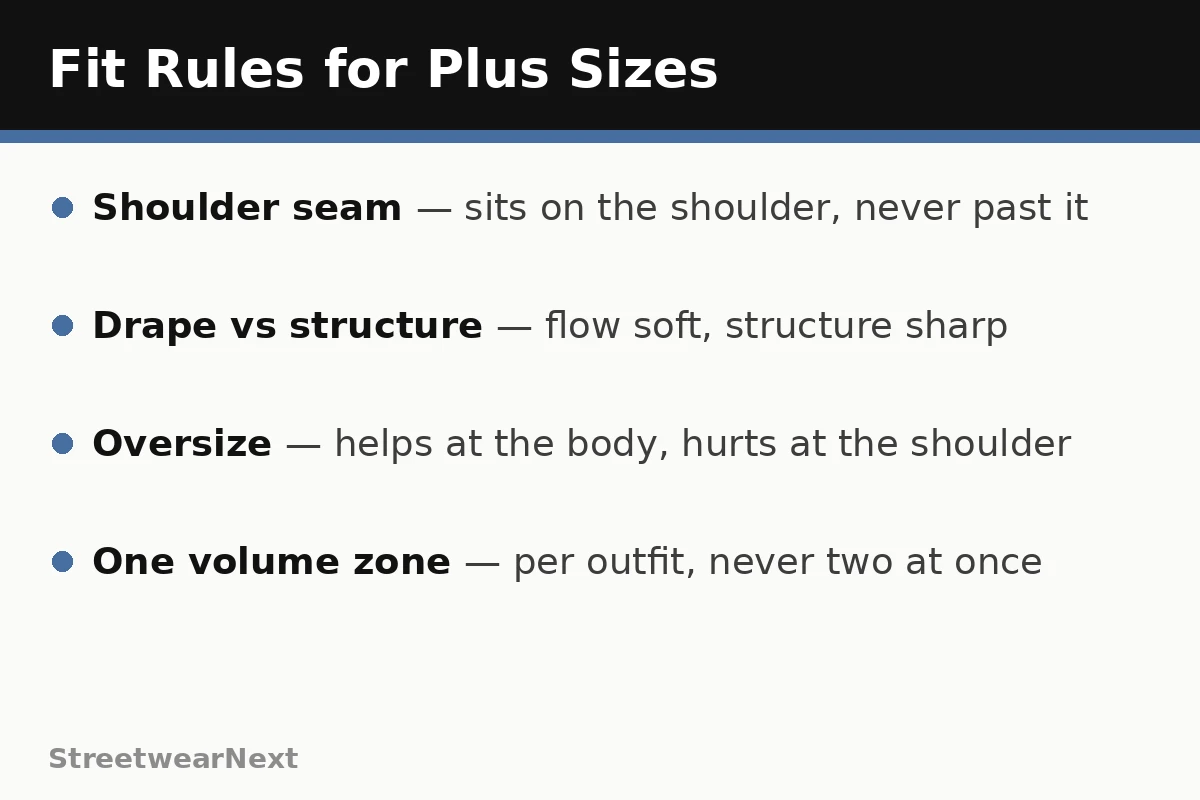
For plus-size frames the whole fit of a Korean top is decided at one point, the shoulder seam, and everything else about the garment is commentary on that decision. The seam should sit at or just past the edge of your natural shoulder. On a boxy Korean cut it will sit past it by design, dropped down the upper arm, and that is correct and comfortable. What must not happen is the opposite error, a seam that lands inside the shoulder line, up toward the neck, because a seam placed there announces that the garment’s frame is smaller than the body inside it, pulls the sleeve up with every movement, and strains the chest closure no matter how generous the listed chest measurement is. This is the context in which plus-size clothing extends standard ranges properly or fails to: a range that only adds width to the body of a garment while leaving the shoulder, the armhole and the neck on the standard block has extended the label, not the fit. When you compare listings, compare shoulder width first, armhole depth where it is given second, and chest width third, in that order, against the best-fitting top you own.
Room, the second check, has to be in the right places, and Korean oversize is generous in some of them and stingy in others. It gives width freely through the chest and the body, which helps. It is less reliable at the waist and hip of trousers and skirts, where a straight Korean block can run narrower than the top half of the same outfit suggests, and at the bicep, where a dropped shoulder helps only if the sleeve itself is cut wide enough to continue the line. Test room functionally rather than visually. Sit down in the trouser and note whether the waistband stays where it was standing. Raise your arms in the top and note whether the whole garment travels up with them, a sign the armhole and shoulder are borrowing room from the hem. Cross your arms and feel for strain across the back. A garment that passes those three movements has room where it counts. A garment that only looks roomy standing still in a mirror has room where it photographs, which is a different and much less useful thing, and it is the reason so many oversized purchases disappoint larger wearers by the end of the first day.
The waist check completes the set, and it is about placement rather than measurement. On plus-size frames a waistband, a belt line or the hem of a cropped layer should sit at the natural waist or deliberately below it, and the dangerous ground is the in-between, a break that lands at the widest point of the stomach or hip and draws a horizontal line exactly there. Korean styling, with its high rises and its habit of tucking or half-tucking boxy tops, is unusually helpful here, because the high waist is already the house style rather than an adjustment you have to invent. Use it. A high-rise wide leg with a boxy top half-tucked at the front places the break at the natural waist, lets the top fall freely from the shoulder over the midsection, and lets the trouser fall freely from the waist over the hip, two clean falls with one deliberate break between them. That arrangement, more than any single garment in this guide, is the plus-size version of the Seoul silhouette, and it is assembled entirely from standard Korean pieces chosen by seam, room and break rather than by size label.
Drape vs Structure: Fabric Behaviour on Larger Frames
When a garment has no tailoring to hold its shape, the fabric is the tailoring, and for tall and plus-size frames the choice between drape and structure decides whether oversize reads as ease or as bulk. The core rule is direct: choose drape fabrics over stiff ones. Drape is the quality that lets cloth fall in soft vertical folds under its own weight, and the standard definition of drape describes how fabric falls when it is suspended, which is exactly what a garment does on a body all day. A draping fabric, a soft jersey, a fluid twill, a washed cotton, a knit with some weight to it, falls from the shoulder or the waist and moves past the body’s widest points in a continuous fall. A stiff fabric, a rigid denim, a crisp canvas, a heavily bonded synthetic, holds the shape it was cut into and adds that shape to yours, so an oversized stiff garment does not fall around a larger frame, it stands around it, tent-like, at its full cut width from shoulder to hem.
Structure still has a job, and the skill is placing it where it works instead of where it widens. Structure belongs at the points an outfit hangs from and at the points it is finished: a shoulder with enough body to hold the dropped seam in its line, a waistband firm enough to stay at the natural waist, a hem with enough weight to fall straight instead of curling or floating. It does not belong across the chest, the stomach or the hip in the form of stiff panels that hold the garment away from the body in a rigid shell. The practical test in a shop is the handful test. Gather the fabric of the body of the garment in one hand and let it go. If it drops back into a soft fall, it will drape on you. If it keeps some of the shape of your grip, springs outward, or crackles with synthetic stiffness, it will keep its own shape on you too, and on a tall frame that stiffness usually shows as extra width at exactly the heights, mid-thigh, mid-calf, where the garment’s panels end. Weight is the ally of drape at both ends of the size range. Heavier cloth falls straighter, which is why the heavyweight Korean tee so often fits larger frames better than the thin promotional-weight tee in the same cut and the same listed size.
Finishing pieces follow the same logic, because the accessories that close a Korean outfit are mostly soft goods. The crossbody bags, beanies and socks gathered in our guide to Korean streetwear accessories add detail without adding rigid volume, and on larger frames that softness is a genuine advantage over structured belts, stiff caps and hardware-heavy pieces that introduce hard horizontal lines. Layering is the final drape decision. Two draping layers, a boxy hoodie under an open long padding coat, fall as one column with a soft edge, and the combined silhouette stays calm. Two structured layers, a stiff overshirt over a rigid jacket, stack their shapes and the body wears the sum of both garments’ width. Build the outfit soft at the body and structured only at its skeleton, shoulder, waistband and hem, and the fabric stops being a gamble you take on every order. It becomes the most predictable part of the fit, the quality you can judge from a fibre label and a handful of cloth before the garment ever reaches your frame.
Cuts That Hurt and What to Choose Instead
Every styling tradition has cuts that punish the bodies outside its standard block, and Korean streetwear’s problem pieces are predictable once you know the checks: they are the cuts that take length away, add stiffness, or place a break at the widest point. The cropped boxy top heads the list for both tall and plus-size wearers. Cropped and boxy is the signature Seoul proportion, but crop is a relative term, and a top cropped for a standard frame lands high on a tall torso, ending nearer the ribs than the waist, while on a plus-size frame the same crop places its hem at the widest point of the midsection and holds it there in a stiff horizontal line. The slim skinny trouser is the second offender. It contradicts the wide-leg logic that makes Korean bottoms so transferable, clings at the calf where a tall leg is longest, and on larger legs it turns the even fall of the silhouette into a map of every contour the style was supposed to skim. Short padding, the cropped puffer that ends at the hip, commits the long padding’s sins in reverse, adding maximum loft at maximum width and then stopping, so the volume has no length to travel down and simply sits on the frame.
The replacements are, in every case, the same garments with the proportion corrected rather than different garments altogether. For the cropped boxy top, choose the regular-length boxy top in the same cut and place the break yourself with a half tuck, which gives you the boxy width with a hem you position at your own natural waist. For the slim trouser, choose the wide leg or a relaxed straight leg with a high rise, keeping the Korean details, the clean front, the minimal pockets, the full length, that made the piece attractive in the first place. For short padding, choose the long version and wear it open, trading a block of hip-level volume for two vertical lines and a column of length. Even the free-size garment, the recurring gamble of Korean shopping, has a disciplined replacement strategy: buy it only when its published measurements pass your shoulder, length and drape checks, and when they are not published, spend the same money on a graded size from the same brand whose numbers you can read. None of these swaps requires leaving Korean streetwear. They require refusing the two or three cuts that were never drafted with your frame in the room, and building the silhouette from the many that were, accidentally or otherwise, drafted almost exactly for it.
Our View
Our view is that Korean streetwear is the most adaptable major style going for tall and plus-size wearers, provided you adapt it on purpose. The oversize is real, the wide legs and long padding genuinely give length and room that other styles ration, and the centimetre sizing, read as a fit tool, tells you more before you buy than most Western labels ever do. What it will not do is translate itself. Check the shoulder, the inseam, the sleeve and the drape, rebuild the proportions at your scale, and the Seoul silhouette stops being a look you admire on other bodies and becomes one you own.
Do not ask whether Korean streetwear comes in your size. Ask whether the shoulder, the inseam and the drape are right, because those three answers are the size.
— Brian Ka
Frequently Asked Questions
What do Korean men’s sizes 95, 100 and 105 mean?
They track chest in centimetres. A 100 is built around a chest of roughly 100 centimetres, and each step changes the size by about five centimetres. Always confirm with the garment’s own flat measurements, especially shoulder width and total length, before ordering.
What is the women’s 44, 55 and 66 system?
It is a Korean numbered sizing convention in which the numbers step up with the size of the garment. The numbers are not inches and do not convert directly from Western dress sizes, so use the listing’s centimetre garment measurements for waist, hip and length instead.
How long should the inseam be for tall wearers of Korean trousers?
Look for an inseam of 32 inches or longer for a full-length fit, and treat anything shorter as a cropped trouser in practice. The finished hem should meet the shoe and break once, lightly, rather than pooling in folds or hovering above the ankle.
Where should the shoulder seam sit on a plus-size frame?
At or just past the edge of the natural shoulder. Boxy Korean cuts drop the seam down the upper arm by design, which is comfortable and correct. A seam landing inside the shoulder line, toward the neck, means the garment’s frame is too small regardless of its chest measurement.
Is free size a safe choice for tall or plus-size shoppers?
Only when the listing publishes garment measurements that pass your checks for length, shoulder width and fabric drape. Free size describes one generous cut with no grading, so without published centimetres there is no way to know whether it will fit your frame.
Questions About Fit and Sizing?
Trying to translate a Korean piece to your height or size and not sure whether the measurements will land the way the photo promises? Send us your questions and we will point you in the right direction.
Sources
- Wikipedia — Clothing Sizes
- Wikipedia — Anthropometry
- Wikipedia — Fashion in South Korea
- Wikipedia — Streetwear
- Wikipedia — Trousers
- Wikipedia — Hoodie
- Wikipedia — Puffer Jacket
- Wikipedia — Inseam
- Wikipedia — Sleeve
- Wikipedia — Plus-Size Clothing
- Wikipedia — Drape