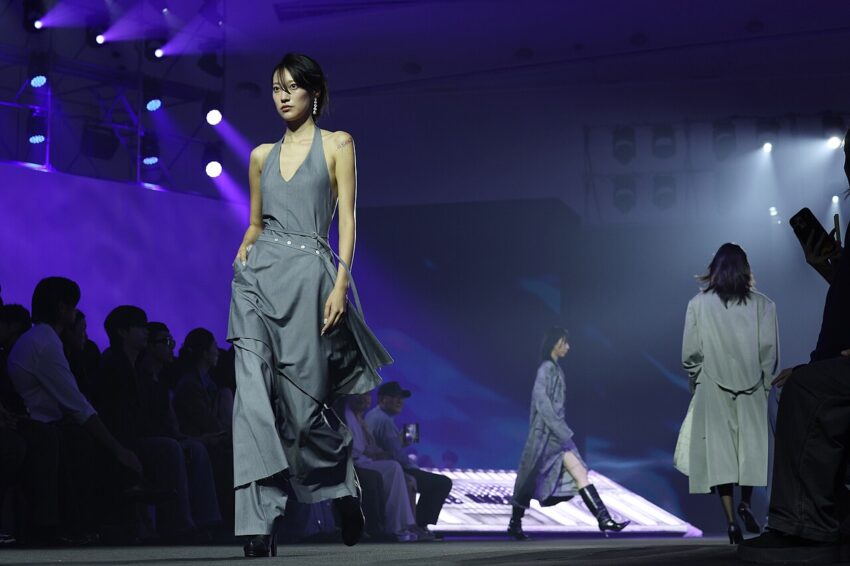
Korean street style for women works because it solves a problem most wardrobes never quite solve: how to look deliberate, comfortable and current at the same time, without rebuilding your closet every season. The Seoul approach is not about copying an outfit you saw outside a fashion week venue down to the last accessory. It is about learning a small set of proportion rules, layering habits and outfit formulas, then running those formulas with pieces you can actually wear to work, to class, on a train, in the rain and on a long day when you still want to feel like yourself. Once you understand why an oversized hoodie sits differently over wide-leg jeans than over leggings, why a cropped jacket changes a long dress, and why one strong accessory does more than five small ones, the look stops being a location and becomes a method you can use anywhere.
Start Here
Key Takeaways
- Korean street style for women is built on proportion first: one oversized piece, one structured piece, and one clean finishing piece in almost every outfit.
- The most reliable formulas are repeatable — oversized hoodie with wide bottoms, cropped jacket over a long line, monochrome base with one statement accessory, and layered neutrals with a single colour pop.
- Fit matters more than logos. Shoulder line, hem length and trouser break decide whether oversized reads as intentional or simply too big.
- Seoul looks adapt well beyond Seoul when you adjust fabric weight, footwear and layering for your own climate, commute and dress code.
- A small wardrobe of well-chosen essentials — hoodies, wide jeans, joggers, a cropped jacket, a long coat, clean trainers and a cap or bag with presence — can produce weeks of distinct outfits.
- Accessories are not decoration added at the end. In this style they set the tone: sporty, polished, playful or sharp.
Contents
- What Korean Street Style Actually Is — And Why It Travels
- The Oversized Foundation: Silhouette First, Details Second
- Five Outfit Formulas That Work Anywhere
- Bottoms, Layers and the Art of Proportion
- Accessories, Shoes and the Finishing Layer
- Adapting Seoul Looks for Work, Weather and Real Life
- Building a Small Wardrobe That Keeps Delivering
- Our View
- Frequently Asked Questions
- Sources
- Recommended
What Korean Street Style Actually Is — And Why It Travels
Korean street style is a system of contrasts, and that is exactly why it travels so well. Soft against structured, long against cropped, plain against graphic, sporty against polished — the outfit holds together because each piece has a clear job. A museum survey of the wider cultural movement, explored in the V&A Hallyu exhibition, helps explain why Korean fashion did not arrive in isolation: it travelled with music, film, television and digital culture, so people around the world were already familiar with the silhouettes before they ever tried to wear them. That familiarity matters for women building outfits at home, because the references are everywhere and the individual pieces — hoodies, denim, trainers, long coats — are already ordinary wardrobe items in most countries.
The same global story is traced in MFA Boston’s Hallyu exhibition, which places fashion inside a broader creative wave rather than treating it as a passing trend. For everyday dressing, the practical lesson is simpler than the exhibition framing. Seoul street style rewards observation. People dress for dense city life: walking, public transport, cafés, classes, offices and evenings that start in one neighbourhood and end in another. Outfits therefore need to move, layer and survive a full day. That functional pressure produced a look that photographs well but is not costume. When you borrow the formulas rather than the exact styling, they hold up in London, Los Angeles, Toronto, Sydney or anywhere else a day involves weather, walking and more than one setting.
History gives the style its depth. A look back at earlier decades in this Seoul fashion history shows how quickly Korean city dressing absorbed new influences and remade them locally, while material held by the Seoul Museum’s Dongdaemun exhibition underlines how central the Dongdaemun district has been as a place where design, making and selling sit side by side. That closeness between design and street helps explain the speed of the style: a silhouette seen in the morning can be reinterpreted, produced and worn again within the same season, refined by real people rather than only by runways.
| Element | Seoul Street Approach | Common Mistake Elsewhere | How to Adapt It |
|---|---|---|---|
| Oversized top | Balanced by a defined waist, hem or trouser line | Oversized everywhere, no structure | Pair with wide but clean bottoms or a cropped layer |
| Colour | Neutral base, one deliberate pop | Several competing bright pieces | Keep the base quiet and let one item speak |
| Footwear | Chunky trainers or boots that ground volume | Delicate shoes lost under wide trousers | Choose shoes with enough visual weight |
| Accessories | One or two strong finishing pieces | Many small pieces with no focal point | Pick a cap, bag or jewellery statement and stop |
If you are starting from scratch, begin with the broader streetwear aesthetic for women and notice how often the same principles return: volume on top or below but rarely uncontrolled in both places at once, a limited palette, and shoes chosen to anchor the whole silhouette. Korean street style is a particularly clear version of that aesthetic because the formulas are so consistent. You can learn them from a handful of outfits and then vary them endlessly with colour, fabric and accessories, which is why the style suits women who want a recognisable personal look without owning a huge wardrobe.
The Oversized Foundation: Silhouette First, Details Second
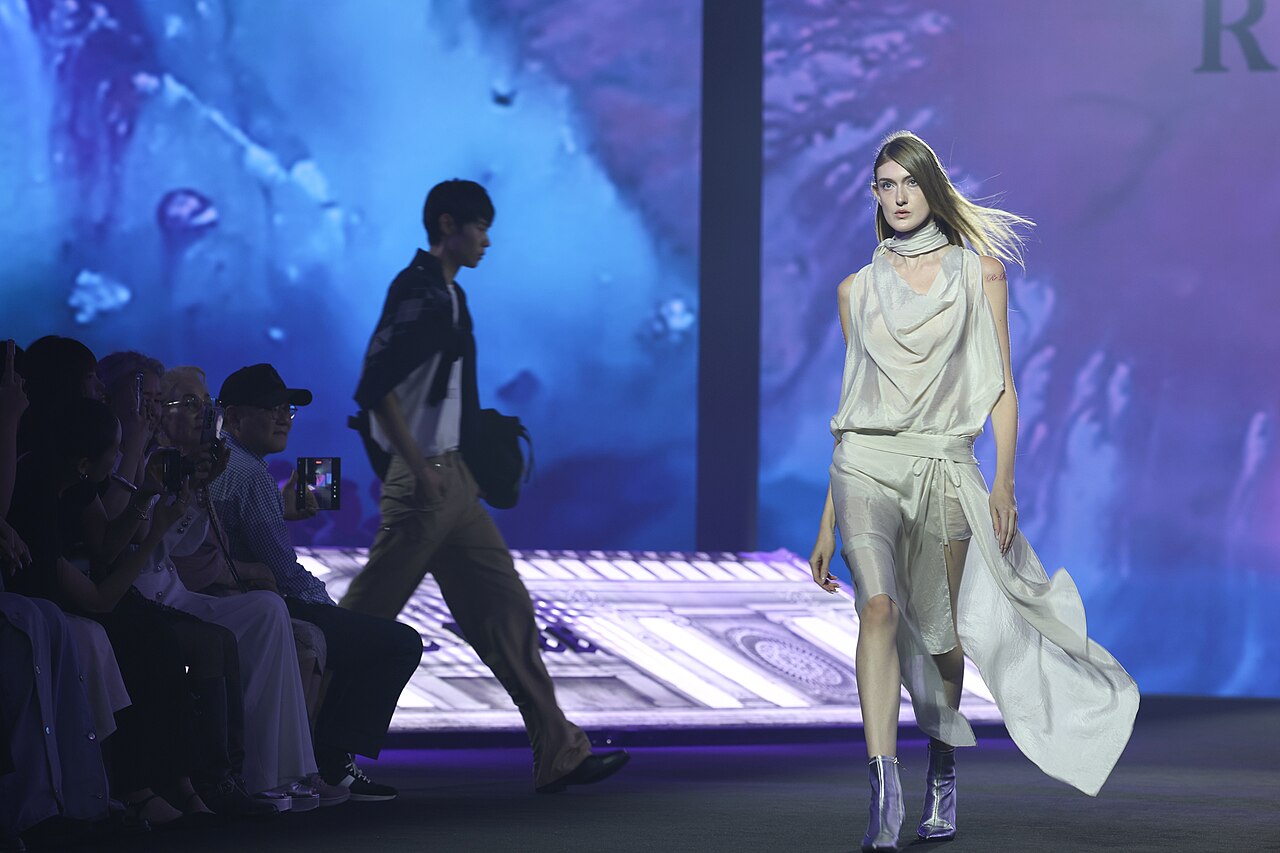
Oversized does not mean shapeless, and learning that difference is the single most useful step in this style. In Seoul dressing, an oversized hoodie, shirt or knit is cut or chosen so the shoulder, sleeve and hem fall in a deliberate place. The garment has volume, but the outline is controlled. Try a hoodie that drops slightly off the shoulder with sleeves that reach the wrist rather than swallowing the hands, and a hem you can half-tuck, fully tuck at the front, or leave long over a skirt with intention. Each small decision tells the eye the volume was chosen. That is also why sizing up two sizes in a garment that was never designed to be oversized often fails: the proportions distort instead of expanding evenly.
Domestic platforms show how central these everyday pieces are to the market. Updates from the Musinsa newsroom announcements reflect a retail culture built around young, style-conscious shoppers who buy streetwear as daily clothing rather than occasional statement dressing. For your own wardrobe, that translates into a quality test: an oversized piece should work on an ordinary Tuesday, not only in a photograph. Check that you can sit, carry a bag, layer a coat over it and move your arms comfortably. If a hoodie only works when you stand still and hold the pose, it is styling, not clothing, and it will quietly leave your rotation within a month.
Brand culture reinforces the same point. Round-ups of the best Korean brands repeatedly feature labels that treat hoodies, sweatshirts, cargo trousers and outerwear as design pieces in their own right, with attention to cut, fabric weight and graphic placement. You do not need those exact labels to use the lesson. Look for mid-weight to heavy fabrics that hold a line, ribbing that keeps its shape, and graphics placed where they will still read when the garment is layered. Our guide to oversized hoodie outfit ideas for women works through the pairings in detail, and the core rule stays constant: give the oversized piece one job, then let everything else support it quietly.
Colour is part of silhouette, too. A pale grey, cream, washed black or soft brown oversized top reads larger and softer; a deep black or navy version reads sharper and more compact even at the same size. That is why monochrome dressing is such a reliable entry point. Working through all-black streetwear for women teaches you to separate pieces by texture — matte cotton against denim, knit against a smooth bag — instead of relying on colour contrast. Once you can build an interesting outfit in one colour, adding a single pop colour later becomes easy and controlled rather than chaotic.
Five Outfit Formulas That Work Anywhere
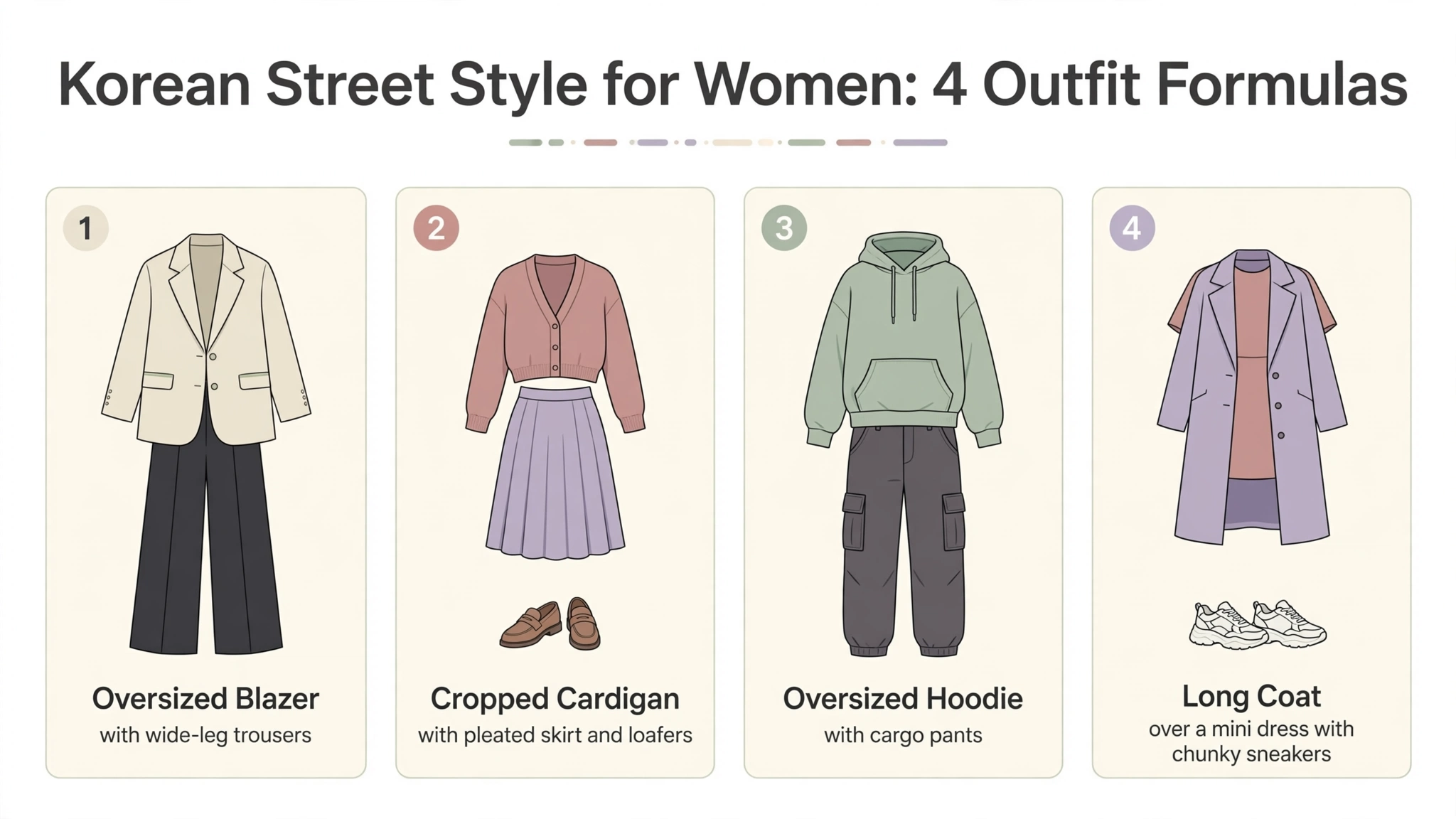
Formulas remove the morning guesswork, and these five cover most of what women actually ask this style to do. Formula one is the oversized hoodie, wide-leg jeans and chunky trainers combination, finished with a crossbody bag and a cap worn only when the rest of the outfit is simple. Formula two is a cropped jacket over a long T-shirt dress or a longline top with straight trousers, where the short-over-long contrast does the styling work for you. Formula three is the monochrome base — black, grey, cream or denim-on-denim — lifted by one accessory in a contrasting colour or metallic finish. Formula four pairs a fitted or cropped top with high-waisted wide bottoms, keeping the volume below the waist and the line clean above it. Formula five layers a collared shirt under a sweatshirt or knit, with the collar and cuffs showing, over a pleated skirt, wide trousers or relaxed denim for a softer, more polished version of the look.
Seoul Fashion Week helps explain why these combinations keep renewing themselves rather than dating. Coverage of the event’s use of city landmarks in Seoul’s landmark runway plans shows fashion presented as part of the city itself, and the anniversary overview in Seoul Fashion Week at 25 years describes an event built to connect designers with a global audience. Street dressing absorbs that energy at ground level: each season tweaks a hem, a shoe or a layering trick, but the underlying formulas persist because they are practical. You are therefore not chasing a moment when you learn them; you are learning a grammar that new pieces can slot into.
For hoodie-led days specifically, our breakdown of how to style a hoodie for women shows how the same hoodie moves between formulas: tucked and structured with trousers for a smarter setting, long and relaxed over a skirt for contrast, or layered under a long coat when the weather turns. The trick is to change the supporting pieces, not to buy a different hoodie for every mood. A single well-cut hoodie in a neutral colour can anchor formula one on Saturday, sit under a coat on a cold weekday, and layer over a dress for an evening walk, which is exactly the kind of cost-per-wear thinking that makes a small wardrobe feel generous.
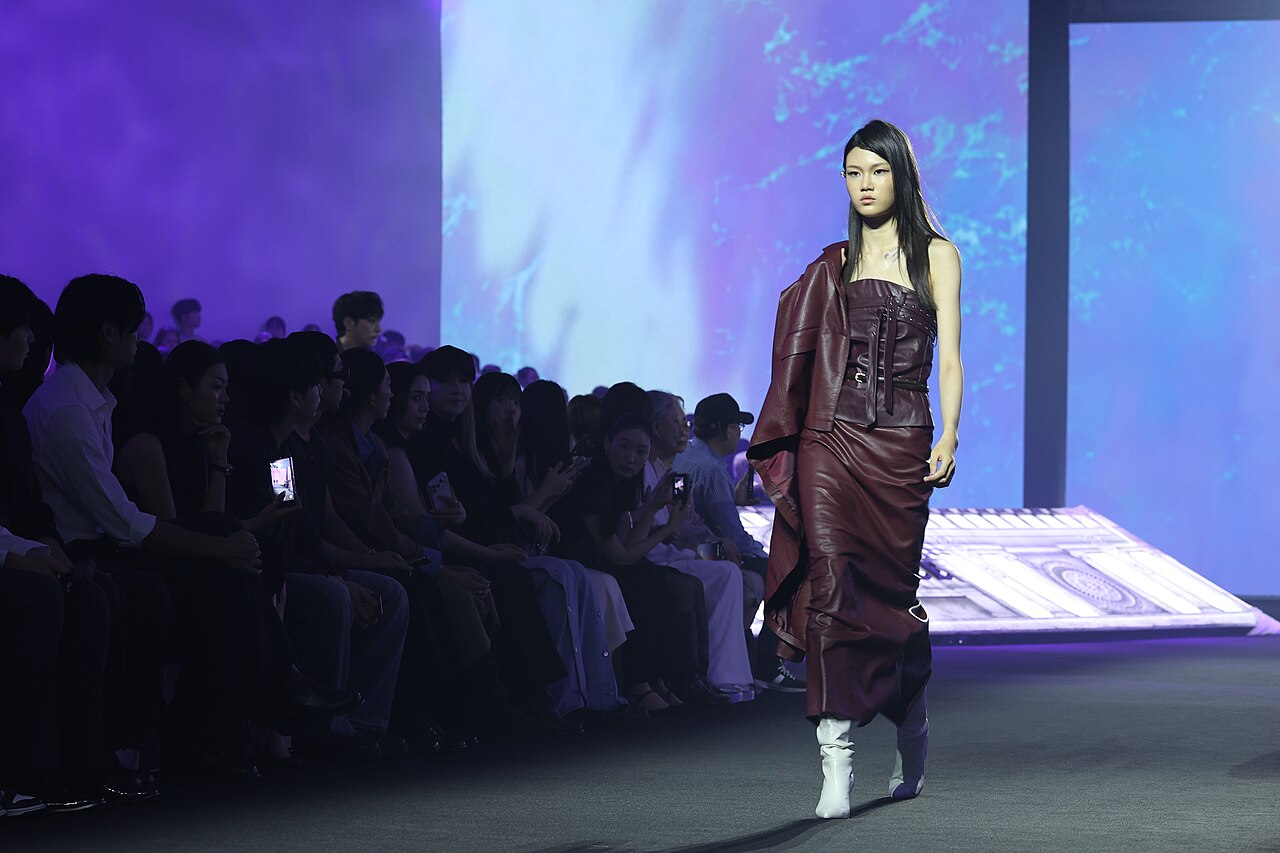
Music culture remains part of the reference library, handled best with restraint. Analysis of K-pop and idol fashion shows how stage and off-duty styling circulate ideas quickly, but the wearable takeaway for most women is not the stage costume — it is the off-duty version: relaxed denim, a graphic or plain oversized top, strong shoes and one memorable accessory. Borrow the confidence and the proportion, leave the performance elements behind, and the outfit reads as inspired rather than imitated. That distinction keeps the look personal, which is ultimately what makes it convincing on the street in any city.
Bottoms, Layers and the Art of Proportion
Bottoms decide whether an oversized top looks styled or swamped, so choose them with the top already in mind. Wide-leg and straight-leg trousers are the workhorses because they continue the relaxed line without clinging, while cargo trousers add pockets and a more utilitarian tone that suits plain hoodies and sweatshirts. Denim deserves its own attention: a long, clean rise with a hem that meets the shoe gives the outfit its characteristic grounded feel. Our guide to streetwear jeans covers rises, washes and breaks in detail, and the short version is to favour a hem that sits on the shoe rather than pooling over it, unless pooling is a deliberate choice matched by a shorter, cleaner top.
Joggers play a different but equally useful role. Relaxed joggers with a tapered ankle give you comfort with a defined ending, which makes them ideal under longer tops that might otherwise overwhelm the frame. Styling notes for joggers for women and for high-waist joggers both point to the same adjustment: define the waist, even with a partial tuck or a cropped layer, and choose footwear with enough substance to balance the soft fabric. A delicate shoe under soft joggers and a soft hoodie can make the whole outfit collapse visually; a chunky trainer restores the structure the fabrics themselves do not provide.
Layering is where Korean street style becomes genuinely skilful. A long coat over a hoodie and wide trousers extends the vertical line and adds polish without formality. A cropped puffer or denim jacket over a long top creates the opposite effect, breaking the outfit into clear horizontal sections. Brand stories such as the profile of Ader Error’s design collective illustrate a playful approach to proportion and graphics that many women borrow in diluted form: one unexpected proportion or detail per outfit, everything else calm. Guides to Seoul brands to know show a similar pattern across labels — recognisable silhouettes, tweaked just enough each season to feel new. For daily wear, tweak one variable at a time: a longer coat, a shorter jacket, a wider trouser. Small changes, repeated, are how a personal version of the style emerges.
Accessories, Shoes and the Finishing Layer
Accessories in Korean street style are the punctuation, and punctuation changes meaning. A plain hoodie-and-jeans outfit becomes sporty with a cap and crossbody bag, polished with a structured shoulder bag and simple jewellery, or playful with a beanie and a colour-pop trainer. Because the base outfits are deliberately simple, one accessory choice genuinely redirects the whole impression, which makes accessories the cheapest and most flexible styling tool you own. Our round-up of streetwear accessories sorts the useful pieces from the clutter, and the principle is consistent: buy fewer, stronger pieces and wear them often enough that they become part of your signature rather than occasional decoration.
Headwear deserves special mention because it appears in Seoul street dressing with unusual confidence. Caps, beanies and bucket hats finish outfits, manage bad-weather hair and add the sporty note that keeps relaxed clothing from reading as loungewear. The selection in our guide to streetwear hats shows how shape matters: a structured cap sharpens, a soft beanie relaxes, a bucket hat adds a playful, slightly retro tone. Choose based on the outfit’s missing ingredient rather than habit. If the look already has plenty of softness, a structured cap supplies the contrast; if the outfit is sharp and monochrome, a beanie can soften it into something more approachable.
Shoes carry more weight in this style than in most others, literally and visually. Chunky trainers, platform soles and clean boots give wide trousers and long coats the foundation they need, and they also make the outfits practical for real walking distances. Sneaker culture is part of the wider story, as explored in SNKRDUNK’s Korean streetwear overview, which connects Korean street fashion’s growth to a global audience that treats trainers as a central piece rather than an afterthought. You do not need a collection to apply this. One clean, substantial trainer in a neutral colour and one boot or second trainer with a different tone will cover nearly every formula in this guide, provided both are comfortable enough for the day you actually live.
Jewellery and bags work best with the same discipline. Silver-tone chains, small hoops and simple rings suit the style’s clean lines, while one larger piece — a bolder earring or a distinctive bag shape — can serve as the outfit’s single statement. Resist stacking statements. When the bag, the jewellery, the hat and the shoes all compete, the relaxed confidence that defines the look disappears and is replaced by effort, which is the one thing this style never wants to show. Finish the outfit, check the mirror for the one item you could remove, and consider removing it. That final edit is a styling habit worth more than any single purchase.
Adapting Seoul Looks for Work, Weather and Real Life
The test of any style is a wet Tuesday with a dress code, and Korean street formulas pass it better than most because they were built for real city days. For workplaces that allow smart-casual dressing, swap the hoodie for a clean sweatshirt or knit in a neutral colour, keep the wide trousers, choose a longer structured coat and replace trainers with a minimal leather shoe or clean boot. The silhouette stays recognisably in the family while the surface becomes office-appropriate. For stricter settings, borrow only the proportion: a slightly relaxed blazer, a straight trouser with a proper break, and one understated accessory. Style travels through principles even when individual items cannot.
Weather adaptation is mostly a fabric and layering exercise. In cold months, the oversized framework is an advantage: thermal layers sit comfortably under hoodies and knits, and a long coat or padded jacket completes the outfit without changing its logic. In warm months, move the volume into lighter fabrics — an oversized shirt worn open over a fitted top, wide linen-blend trousers, a skirt with a relaxed sweatshirt carried for the evening. Looking through streetwear inspiration across seasons shows the same silhouettes reappearing in different weights, which is the real lesson: keep the formula, change the fabric. Rain asks for practical edits only — waterproof footwear with presence, a cap under a hood, and bags that close properly.
Body diversity is sometimes raised as a question about this style, and the honest answer is that proportion-based dressing is unusually adaptable because it is not built around one garment fitting one way. Volume can sit on top or below, waists can be defined with a tuck, a belt, a cropped layer or a high rise, and length can be adjusted at the hem rather than by abandoning the silhouette. Our earlier guide to the oversized hoodie outfit in Korean style shows the same hoodie styled at different lengths and with different definitions at the waist. Start from the formula that matches the proportions you enjoy on yourself, adjust one variable at a time, and judge the result by how you move through the day, not by comparison with a street photograph taken in a single posed moment.
Budget adaptation follows the same logic. Because the formulas depend on cut and combination more than on labels, they work at almost any price level provided the fabric holds its shape. Spend first on the pieces with structural jobs — trousers, outerwear, shoes — and save on the simple layers underneath.
Building a Small Wardrobe That Keeps Delivering
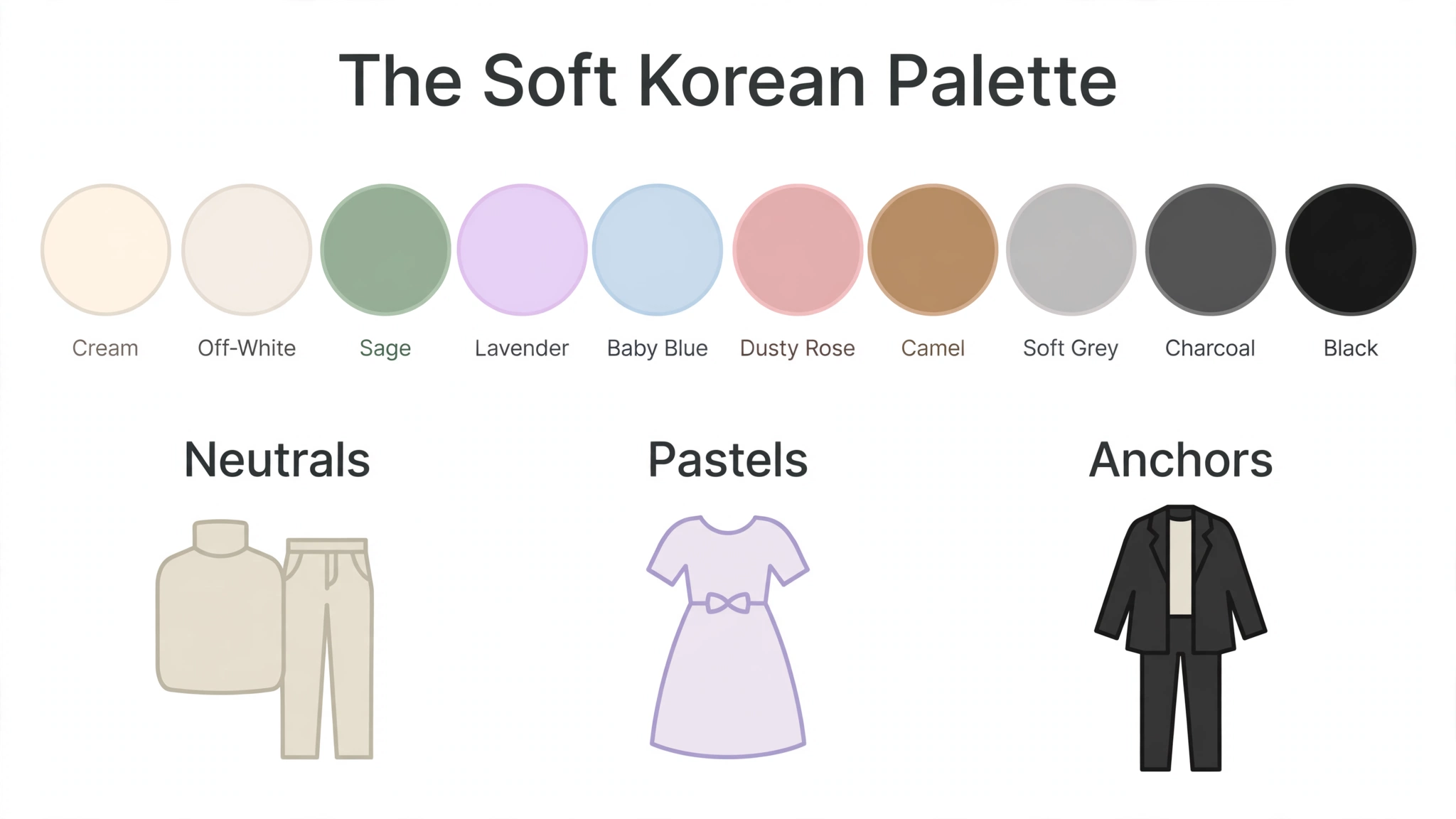
A small Korean-inspired street wardrobe is built in layers of usefulness, starting with the pieces that appear in the most formulas. Begin with two oversized tops in neutral colours — a hoodie and a sweatshirt or knit — one cropped jacket, one long coat, wide-leg jeans, one pair of relaxed trousers or cargos, joggers you would happily leave the house in, a simple long dress or pleated skirt, chunky trainers and one alternative shoe. That core, chosen in a palette of three or four colours that all combine, already produces every formula in this guide. Our checklist of streetwear essentials can help you audit what you already own before buying anything, because most women find the gaps are smaller than expected: often one trouser shape and one outer layer are all that stand between an existing wardrobe and a working system.
Add personality only after the core works. A graphic top, a colour-pop accessory, a distinctive hat or a patterned skirt earns its place when the neutrals around it are settled, because then the new piece has something calm to play against and will be worn constantly instead of waiting for the right occasion. Keep a simple record for the first month: photograph outfits you felt good in, note which formula each one used, and let that evidence guide your next purchase. Wardrobes built from your own data, rather than from hauls and hope, are the ones that keep delivering on ordinary mornings when inspiration is low and the formulas have to do the work for you.
Finally, maintain the system lightly. Rest pieces, rotate shoes, and retire anything whose fabric has lost the structure the style depends on. Korean street style looks effortless partly because the clothes themselves are in good condition: hems sit where they should, whites stay bright, and knitwear keeps its shape. A short seasonal review — what earned its place, what went unworn, which formula you reached for most — keeps the wardrobe aligned with your actual life as it changes. That, more than any single item, is how a style borrowed from Seoul becomes genuinely yours in the place where you live.
Our View
Our view is that Korean street style for women endures because it respects the wearer’s day. It offers comfort without carelessness, personality without costume and novelty without demanding a new wardrobe every season. Learn the proportions, trust the formulas, edit your accessories and let the style adapt to your climate, your work and your body. The women who make this look their own are rarely the ones who copied an outfit exactly — they are the ones who understood why the outfit worked and then wore that understanding in their own way, repeatedly, until it became signature rather than imitation.
Wear the formula, not the photograph. Once proportion becomes habit, getting dressed stops being a problem you solve every morning and becomes a language you already speak.
— Brian Ka
Frequently Asked Questions
What is Korean street style for women, in simple terms?
It is a proportion-based way of dressing built on relaxed and oversized pieces, clean neutral palettes, strong footwear and one or two deliberate accessories. The core habit is contrast with control: volume in one place, structure in another, and a limited colour story so the outfit reads as intentional.
Can I wear Korean street style if my workplace has a dress code?
Yes, by borrowing the principles rather than the most casual items. Keep the relaxed trouser silhouette, a tidy sweatshirt or knit instead of a hoodie, a long structured coat and minimal shoes. In stricter offices, use only the proportion ideas — a slightly relaxed blazer and a clean trouser break — and keep accessories understated.
How do I stop oversized clothes from looking shapeless?
Define one point of structure in every outfit: a partial tuck, a cropped layer, a high waistline, a firm bag or a substantial shoe. Choose oversized pieces whose shoulders and hems fall deliberately, and avoid wearing uncontrolled volume in every layer at once.
What should I buy first if I am starting on a budget?
Start with the structural pieces: wide-leg jeans or trousers that sit correctly on your shoes, one well-cut oversized hoodie in a neutral colour, and trainers with enough presence to ground wide bottoms. Those three items unlock the most formulas. Add a cropped jacket and a long coat when you can.
Does this style work in warm climates?
Yes, if you keep the formulas and change the fabrics. Use an oversized shirt open over a fitted top, wide lightweight trousers, skirts with relaxed tops and breathable trainers. The silhouette and proportion rules stay the same; only the weight of each layer changes.
Questions About Building Your Wardrobe?
Tell us which formula you are trying, what is not working, and where you live — proportion advice is always specific to the outfit and the day it has to survive.
Sources
- V&A — Hallyu! The Korean Wave exhibition
- Museum of Fine Arts, Boston — Hallyu! The Korean Wave
- Musinsa — Newsroom
- Seoul Metropolitan Government — Seoul Fashion Week landmarks
- Seoul Metropolitan Government — Seoul Fashion Week marks 25 years
- Highsnobiety — The Best Korean Brands
- Highsnobiety — Seoul Fashion Brands
- Hypebae — Ader Error, Korean design collective
- Dazed — K-pop and Korean fashion
- SNKRDUNK Magazine — The Korean Takeover of Streetwear Fashion
- Korea JoongAng Daily — Seoul fashion history
- Seoul Museum of History — Dongdaemun exhibition