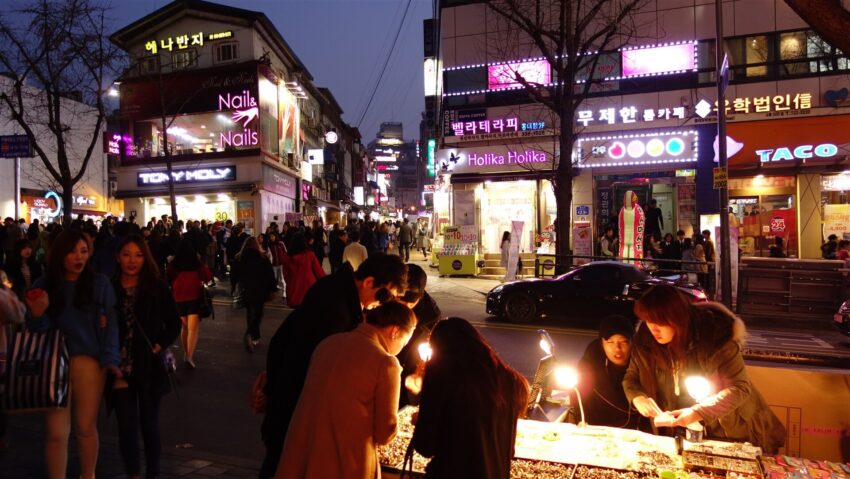
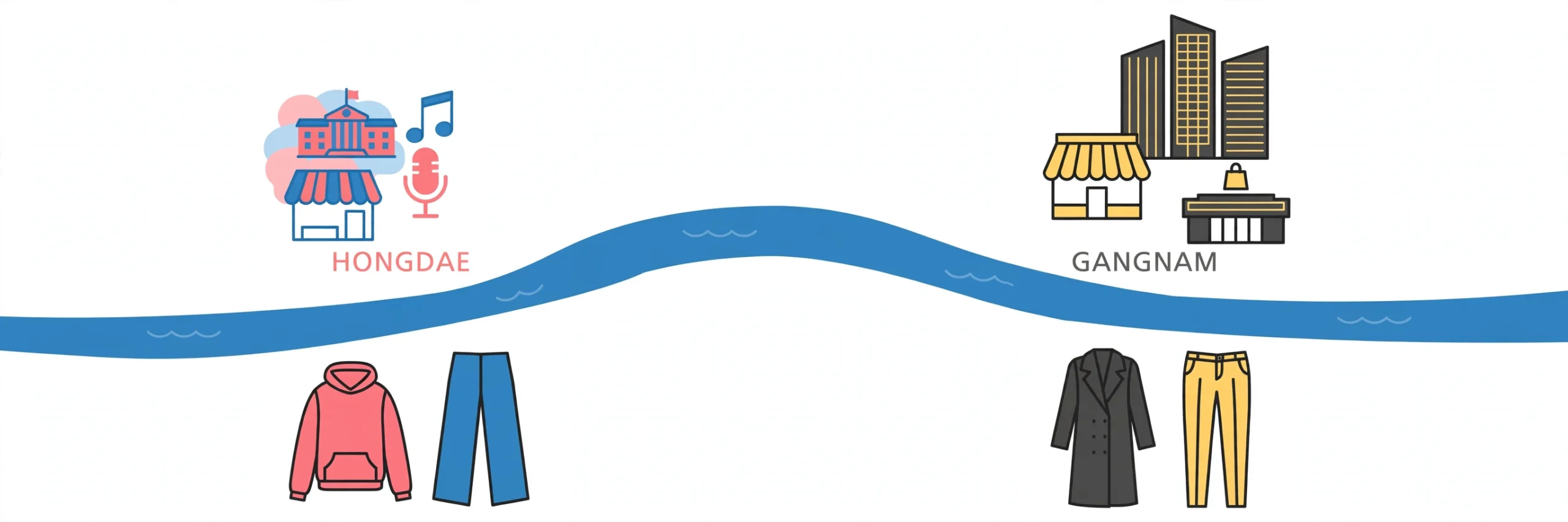
Seoul does not have one street style, it has at least two, and you can see the split most clearly by crossing the city from Hongdae in the north-west to Gangnam in the south. Hongdae, the streets around Hongik University, dresses young, experimental and budget-conscious: oversized hoodies, vintage finds, graphics worn loud and outfits assembled for a night that starts with busking and ends whenever it ends. Gangnam, and especially Apgujeong and Cheongdam within it, dresses polished, luxury-adjacent and office-clean: tailored coats, quiet colours, immaculate shoes and pieces chosen to look considered rather than discovered. Neither district is more fashionable than the other. They are answering different questions — Hongdae asks what looks new, Gangnam asks what looks right — and once you understand what each district wears and why, you can decide honestly which look fits your life, your budget and your wardrobe, or how to borrow from both without looking like you are wearing a costume from either.
Start Here
Key Takeaways
- Hongdae dresses for youth and experiment: oversized fits, graphics, vintage and indie pieces, bought on a student budget around Hongik University.
- Gangnam dresses for polish: clean lines, tailored outerwear, quiet luxury-adjacent pieces and office-ready finishes around Apgujeong and Cheongdam.
- The difference is register, not quality. Hongdae signals creativity and belonging to a scene; Gangnam signals care, status and professional readiness.
- Price follows the same split: Hongdae outfits are built cheaply and changed often, Gangnam outfits cost more per piece and are expected to last and repeat.
- The same base pieces — hoodie, wide trousers, long coat, trainers — read completely differently depending on fit, fabric, colour and finishing in each district.
- Most readers should not pick a side permanently. Borrow Hongdae energy for weekends and creative settings, Gangnam polish for work and formal days, and mix deliberately.
Contents
- Two Districts, Two Dress Codes: The Comparison at a Glance
- The Hongdae Look: Young, Indie and Built to Experiment
- The Gangnam Look: Polished, Quiet and Office-Clean
- Price and Register: What the Clothes Are Really Saying
- Same Pieces, Different District: How Styling Flips the Meaning
- Which Look Fits You? Reading Your Own Life Honestly
- Mixing Both Districts Without Wearing Either as a Costume
- Our View
- Frequently Asked Questions
- Sources
- Recommended
Two Districts, Two Dress Codes: The Comparison at a Glance
Start with the districts themselves, because the clothes only make sense once you know who is wearing them and where their day takes them. Hongdae grew up around an art university, and its streets are filled with students, indie musicians, buskers, small boutiques and cafés that stay open late. The official city guide captures that character directly in Visit Seoul’s Personable Seoul guide, which describes Hongdae as a mecca of youth where live bars, clubs and busking fill the streets and prices stay cheaper because so many universities are nearby. Gangnam, in the same guide, is presented almost as the mirror image: a forest of buildings, department stores and global luxury brand stores south of the river, with Apgujeong and Cheongdam as its cultural and retail core. Two districts, two economies, two ideas of what a good outfit is for.
A direct district comparison makes the same point in practical terms. The breakdown in this Hongdae vs Gangnam guide describes Hongdae as youthful, artistic and budget-friendly, built around independent artists and performers, and Gangnam as affluent, polished and aspirational, built around luxury brands, beauty culture and entertainment companies. That contrast is not a marketing invention. It is visible in the first ten minutes of walking either district: in Hongdae the interesting outfits are the ones that break a rule, while in Gangnam the interesting outfits are the ones where nothing is out of place. One district rewards novelty, the other rewards finish, and almost every clothing difference in this post flows from that single distinction.
| Element | Hongdae | Gangnam |
|---|---|---|
| Core crowd | Students, indie musicians, young creatives around Hongik University | Professionals, shoppers and residents around Apgujeong and Cheongdam |
| Silhouette | Oversized, layered, deliberately unfinished in places | Clean, tailored, proportions controlled from coat to shoe |
| Colour and graphics | Graphics, logos, colour pops and clashing accents welcomed | Neutrals and monochrome first, branding quiet or hidden |
| Key pieces | Oversized hoodie, graphic tee, cargos, vintage finds, chunky trainers | Long coat, blazer, straight trousers, knit, minimal leather shoes |
| Budget logic | Low cost per piece, bought often, easy to replace and restyle | Higher cost per piece, bought less often, expected to repeat for years |
| What it signals | Creativity, scene knowledge, willingness to experiment | Care, polish, professional and social readiness |
| Best setting | Campus, gigs, cafés, weekends, creative work | Office, meetings, dinners, formal-leaning days |
It helps to place both districts inside the wider Korean style story rather than treating them as rivals in isolation. Our complete guide to Korean streetwear style shows how the national look combines proportion, layering and strong footwear, and both districts use that same grammar — they simply stress different words in the sentence. Hongdae stresses volume and graphics, Gangnam stresses line and finish. If you are new to the style, read the two districts as two dialects of one language. That framing stops the most common mistake readers make, which is copying surface details from photographs without understanding the register those details carry at home.
The Hongdae Look: Young, Indie and Built to Experiment
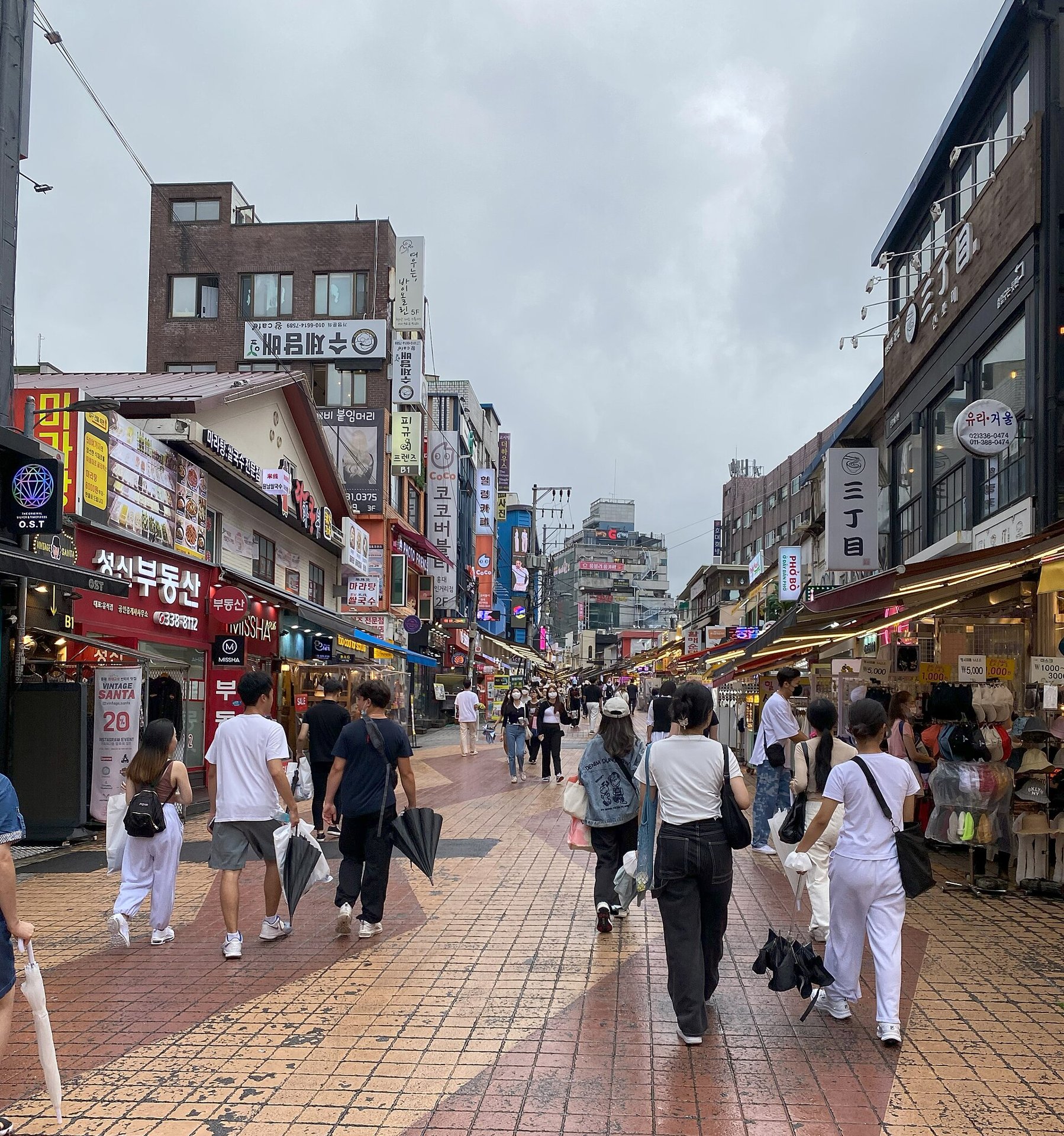
Hongdae dressing starts from a simple permission: try it and see. Because the crowd is young and the shops are cheap, an outfit does not need to justify itself for long. Oversized hoodies are worn over wide jeans or cargos, graphic T-shirts are layered under open shirts, skirts are paired with heavy boots, and vintage pieces are mixed with new ones without worrying whether the combination looks expensive. The museum view of the wider movement, set out in the V&A Hallyu exhibition, helps explain the confidence behind that experimentation: Korean fashion travelled with music, drama and digital culture, so young wearers grew up treating clothes as part of a creative output, not just a purchase. In Hongdae that attitude is at its most concentrated, because the district’s art school, live venues and busking corners reward people who look like they made a choice.
The pieces themselves are familiar, which is why the look travels so well. A hoodie with real weight to it, wide-leg denim, a pleated skirt or cargo trousers, chunky trainers and one accessory with personality — a cap, a tote, a chain, a coloured bag — will build most Hongdae outfits. Our formulas for Korean street style for women and the lookbook for Korean streetwear for men both draw heavily on this district’s habits, because Hongdae is where the oversized, layered end of Korean street style is worn most naturally. The key detail is proportion control inside the looseness: one oversized piece at a time, a hem or waist defined somewhere, and shoes heavy enough to ground the volume. Without that control the outfit stops reading as Hongdae and starts reading as laundry day, a distinction the district’s own wearers observe instinctively.
Graphics are Hongdae’s native language. Logos, prints and statement designs are not treated as advertising for a brand so much as a quick way to say which scene, humour or reference group you belong to. Exploring streetwear graphics and the history inside streetwear logos shows how much information a single chest print can carry in this culture, and Hongdae wears that information openly: band references, university humour, indie label art and deliberately odd English phrases all appear on the same street. Domestic retail reflects the same appetite. Updates from the Musinsa newsroom announcements describe a platform built around young Korean brands and shoppers who treat streetwear as everyday clothing, and Hongdae’s small shops and showrooms are the physical version of that market — fast turnover, low prices and new ideas tested on real students before they reach a wider audience.
History supports the district’s role as Seoul’s experiment lab. A look back through this Seoul fashion history notes that as early as the mid-1990s the commercial streets in front of Hongik University were being described as a fashion venue for a new generation whose defining taste was not wanting to look like anyone else. That sentence could be written about Hongdae today without changing a word. The district’s style is therefore not a trend cycle so much as a standing arrangement: cheap space, young people, music at street level and permission to fail in public. Dressing Hongdae outside Seoul means importing that arrangement into your own wardrobe — small risks, frequent changes and at least one piece in every outfit that is there purely because you liked it.
The Gangnam Look: Polished, Quiet and Office-Clean
Gangnam dressing starts from the opposite permission: get it exactly right. South of the Han River, around Gangnam Station, Garosu-gil, Apgujeong Rodeo and Cheongdam’s flagship streets, the dominant look is clean and composed. Long coats fall without creasing, trousers break precisely on polished shoes, knitwear is fine rather than slouchy, and colour is restrained to black, navy, grey, cream and camel with occasional soft pastels. Hair, nails and bags are part of the outfit in a way Hongdae rarely bothers with. The result is sometimes described as luxury, but that undersells what is actually happening: most Gangnam outfits are not built from luxury brands at all. They are built from ordinary pieces held to a luxury standard of fit, condition and coordination, which is a much more useful lesson for readers than a list of flagship stores.
The district’s fashion infrastructure reinforces that standard. The city itself stages major fashion activity in the area, as noted in Seoul Fashion Week at 25 years, where Cheongdam appears alongside the main venue as a presentation district, and in coverage of Seoul’s landmark runway plans, which treat fashion as part of the city’s polished public image. Brand geography tells the same story. Guides to Seoul brands to know place concept stores and refined Korean labels in and around Gangnam, where retail is designed like gallery space and clothes are presented as considered objects. Walking those streets trains the eye: windows show one outfit at a time, fully finished, and the people passing them tend to dress the same way.
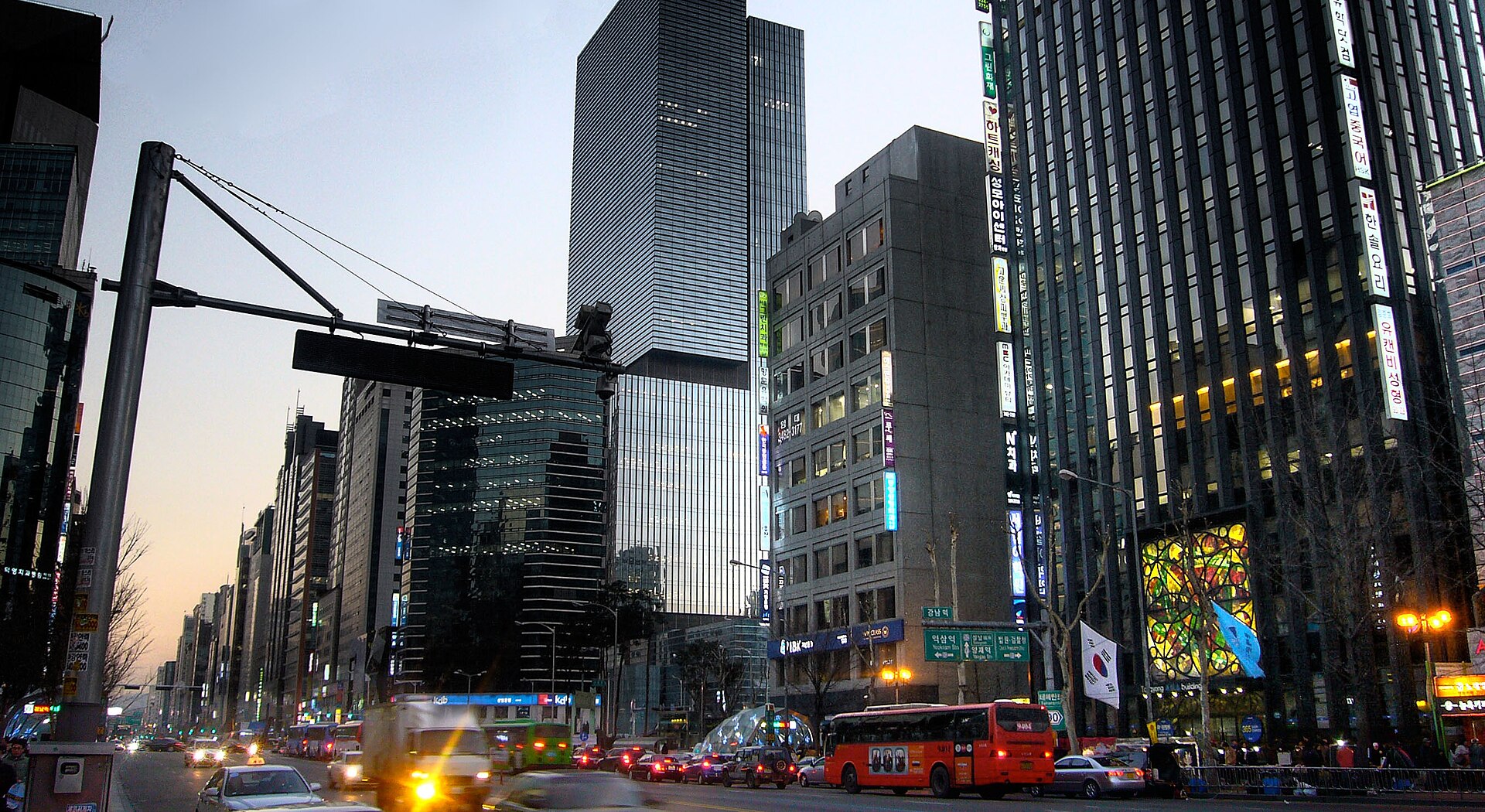
For women, the Gangnam version of Korean style usually means a long coat or tailored blazer over a fine knit, straight or gently wide trousers, a midi skirt with clean boots, and a structured bag, with makeup and hair finished to the same standard as the clothes. For men it means a coat or blazer with a proper shoulder, a plain knit or shirt, trousers with a clean break and minimal shoes, with streetwear admitted only in disciplined doses — a plain premium hoodie under a coat, or immaculate trainers with tailored trousers. In winter the discipline becomes even clearer, as our guide to Korean streetwear in winter shows: the long padded coat that appears all over Seoul is worn in Gangnam in black or neutral tones, zipped and neat, over an outfit that would still look complete if the coat came off indoors. Nothing is accidental, and that is precisely the appeal for readers whose days include clients, colleagues or family occasions where looking deliberate matters.
It is worth saying clearly that Gangnam polish is not stiffness. The best Gangnam outfits still use Korean proportion — a slightly relaxed trouser, a coat with room to layer, trainers chosen as a deliberate contrast — they simply edit harder. Where Hongdae might add a second graphic or a third layer, Gangnam removes one element and checks the mirror. Readers who want that register at home should study finishing before buying anything: ironed or steamed clothes, shoes cleaned, bag structured, colours limited to a family that repeats across the wardrobe. Polish is mostly maintenance, and maintenance is free, which makes the Gangnam look more accessible than its reputation suggests.
Price and Register: What the Clothes Are Really Saying
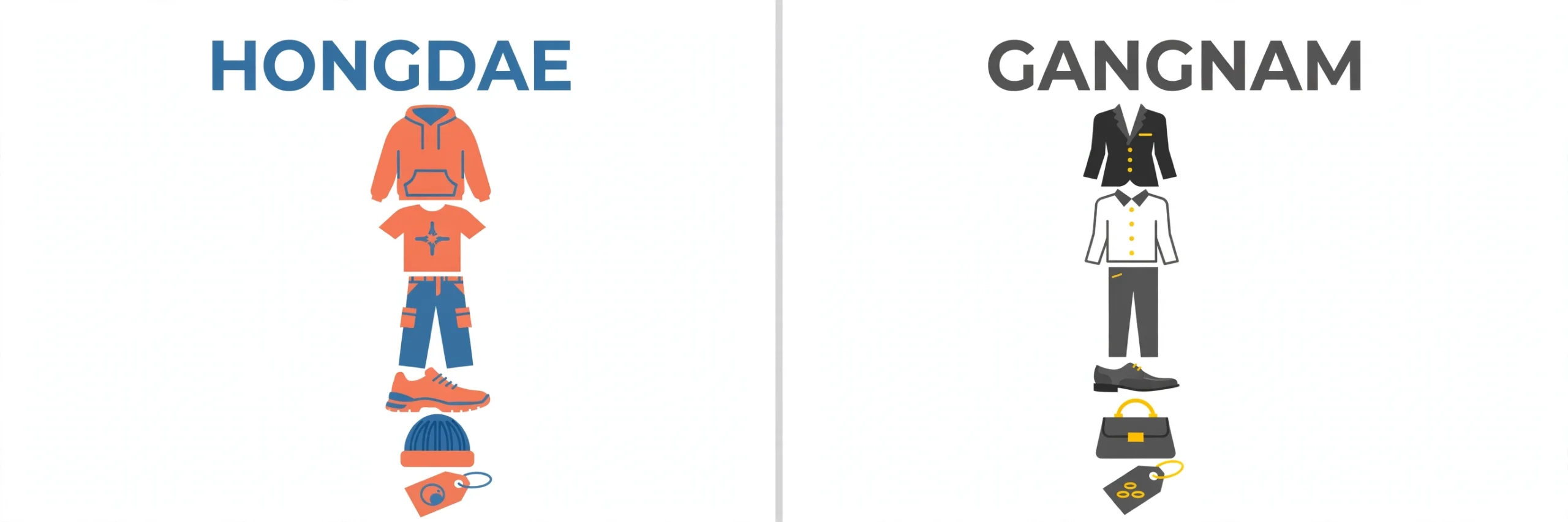
Price is the most visible difference between the districts, but register — the social message the outfit sends — is the more important one. A Hongdae outfit might cost very little in total: a market hoodie, vintage jeans, a graphic tee from a small Korean label and trainers bought on sale. Its value is not in the spend but in the combination, and it is designed to be changed next month without regret. A Gangnam outfit spreads its budget differently: fewer pieces, each costing more, chosen in fabrics and cuts that survive repetition. Neither approach is smarter in the abstract. Hongdae spending buys experimentation and learning, which is exactly what a young wardrobe needs. Gangnam spending buys reliability and time, which is what a working wardrobe needs. Problems start only when the spending pattern and the life pattern disagree — luxury prices paid for clothes worn like experiments, or fast, disposable pieces expected to perform like tailored staples.
The wider cultural exhibitions help explain why both registers carry weight in Korea rather than one cancelling the other. The survey in MFA Boston’s Hallyu exhibition presents Korean fashion as versatile, fast-moving and built on mix-and-matching, which describes Hongdae’s method precisely, while its account of K-beauty and polished presentation describes the Gangnam standard. Korean style holds both because Korean life holds both: student years and office years, festival nights and family lunches, often for the same person in the same week. Analysis of K-pop and idol fashion adds another layer, showing how idols move between street-experimental styling and luxury ambassador polish, teaching fans to read both registers fluently and to switch between them by occasion rather than treating one as their identity.
Brand culture sits across both registers rather than inside one. The profile of Ader Error’s design collective describes a label built on playful proportion and youth expression that is sold in gallery-like stores — Hongdae energy presented with Gangnam finish. That combination is increasingly the commercial centre of Korean fashion: experimental ideas, professionally presented. For readers, the practical translation is to judge pieces on two separate axes. Ask first which register the piece belongs to — experiment or polish — and then ask whether its quality matches the job. A playful graphic can be beautifully made, and a tailored coat can be badly made. District loyalty should never substitute for checking fabric, stitching and fit with your own hands.
Same Pieces, Different District: How Styling Flips the Meaning
The fastest way to understand the two districts is to watch the same garment change meaning as it crosses the river. Take the hoodie, the single most shared piece in Korean street style. In Hongdae it is oversized, often graphic, worn with wide jeans or a skirt, sleeves long, hood up when the music starts. In Gangnam the same garment is plain, in black, grey or cream, cut closer, layered under a long coat with the hood arranged neatly over the collar, and paired with trousers rather than denim. Our breakdown of hoodie outfit ideas in Korean style contains both versions, and the difference is never the hoodie itself — it is size, colour, company and finish. Sneaker culture tells a similar story, as explored in SNKRDUNK’s Korean streetwear overview: trainers are central in both districts, but Hongdae favours chunky, coloured and retro shapes worn as a statement, while Gangnam favours clean, minimal pairs kept spotless and worn as a softener for tailoring.
The long coat flips in the opposite direction. In Gangnam it is the outfit’s anchor, tailored and neutral, signalling that the wearer planned the whole look. Carried into Hongdae, the same coat is worn open over a hoodie and graphic tee, sleeves pushed up, deliberately too formal for everything underneath it — and that mismatch is the point. Denim does similar work: Hongdae denim is wide, washed, sometimes distressed or patched, while Gangnam denim is dark, straight and treated almost like a trouser. Even the broader streetwear aesthetic bends by district, reading loose and graphic-led in the north-west of the city and minimal and monochrome in the south. Learning to see these flips is more valuable than memorising either district’s shopping list, because it teaches you to steer an outfit you already own toward either register with small, reversible changes.
Accessories are where the flip is cheapest to perform. A Hongdae base outfit becomes Gangnam-leaning when you swap the tote for a structured bag, the beanie for nothing, coloured trainers for minimal ones and add one piece of simple jewellery, then steam the hoodie. A Gangnam base becomes Hongdae-leaning when you add a graphic layer under the coat, swap the leather shoes for chunky trainers, add a cap and let one colour clash on purpose. Browsing streetwear inspiration with this district lens in mind turns a random gallery into a training set: for each outfit, ask which district it belongs to and which single swap would move it across the river. After a few dozen repetitions the judgement becomes automatic, and getting dressed in either register stops requiring a photograph to copy.
Which Look Fits You? Reading Your Own Life Honestly
Choose your default district by your calendar, not by your fantasy. If most of your week is campus, creative work, cafés, gigs, markets and friends, and your clothing budget is small but your appetite for change is large, Hongdae is your natural home register. Its formulas forgive cheap fabrics, reward thrifting and mixing, and treat a failed experiment as entertainment rather than embarrassment. If most of your week is office, meetings, clients, formal family settings or any environment where being read as careful and competent matters, Gangnam should be your default. Its formulas reward maintenance, repetition and fit, and they keep working on days when you have no energy to be creative because the system, not your mood, produces the polish.
Age is a weaker guide than lifestyle, despite both districts having reputations. Hongdae is young in spirit but its core skills — proportion, layering, thrift, confidence with graphics — work at forty and beyond when the graphics are chosen well and the fit is controlled, as the mature end of Korean street dressing shows regularly. Gangnam polish, equally, is not an older person’s uniform: students in Seoul wear the tailored-coat version on presentation days and job-interview days precisely because it borrows adult credibility. Body type is also a weaker guide than either district suggests. Oversized Hongdae dressing needs one defined point to avoid swamping the frame, and tailored Gangnam dressing needs ease in the right places to avoid stiffness, but both are proportion systems, and proportion systems adapt. What does not adapt is a wardrobe built entirely for a life you do not live, so audit your last two ordinary weeks before you buy for either district.
Budget honesty matters just as much. A Hongdae wardrobe built at Gangnam prices — expensive experimental pieces replaced every season — is the most costly mistake in this whole comparison, because experimentation by definition discards. Keep experimental spending cheap and put serious money only into pieces that have survived a season of experiments and earned promotion to staples. Conversely, a Gangnam wardrobe built at Hongdae prices fails differently: coats that lose shape, knitwear that pills and shoes that scuff beyond cleaning will quietly destroy the polish the register depends on. If money is tight, run a Hongdae wardrobe with Gangnam maintenance habits — few districts anywhere offer better training than that combination.
Mixing Both Districts Without Wearing Either as a Costume
The most convincing Seoul dressers are not loyal to one district, and your wardrobe should not be either. The reliable mixing rule is one district leads, the other accents. A Gangnam-led outfit — coat, trousers, minimal shoes — takes one Hongdae accent, such as a graphic tee under the coat or a cap carried for after work, and stops there. A Hongdae-led outfit — oversized hoodie, wide denim, chunky trainers — takes one Gangnam accent, such as a structured bag, a steamed finish or a single piece of clean jewellery, and stops there. Two accents from the visiting district is where outfits start to look undecided, and a full fifty-fifty split usually reads as costume because the registers are signalling opposite things at equal volume. Build the base from the essentials in our checklist of streetwear essentials, most of which are register-neutral, then steer each day’s outfit with fit, colour and one deliberate accent.
Season makes mixing easier. Winter pushes both districts toward long coats and heavy layers, so the difference narrows to colour and finish, and a single wardrobe can serve both registers with a change of shoes and bag. Summer pushes them apart — Hongdae opens into graphics, shorts, skirts and colour, Gangnam tightens into clean shirts, light tailoring and minimal dresses — so summer is when your default district shows most honestly. Travel makes mixing necessary rather than optional: a reader visiting Seoul will want Hongdae energy for the evening streets and Gangnam polish for the restaurants and galleries, ideally from one suitcase built on neutral bases with two accent pieces per register. That is also, not coincidentally, how Seoul residents themselves pack for a weekend in another city.
Finally, let your own data settle the question over time. Photograph your outfits for a month and mark each one Hongdae, Gangnam or mixed, then note which photographs you actually like and which days produced them. Most readers discover a ratio — seventy-thirty, fifty-fifty, thirty-seventy — that reflects their real life rather than the district they admired first. Buy toward that ratio, maintain toward the Gangnam standard regardless of register, and keep one cheap experimental slot open in every season so the Hongdae side of the wardrobe never fossilises. Districts in Seoul keep changing because the people in them keep changing. A wardrobe that holds both registers, in your own ratio, is the closest a reader outside Seoul can come to dressing the way the city itself does.
Our View
Our view is that Hongdae vs Gangnam is not a contest and treating it as one misses what Seoul is teaching. Hongdae teaches courage: wear the idea, keep it cheap, change it next month. Gangnam teaches care: fit it properly, finish it completely, repeat it for years. A wardrobe with only courage becomes noisy and disposable, and a wardrobe with only care becomes safe and invisible. The readers who get the most from Korean street style are the ones who let Hongdae choose their experiments and Gangnam set their standard of finish, then dress each day in the ratio their actual life demands.
Let Hongdae teach you to try things and Gangnam teach you to finish them. Experiment like a student, maintain like a professional, and your wardrobe will work in both districts.
— Brian Ka
Frequently Asked Questions
What is the main difference between Hongdae and Gangnam style?
Hongdae style is young, experimental and budget-led: oversized fits, graphics, vintage and indie pieces worn around Hongik University. Gangnam style is polished and office-clean: tailored coats, quiet colours, controlled proportions and immaculate finishing around Apgujeong and Cheongdam. The difference is register — creativity signalled in Hongdae, care and polish signalled in Gangnam.
Is Hongdae style only for young people?
No. The crowd is young, but the skills are ageless: proportion control, layering, thrifting and confident use of graphics work at any age when fit is deliberate and graphics are chosen well. What dates an outfit is uncontrolled volume and novelty bought without judgement, not the district it came from.
Is Gangnam style expensive to copy?
Less than its reputation suggests. Most Gangnam outfits are ordinary pieces held to a high standard of fit, condition and coordination rather than luxury-brand purchases. Spend on a coat that keeps its shape, trousers with a clean break and shoes you maintain, then let steaming, cleaning and colour discipline do the rest for free.
Can I mix Hongdae and Gangnam pieces in one outfit?
Yes, with one rule: one district leads and the other provides a single accent. A tailored Gangnam base can take one graphic or cap as its Hongdae accent, and an oversized Hongdae base can take one structured bag or clean finish as its Gangnam accent. A half-and-half split usually reads as undecided rather than eclectic.
Which district should I shop in if I visit Seoul?
Both, for different jobs. Shop Hongdae for cheap experiments, graphics, vintage and small Korean labels you can test without regret. Shop Gangnam, especially Apgujeong, Cheongdam and Garosu-gil, for considered pieces, flagship presentations and the standard of finish you want your staples to meet. Set the budget split before you go, not in the store.
Questions About Building Your Wardrobe?
Tell us which district you lean toward, what your ordinary week actually looks like, and where your outfits feel off — district advice is always specific to the life the clothes have to serve.
Sources
- Visit Seoul — Person:able Seoul, 2023 Seoul K-Wave Travel Guide
- Korea Visiting — Hongdae vs Gangnam District Guide
- V&A — Hallyu! The Korean Wave exhibition
- Museum of Fine Arts, Boston — Hallyu! The Korean Wave
- Musinsa — Newsroom
- Seoul Metropolitan Government — Seoul Fashion Week landmarks
- Seoul Metropolitan Government — Seoul Fashion Week marks 25 years
- Highsnobiety — Seoul Fashion Brands
- Hypebae — Ader Error, Korean design collective
- Dazed — K-pop and Korean fashion
- SNKRDUNK Magazine — The Korean Takeover of Streetwear Fashion
- Korea JoongAng Daily — Seoul fashion history