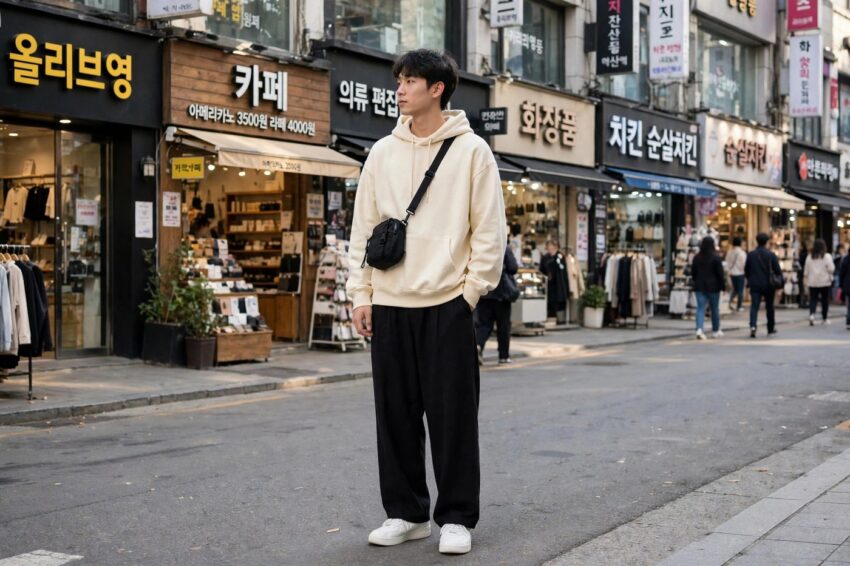
The Seoul look looks expensive from a distance, and that is exactly why people assume it costs a fortune to copy. In practice, most of the outfits you see on the street in Hongdae are built from a small number of well-chosen pieces, bought slowly, in the right order, at prices that would surprise anyone used to Western high-street markups. Korean streetwear rewards proportion, layering and restraint far more than it rewards logos or premium labels, and all three of those things are free. What it does require is a system: a price cap for every category, a sensible order to buy in, and the discipline to spend where the money actually shows and save where it does not. This guide is that system. It sets a budget ceiling for each core piece, works through the maths of a complete starter set, and shows how secondhand finds, sale timing and cost-per-wear thinking turn a modest budget into a wardrobe that reads as deliberate rather than cheap.
Start Here
New to buying Korean pieces online? Begin with our guide to Korean streetwear brands and Musinsa, which covers where to order and how sizing runs, then see the full silhouette in our Korean streetwear for men lookbook and the companion formulas in Korean street style for women. For the two neighbourhoods that define the look, read Hongdae vs Gangnam before you spend anything.
Key Takeaways
- Cap every piece before you shop: $25 for an oversized tee, $45 for a hoodie, $50 for wide trousers, $55 for cargo pants, $80 for sneakers, $30 for a crossbody bag and $18 for a beanie.
- Buy in order: trousers and sneakers first, then the hoodie and tees, then accessories last.
- Spend where money shows, on outerwear, shoes and fit; save on basic tees and plain hoodies, where nobody can tell.
- A complete starter set built to these caps costs $218, or $248 with the crossbody bag included.
- Secondhand marketplaces and end-of-season sales routinely cut Korean pieces by a third or more.
- Judge every purchase by cost per wear, not by the price tag on the day you buy it.
Contents
- The Price Caps: What Each Piece Should Cost
- Buy First, Second, Later: The Order That Works
- Where Money Shows and Where It Does Not
- Wardrobe Math: A Starter Set That Adds Up
- Secondhand Finds and Sale Timing
- Cost Per Wear: The Only Number That Matters
- Fit, Tailoring and Making Cheap Look Expensive
- Our View
- Frequently Asked Questions
- Sources
- Recommended
The Price Caps: What Each Piece Should Cost
A budget wardrobe starts with a ceiling for every piece, decided before you open a single shop tab. Without caps, a budget quietly becomes whatever the algorithm puts in front of you, and Korean retail is very good at making a $90 hoodie feel like a bargain next to a $160 one. The caps below are set for the budget tier of the Seoul look: domestic Korean labels, marketplace brands and sale stock, bought with the patience this guide assumes. They are not the cheapest prices that exist. They are the prices at which each piece is genuinely good, heavy enough fabric, correct cut, stitching that survives a season of washing, without paying for a name. The wider context helps here. What most people call streetwear as a culture began as clothing built from workwear and sportswear basics, and the Korean version of it stays close to those roots: oversized tees, wide trousers, hoodies, sneakers and small accessories, repeated in different proportions. Nothing on the list is exotic, which is precisely why a cap system works. You are not hunting rare items. You are buying ordinary items at the right price, in the right order, and letting proportion do the styling.
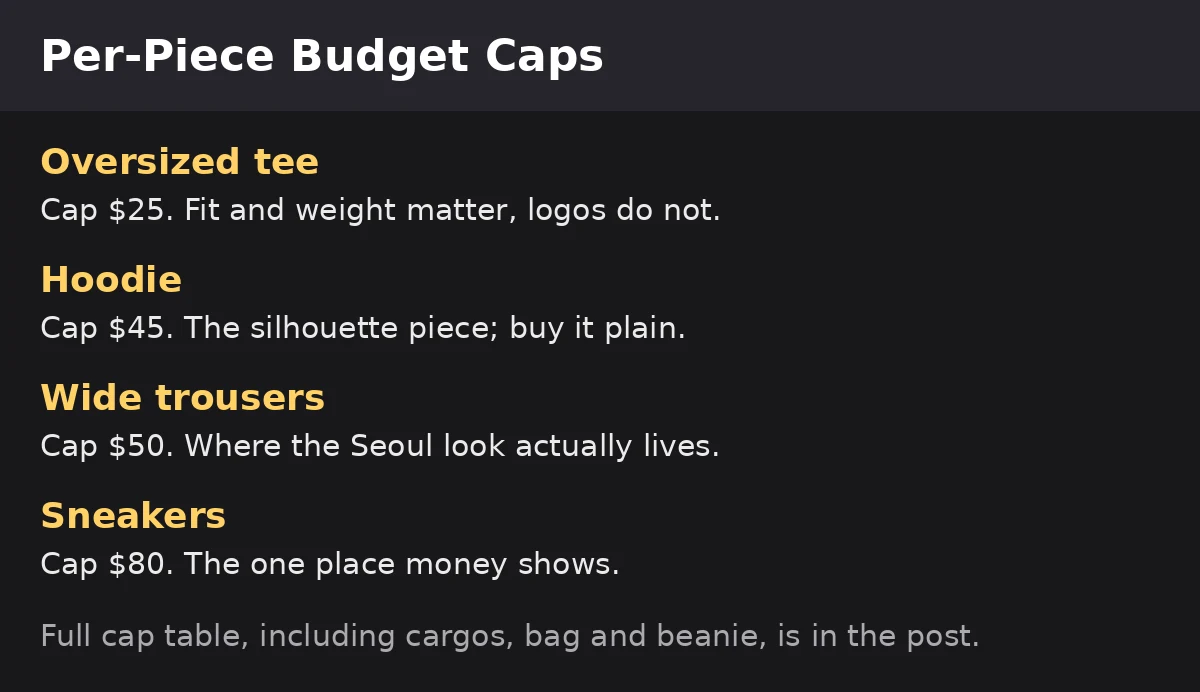
| Piece | Budget cap | Why |
|---|---|---|
| Oversized tee | $25 | Heavyweight cotton at this price drapes correctly; above it you are paying for graphics and branding, not fabric. |
| Hoodie | $45 | Covers a solid mid-weight fleece with a proper double-layer hood; plain colours at this level are indistinguishable from premium ones. |
| Wide trousers | $50 | The silhouette piece of the whole look, so the cap is generous enough for fabric that holds its shape and a clean taper. |
| Cargo pants | $55 | Pockets, straps and hardware cost a little more to make well; below this, zips and buckles are usually the first things to fail. |
| Sneakers | $80 | The highest cap on the list because shoes carry the outfit and your feet; this buys previous-season models from major brands on sale. |
| Crossbody bag | $30 | A small nylon or canvas bag is a simple object; at this price you get sound zips and stitching, and nothing above it changes the look. |
| Beanie | $18 | A ribbed knit beanie is a commodity item; the cap buys a wool blend that keeps its shape instead of a thin acrylic that goes slack. |
Read the caps as a set, not as isolated bargains, because they are weighted by importance. Sneakers get $80, the largest allowance, because footwear is the one place where cheapness announces itself immediately, in shape, in sole wear and in how the shoe ages after a month of pavements. Wide trousers at $50 and cargo pants at $55 come next, because the lower half sets the silhouette that makes the whole outfit read as Korean rather than generic. At the other end, the beanie at $18 and the oversized tee at $25 are deliberately tight caps. A tee is a rectangle of cotton with sleeves; once the fabric weight is right, extra money buys a logo, and a logo is not what makes an outfit look Seoul. The hoodie sits in the middle at $45 for the same reason. Hoodies are the most forgiving garment in the wardrobe, and a plain $45 hoodie in the right oversized cut will pass next to one costing three times as much in almost every photograph and every street encounter. The crossbody bag at $30 follows the same logic: it is a finishing piece, small and simple, and its job is proportion and convenience rather than craftsmanship theatre.
Two rules keep the caps honest in practice. The first is that a cap is a ceiling, not a target. If a heavyweight tee appears in a sale at $16, the system has worked, not failed, and the $9 difference goes back into the pool for a piece where quality matters more. The second is that caps apply to the delivered price you actually pay, so a piece that sneaks over its ceiling once fees are added is over budget however attractive the headline number looked. This guide deliberately does not re-teach ordering mechanics, shipping or size conversion; that ground is covered in the Musinsa buying guide linked at the top of this page, and the caps here assume you have read it. What matters for the budget is simpler: decide the number first, shop second. The global reach of the Korean Wave means Korean cuts and proportions are now copied at every price level in every market, so a disciplined buyer is never choosing between the look and the budget. The look is available at these prices. It always was, provided you shop with a ceiling instead of a mood.
Buy First, Second, Later: The Order That Works
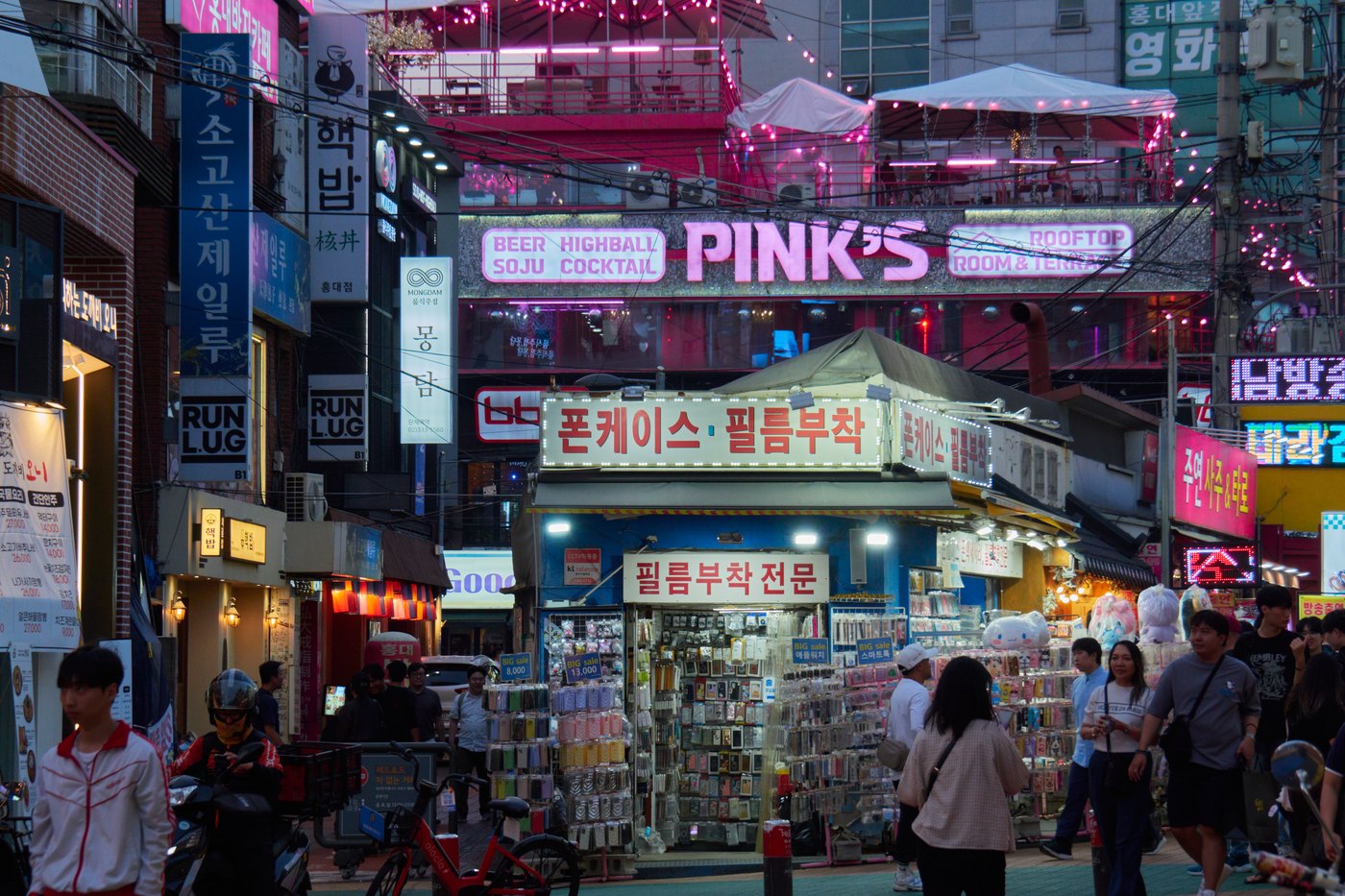
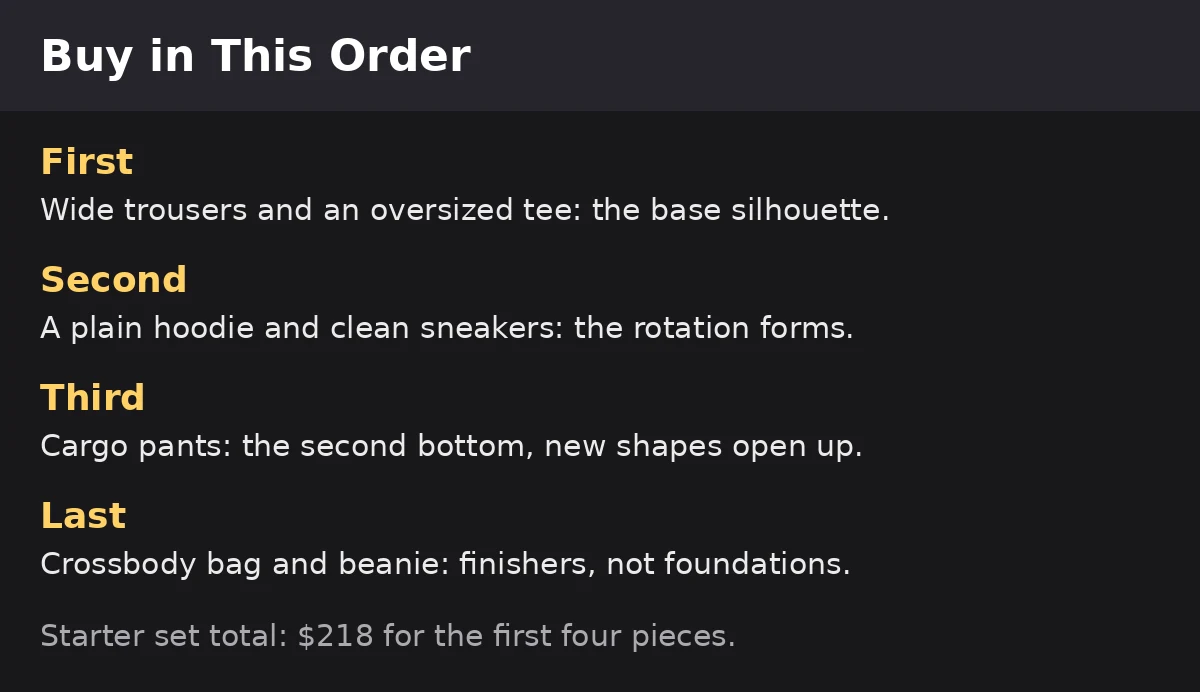
The order you buy in matters as much as what you buy, because the first pieces decide how many outfits you can actually wear. Most failed budget wardrobes fail here rather than on price: three graphic tees, a statement jacket and no trousers that work with any of them, bought in a burst of enthusiasm and worn twice. The correct first purchase is the wide trousers, capped at $50. Trousers are the foundation of the Korean silhouette, which is built from the bottom up: volume below, volume above, nothing tight anywhere. A single pair of well-cut wide trousers in black or charcoal instantly converts tops you already own, plain tees, an old hoodie, a plain shirt, into something close to the Seoul look, because the proportion is suddenly right. Second in the same first phase come the sneakers, capped at $80. Shoes and trousers are bought together in spirit even if weeks apart in practice, because the trouser hem and the shoe have to agree: wide hems need a shoe with enough presence, a chunky sole or a clean retro runner, to stop the fabric swallowing your feet. Get these two pieces right and you own the base of the look for $130 of the total budget.
The second phase builds the top half. Buy the hoodie next, capped at $45, in black, grey or washed navy, oversized enough to sit over the wide trousers without bunching at the waist. Then add the oversized tees, capped at $25 each, starting with one and adding a second when a sale allows. Tees come after trousers and shoes for a deliberate reason: they are the easiest pieces to buy badly in a hurry and the easiest to buy well at leisure, and almost everyone already owns something serviceable to bridge the gap. The background of Korean fashion’s global rise is useful here, because the export version of the look is often sold top-first, heavy on graphic tees and statement hoodies, while the domestic street version is built bottom-first around trousers and shoes. Copy the domestic order. By the end of phase two you have spent $175 on trousers, sneakers and a hoodie, plus $25 on the first tee, and you can already dress in the full silhouette every day of the week by rotating what goes on top.
The third phase is everything else, and it should be spread over months rather than weeks. Cargo pants, capped at $55, come first in this phase because they double your lower-half options and unlock the more utilitarian side of the look. The crossbody bag at $30 and the beanie at $18 finish the set, and they are last for a reason that has nothing to do with their price. Accessories multiply outfits only when there are outfits to multiply; a bag bought before you own trousers is a bag carried with the wrong clothes. Our breakdown of Korean streetwear accessories shows how much work these small pieces do once the base exists, and the same patience applies to seasonal additions. A summer version of this wardrobe, for example, swaps the hoodie phase for lighter layers, as our guide to Korean streetwear in summer sets out. The principle never changes: foundation first, rotation second, decoration last. A wardrobe bought in this order is wearable at every stage, which is what keeps a budget project alive. A wardrobe bought in the wrong order sits in a pile waiting for the missing piece, and piles do not get worn.
Where Money Shows and Where It Does Not
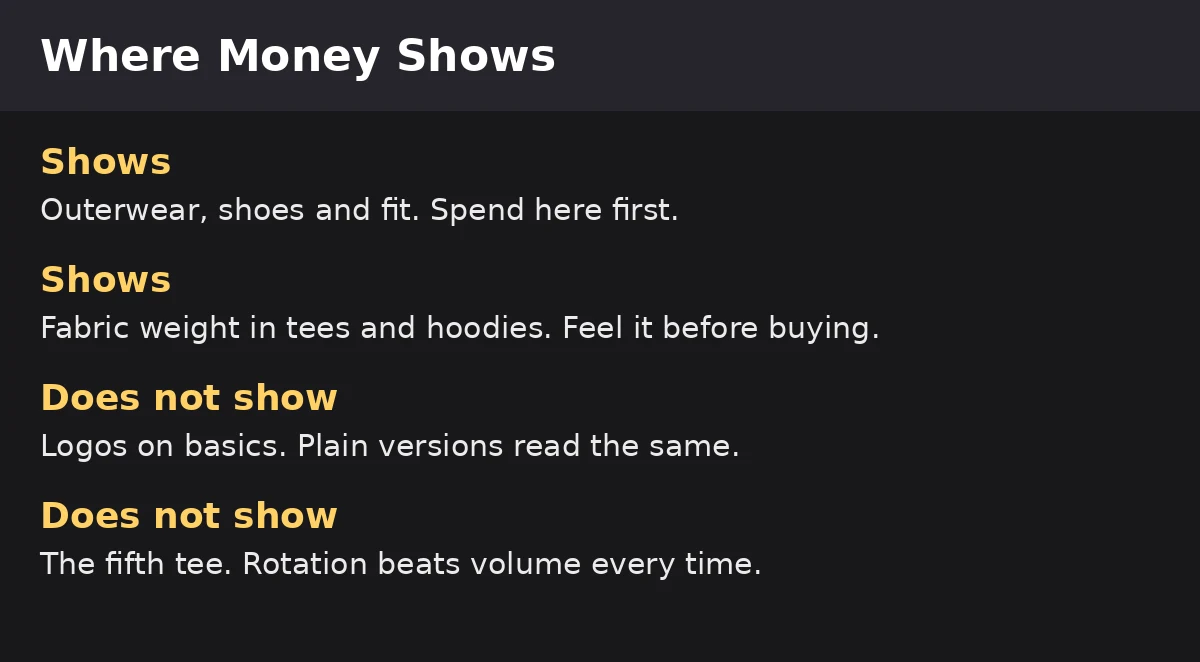
Every wardrobe has places where spending is visible and places where it is completely invisible, and a budget only works if you fund the first group by starving the second. Money shows most clearly in three places: outerwear, shoes and fit. Outerwear shows because it is the largest single surface in the outfit and the layer other people actually see for most of the year. A coat or jacket with structure, clean shoulders, fabric with some body and hardware that works smoothly reads as quality from across the street, and its absence reads just as clearly. This budget system defers serious outerwear until the base wardrobe exists, but when the time comes, this is where the largest single purchase belongs, bought once and worn for years. Shoes show for a different reason: they are the most engineered object you wear, and cheap construction reveals itself in collapsing heels, peeling finishes and soles worn smooth in a month. That is why sneakers hold the $80 cap, the highest on the list, and why our guide to Korean streetwear shoes treats footwear as the finishing decision rather than an afterthought. Fit, the third place money shows, is covered fully in the final section of this guide, because it is the one place where a small spend outperforms a large one.
Money does not show in basic tees, plain hoodies and simple accessories, and understanding why is liberating. A plain black oversized tee is judged by the eye on two things only: the weight of the fabric and the shape of the cut. Both are available at $25. There is no visible difference, at any social distance, between that tee and one costing $85, because there is nothing else on the garment for the money to buy. The same holds for a plain hoodie at $45: once the fleece is decent and the hood stands up properly, the remaining price of a premium version is a chest logo and a story. The wider history of Musinsa’s rise in Seoul is instructive, since the platform grew by selling exactly these well-made domestic basics at honest prices to students who could spot a markup instantly. Beanies at $18, plain caps, simple socks and small bags belong to the same category. Nobody has ever identified the price of a beanie from looking at it. Spend the minimum that buys sound construction in these categories, and move the savings to where eyes can actually detect them.
The trap to avoid is the middle ground, pieces expensive enough to hurt but not distinctive enough to show it. A $70 plain tee, a $110 logo-free hoodie from a mid-tier label, trousers at $95 that are cut like the $50 pair: these purchases consume the budget that outerwear and shoes needed, while looking identical to the capped versions. The test before any purchase above a cap is a single question: what, exactly, will look different in a photograph? If the honest answer is nothing, the cap stands. There is one deliberate exception, and it is fabric in the pieces you wear against the skin daily. If a tee at $30 uses noticeably heavier, softer cotton than the $25 option and you will wear it twice a week for two years, the extra $5 is a cost-per-wear decision rather than a vanity one, and the maths section below shows how to judge it. Exceptions should be argued with numbers, though, never with the feeling that a piece is somehow more real than the capped version. On the street, real is what the eye can see, and the eye is a strict accountant.
Wardrobe Math: A Starter Set That Adds Up
Put the caps together and the Seoul look stops being an aspiration and becomes a number: $218 for a complete starter set. Here is the worked example, piece by piece, at exactly the caps from the first section. Wide trousers, $50. Sneakers, $80. Hoodie, $45. One oversized tee, $25. Beanie, $18. Added together: $50 plus $80 is $130, plus $45 is $175, plus $25 is $200, plus $18 is $218. That is the whole entry cost of a wardrobe that dresses you in the full Korean silhouette every day, rotating the tee and hoodie over the same trousers and shoes. Add the crossbody bag at $30 and the total becomes $248, which buys the finished version, the one with the accessory that makes the outfit look styled rather than assembled. Add cargo pants at $55 later, as the phase-three purchase, and the wardrobe reaches $303 with two complete lower halves. These are not sale-dependent fantasy numbers. They are the caps themselves, the maximum the system allows per piece, so a patient buyer shopping sales and secondhand, as the next section covers, will usually land below them.
The more useful number is outfits, not items, because outfits are what a wardrobe actually produces. The $218 starter set combines into more combinations than it first appears. The wide trousers and sneakers form a fixed base. Over them: the tee alone, the hoodie alone, the hoodie open over the tee, the tee with the beanie, the hoodie with the beanie, and any of those with a shirt or jacket you already own added as a layer. That is six to eight distinct looks from five pieces, before the bag and cargos arrive to multiply it further. This is the logic behind capsule wardrobe thinking, applied to a specific aesthetic rather than to minimalism for its own sake: few pieces, chosen to combine, in a tight colour range. Black, charcoal, grey, white and washed navy is the working palette here, because every piece in those colours pairs with every other piece, and a budget cannot afford single-purpose items that only work with one partner. If a piece you are considering does not combine with at least three things you already own, it is not a bargain at any price. It is a future donation.
Set the $218 against the way the same look is usually bought and the system’s value sharpens. Bought without caps, one piece at a time from whichever brand is loudest that month, the same five categories commonly total $450 to $600: $140 sneakers at full price, $120 trousers, a $110 hoodie, an $85 tee and a $40 beanie, each defensible alone and ruinous together. The outfits produced are identical in number and nearly identical in appearance. The difference is roughly $300 that stays available for the outerwear purchase where money genuinely shows, or for a second pair of trousers, or for nothing at all, which is also a legitimate outcome. Budget dressing is not a lesser version of the look. Done with caps and an order, it is the same look bought by someone who read the numbers first. If you want the broader foundations this set builds on, our breakdown of the Korean streetwear style covers the aesthetic in full, and the streetwear essentials guide covers the year-round basics that sit underneath any regional variation.
Secondhand Finds and Sale Timing
The caps assume new prices, but the smartest version of this wardrobe is partly secondhand and mostly bought on sale. Korean streetwear is an ideal secondhand category for three reasons. The pieces are durable basics rather than delicate garments, the cuts are forgiving enough that a size either side of yours can still work in an oversized silhouette, and the domestic Korean market refreshes styles so quickly that barely worn pieces constantly flow into resale at a third to half of their original price. Trousers and hoodies are the safest secondhand buys: construction is easy to inspect from photographs, sizing is forgiving and both categories survive washing well. Sneakers are the category to buy secondhand with care, checking sole wear and heel collapse in the listing photos, or to buy new in end-of-season sales, where last season’s colourway of a major model routinely drops from $120 to the $80 cap or below. The culture of thrift store hunting applies the same patience offline: wide trousers and plain hoodies are staples of charity shops and vintage rails in every city, often at prices that make the caps look generous.
Sale timing follows the Korean retail calendar as much as your local one. Korean platforms run their deepest discounts at season changes, when summer stock clears for autumn and again when winter clears for spring, with further drops around the major holiday periods. The practical rule is to buy each piece one season ahead of needing it: wide trousers and cargos in the late-winter clearance, tees and lighter layers in the autumn clearance, the hoodie whenever the summer sales make fleece look unsellable. A piece bought this way commonly lands 30 to 50 percent under its cap, which compounds across the wardrobe: the $218 starter set, bought patiently across two sale cycles, realistically costs $150 to $170. Geography helps too. The two districts that anchor the look sit at opposite ends of the resale spectrum, as Hongdae’s youth culture shows in its dense clusters of vintage and secondhand shops around the university, while Gangnam’s polished retail represents the full-price flagship end. For a sense of how Korean fashion is covered closer to home, Gangnam USA’s Korean fashion coverage follows the same districts and trends from a US base. You do not need to be in Seoul to shop the Hongdae way, though. Every city has its equivalent streets; the method travels even when the names change.
Secondhand buying has rules, and they protect the budget rather than restrict it. Inspect the failure points in photographs before anything else: trouser hems and pocket corners, hoodie cuffs and the hood’s drawstring holes, sneaker soles and the crease across the toe box. Ask for measurements rather than trusting a size label, because an oversized cut bought blind can land as merely big. Set a secondhand ceiling at roughly half the new cap for trousers and hoodies, $25 and $22 respectively in this system, and walk away from listings above it; another one always appears. Finally, count secondhand savings honestly. Money saved by buying used is only saved if the piece gets worn, and a $15 pair of trousers in a colour that matches nothing is $15 spent, not $35 saved. The discipline is the same as with the caps: the wardrobe plan decides, the marketplace merely supplies. Buyers who reverse that order end up with a rail of bargains and nothing to wear.
Cost Per Wear: The Only Number That Matters
Price is what you pay once, but cost per wear is what a garment actually charges you, and it reverses many buying decisions. The calculation is simple: divide the price by the number of times you realistically expect to wear the piece. The $50 wide trousers, worn twice a week across a year, reach 100 wears quickly and cost 50 cents each time. The $80 sneakers, worn most days, pass 200 wears in a year and cost 40 cents a day. Now compare a statement piece bought on impulse at $90 and worn four times before the trend moved on: $22.50 per wear, forty times the cost of the trousers it was bought to impress alongside. The formal idea of cost per wear has been used by careful dressers for decades, and it is the natural finishing tool for a cap system, because caps control what you pay while cost per wear controls whether you should pay it at all. A piece inside its cap can still be a terrible buy if it will rarely be worn, and a piece slightly above its cap can be a sound one if it will be worn constantly.
Applied honestly, cost per wear explains the shape of the caps themselves. Sneakers earn the $80 cap because their wear count is the highest in the wardrobe; almost no other piece is used daily. The beanie’s $18 cap looks small until its wears are counted seasonally: worn three times a week through a four-month winter, it reaches roughly 50 wears a year and costs about 36 cents each time, which is excellent value that a $40 beanie would halve for no visible gain. The crossbody bag at $30, carried daily, is among the cheapest items in the wardrobe per use despite sitting mid-table on price. The calculation also exposes the real enemy of a budget wardrobe, which is not expensive pieces but unworn ones. Against the churn of fast fashion’s churn, where garments are designed to be replaced within a season, a capped wardrobe of durable basics worn hundreds of times is both the cheaper and the more sustainable option, without needing to make a performance of either. Before any purchase, name the wears out loud. If you cannot honestly reach thirty, the piece does not enter the wardrobe at any price.
There is a second, quieter benefit to thinking this way: it ends the cycle of replacing cheap pieces repeatedly. A $12 tee that loses its shape in five washes and is replaced four times a year costs $48 annually and never once looks right, while the $25 capped tee, heavy enough to hold its cut, is still being worn in its second year at a cost per wear under 25 cents. Cheap is a price. Value is a rate. The budget wardrobe in this guide is built on the rate, which is why its caps sit where they do: high enough to buy construction that survives repetition, low enough that repetition stays affordable. Keep a rough count for your own pieces if it helps, even a note on your phone after the first month. Most people who do it once never buy the same way again, because the numbers make the decision before the shop’s lighting and music get a vote.
Fit, Tailoring and Making Cheap Look Expensive
The final lever costs the least and shows the most: fit, adjusted deliberately, is what separates a budget outfit from a cheap-looking one. Korean streetwear is forgiving here because the silhouette is oversized by design, which means the fit work is about lengths and balance rather than precision tailoring. Three adjustments do most of the work. Trouser length comes first: wide trousers should break just at the shoe, and a $10 hem adjustment that stops them pooling or flapping transforms a $50 pair more than spending $90 would have. Sleeve and body length on the hoodie come second; an oversized hoodie reads as intentional when the hem lands at the hip and the sleeves end at the wrist, and as merely too big when both overshoot. The third adjustment is the tee’s shoulder line, which should drop visibly off the shoulder in this aesthetic; a tee that fits at the shoulder is a different, more Western style, and no amount of fabric quality will make it read as Seoul. Our guide to the oversized hoodie outfit in Korean style works through these proportions piece by piece.
Budget a small tailoring allowance as part of the system rather than an extra. Ten to fifteen dollars per trouser pair, spent once, is the highest-return money in this entire guide, because it converts a generic garment into one that appears made for you. The same thinking covers free adjustments you make yourself: rolling or pinning a hem for a day to test a length before paying to alter it, swapping the drawstring on a plain hoodie, removing a distracting external label with a seam ripper so a capped piece reads as clean as a premium one. These are the habits behind slow fashion principles at wardrobe scale: fewer pieces, kept longer, adjusted to fit the person rather than replaced when they almost fit. Steam and care belong here too. A steamed $45 hoodie over pressed $50 trousers will out-dress a crumpled outfit costing three times as much, every single time, because the eye reads neatness as quality before it reads anything else. The Seoul look is neat underneath its volume. Creased, twisted and lint-covered volume is just mess.
Pull the whole system together and the method is short enough to write on a card. Cap every piece: $25 for the tee, $45 for the hoodie, $50 for wide trousers, $55 for cargos, $80 for sneakers, $30 for the bag, $18 for the beanie. Buy trousers and sneakers first, tops second, accessories last. Spend where money shows, on shoes, outerwear when it comes, and fit; refuse to overspend where it does not. Buy secondhand and a season ahead when you can, judge everything by cost per wear, and spend the small tailoring money without hesitation. The result is not a compromise version of Korean streetwear assembled apologetically from bargains. It is the same wardrobe the students in Hongdae are wearing, bought the way they buy it: slowly, numerically and with the proportions doing the talking. A budget, used this way, is not the obstacle to the Seoul look. It is more or less how the Seoul look was built in the first place.
Our View
Our view is that the Seoul look was never a rich person’s style to begin with, and treating it as one misunderstands where it came from. It was built by students and young workers in Hongdae mixing domestic basics, vintage finds and one or two considered purchases into proportions that flattered everything they owned. A price cap, a buying order and a little tailoring money reproduce that method faithfully. The budget is not a limitation on the look. Used properly, it is the most authentic way to arrive at it.
Decide the number before you open the shop. Trousers and shoes first, logos never, and let the proportions do the work that money was never going to do.
— Brian Ka
Frequently Asked Questions
How much does a complete budget Korean streetwear wardrobe cost?
Built to the caps in this guide, a starter set of wide trousers ($50), sneakers ($80), a hoodie ($45), an oversized tee ($25) and a beanie ($18) totals $218. Adding the crossbody bag at $30 brings it to $248, and cargo pants at $55, bought later, take the full wardrobe to $303.
What should I buy first on a tight budget?
Wide trousers first, then sneakers. Together they cost $130 at the caps in this guide and they set the silhouette every other piece depends on. Hoodies and tees come second, and accessories such as the crossbody bag and beanie come last.
Where should I spend more, and where can I save?
Spend on sneakers, outerwear when you add it, and small tailoring adjustments, because that is where quality is visible. Save on basic tees, plain hoodies, beanies and small bags, where a capped piece at $25, $45, $18 or $30 looks identical to one costing far more.
Is secondhand Korean streetwear worth buying?
Yes, especially trousers and hoodies, which are durable, easy to inspect in photographs and forgiving in an oversized fit. Cap secondhand prices at roughly half the new cap, check hems, cuffs and soles carefully, and ask for measurements rather than trusting the size label.
How does cost per wear change what I should buy?
Divide the price by expected wears. The $50 trousers worn 100 times cost 50 cents per wear, while a $90 statement piece worn four times costs $22.50 per wear. If a piece will not honestly reach thirty wears, skip it at any price.
Questions About Building Your Wardrobe?
Working to a budget and not sure which piece to buy next, or whether a price you have found is genuinely good? Send us your questions and we will point you in the right direction.
Sources
- Wikipedia — Streetwear
- Wikipedia — Hallyu
- Wikipedia — Korean Fashion
- Wikipedia — Musinsa
- Wikipedia — Capsule Wardrobe
- Wikipedia — Cost Per Wear
- Wikipedia — Fast Fashion
- Wikipedia — Hongdae Area
- Wikipedia — Gangnam District
- Wikipedia — Thrift Store
- Wikipedia — Slow Fashion