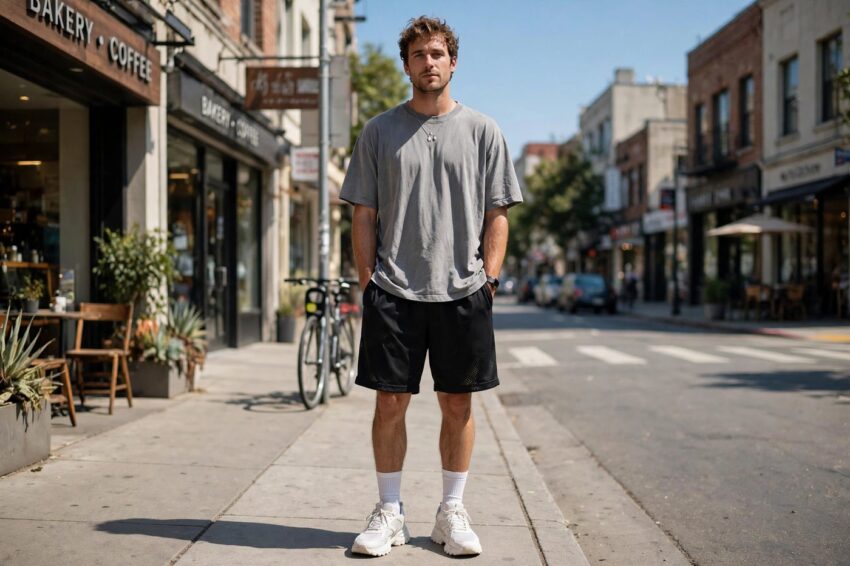
Shorts are the easiest piece in a summer wardrobe to get wrong and the hardest to rescue once the proportions are off. Trousers hide a multitude of decisions. Shorts expose all of them at once: the inseam, the leg opening, the fabric, the shoe and the sock are all visible in a single glance, and any one of them can drag the whole outfit down. Get them right, though, and shorts stop looking like something you settled for on a hot day and start looking like a deliberate part of the outfit, with the same weight and intention as a good pair of cargos or jeans. This guide is about shorts themselves. It works through the five types worth owning, the three inseam lengths that matter and where each one lands on the leg, the fabrics that hold a look together, the footwear and sock rules that finish the lower half, and the mistakes that quietly kill an otherwise solid outfit.
Start Here
New to building men’s outfits from the ground up? Begin with our complete guide to streetwear for men, then lock in the streetwear essentials every rotation needs. For warm-weather outfits in general, see our streetwear outfit ideas for men in summer, and for the Seoul take on hot-weather dressing, read our guide to Korean streetwear in summer.
Key Takeaways
- Inseam decides the look before anything else does: 5 inch reads sharp and athletic, 7 inch is the versatile middle, 9 inch lands at the knee and needs structure to work.
- Five types cover almost every outfit: cargo shorts, jorts, mesh or basketball shorts, sweat shorts and tailored chino-style shorts.
- Fabric carries the outfit: ripstop nylon and twill hold their shape, mesh ventilates, denim adds weight and sweat shorts only work kept deliberately casual.
- Socks are part of the outfit now. Visible crew socks are a styling choice, not an accident, and they need a shoe with enough presence to balance them.
- Volume has to balance: wide shorts want a top with some body, and a tiny fitted top over huge shorts breaks the silhouette.
- The fastest ways to kill the look are below-knee basketball shorts with a longline tee, dress shoes with casual shorts, and pockets stuffed until the shape collapses.
Contents
- The Five Types Worth Owning
- Inseam Lengths: 5, 7 and 9 Inch
- Fabrics That Make or Break Shorts
- Footwear and Sock Rules
- Balancing the Top Half
- Shorts in Real Heat
- Mistakes That Kill the Look
- Our View
- Frequently Asked Questions
- Sources
- Recommended
The Five Types Worth Owning
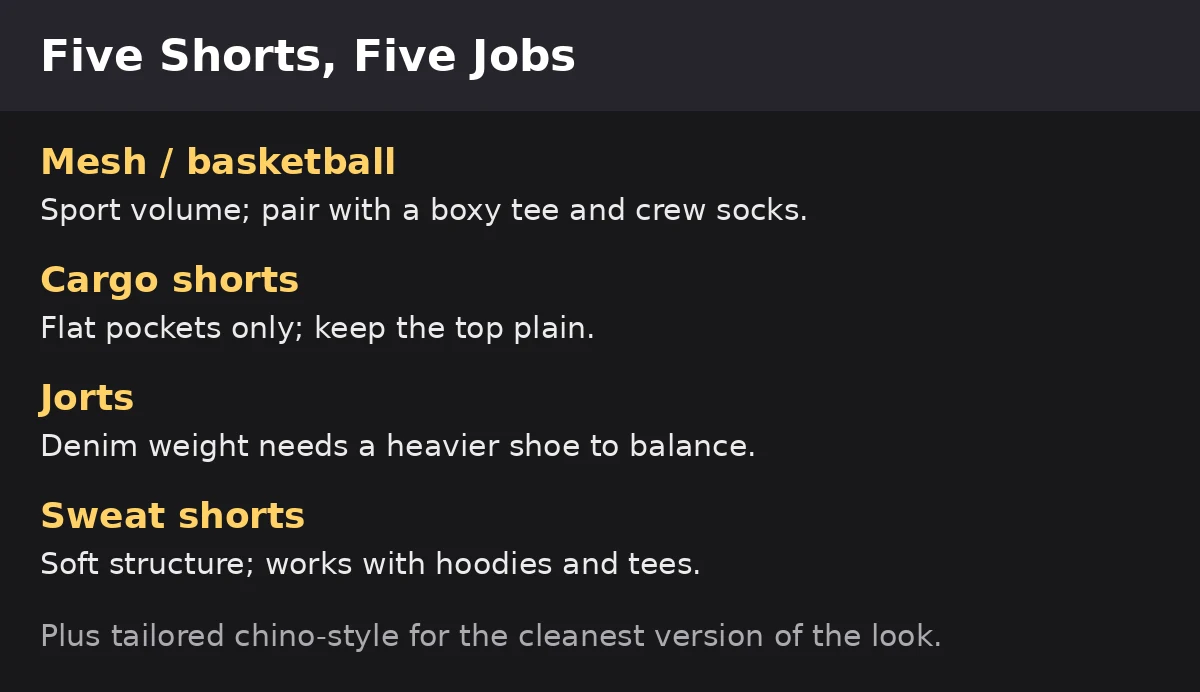
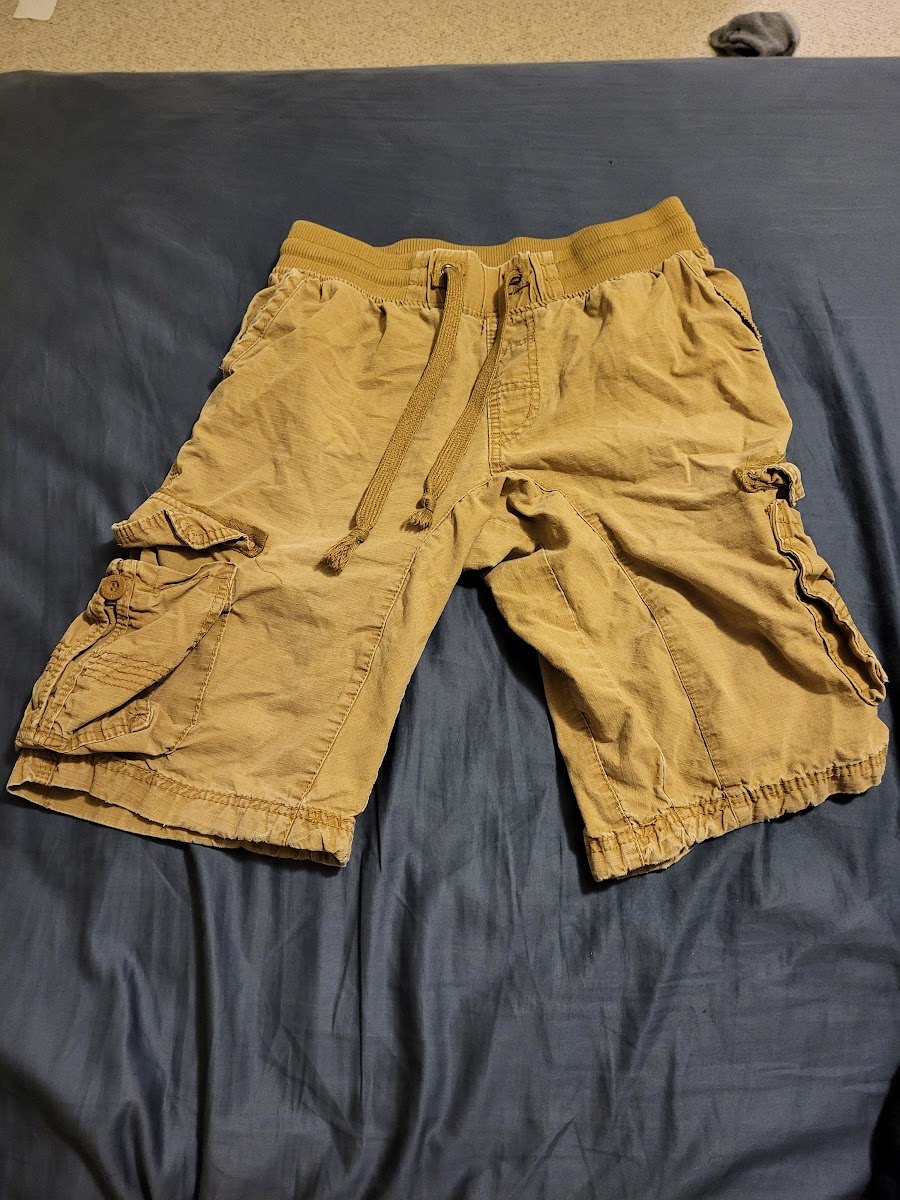
Almost every shorts outfit that works is built on one of five types, and knowing which type you are wearing tells you the rest of the outfit. Start with cargo shorts, the streetwear default. The modern version keeps the bellows thigh pockets that define the history of cargo shorts but trims the excess fabric that gave the old versions their sloppy reputation. Pockets should sit flat when empty, the leg should end above the knee, and the whole garment should read as utility trousers cut off at the right point rather than survival gear. Worn that way, cargo shorts do the same job in summer that cargo joggers do in cooler months: they give a plain tee or vest a structure to play against, and the pockets add visual weight low on the body that balances a graphic or an oversized top. The second type is the jort, denim shorts cut from the same cloth as your jeans. Jorts carry more visual weight than any other shorts type, which makes them the easiest to style up and the hardest to style casually. Treat them as jeans that end early: the same washes, the same rules about fading and distressing, and the same need for the rest of the outfit to stay simple.
The third type is the mesh or basketball short, the lightest and most casual option in the drawer. Mesh shorts began as sportswear and still carry that signal, so they work best when the rest of the outfit leans into it honestly: a jersey, a boxy tee, a tank in the heat. Their strength is airflow and their weakness is structure, because mesh has almost none. A mesh short that fits well through the waist and ends above the knee looks athletic. The same short two sizes up and two inches longer looks like it was borrowed. Fourth come sweat shorts, cut from the same fleece or French terry as sweatpants and joggers. Sweat shorts are comfort clothing and should be styled as comfort clothing, with hoodies, crewnecks and relaxed tees in the same soft register. The mistake is asking them to do a tailored job. A drawstring fleece short with a button-up shirt sends two messages at once and both of them lose. Fifth, and most versatile after the cargo, is the tailored chino-style short: flat front, clean hem, a proper waistband with belt loops, cut from cotton twill. It is the only type that can sit comfortably next to a camp-collar shirt, a knit polo or a lightweight blazer without the outfit arguing with itself.
Most men need two of the five, not all of them, and the honest way to choose is by the rest of your wardrobe. If your summer tops are mostly tees, hoodies and jerseys, cargo shorts and mesh shorts will carry nearly everything you wear. If you lean toward shirts and cleaner pieces, the tailored short and the jort earn their place instead. Roundups such as GQ’s guide to men’s shorts land on the same spread of types for a reason: the categories are stable because each one answers a different dressing problem. What changes season to season is proportion, not the list. One more consideration is colour. Black, washed grey, olive, stone and navy cover the full range for most rotations, and a single loud colour or print pair is enough for the days you want the shorts to be the outfit. Buy the quiet colours in the types you wear weekly and let one statement pair do the occasional work, rather than building a drawer of prints you reach for twice a summer.
| Type | Typical inseam | Fabric | Best footwear |
|---|---|---|---|
| Cargo shorts | 7–9 inch | Ripstop nylon or cotton twill | Chunky sneakers, trail runners |
| Mesh / basketball shorts | 5–7 inch | Polyester mesh | Basketball sneakers, retro runners |
| Jorts | 7–9 inch | Denim | Low-top sneakers, boots in cooler evenings |
| Sweat shorts | 5–7 inch | Fleece or French terry | Relaxed sneakers, slides at home or nearby |
| Tailored chino-style shorts | 7–9 inch | Cotton twill | Clean minimal sneakers, loafers for smarter settings |

Inseam Lengths: 5, 7 and 9 Inch
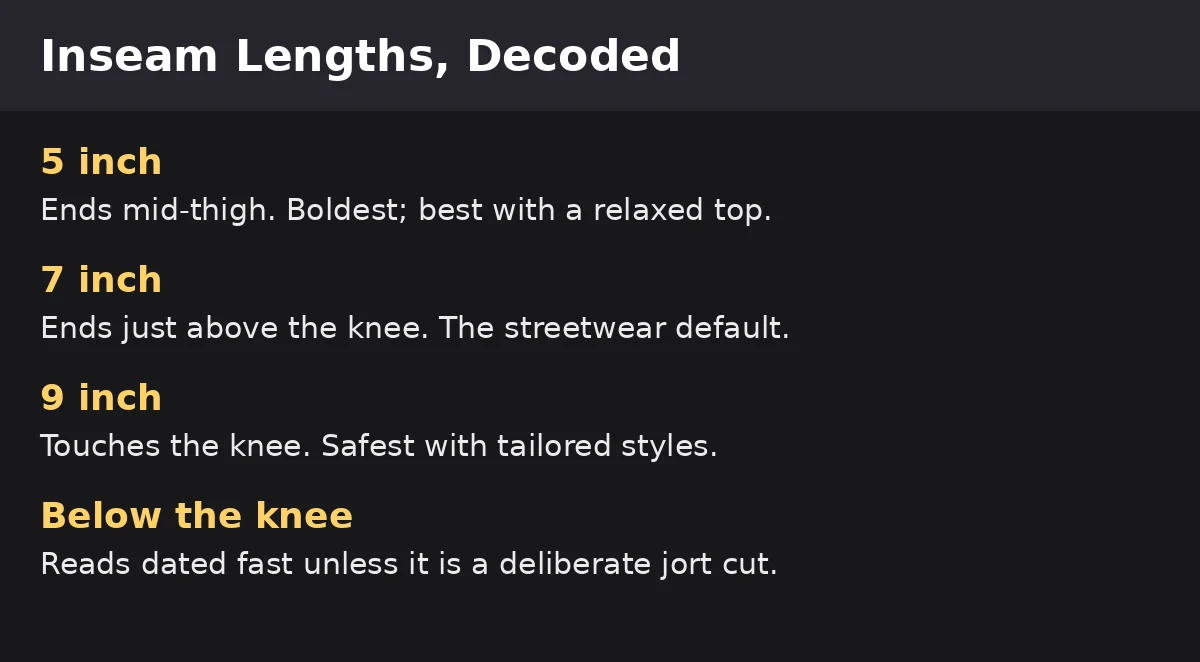
The inseam is the single number that decides whether a pair of shorts looks current, and it is measured along the inner leg from the crotch seam to the hem. Three lengths cover nearly everything worth wearing. The 5-inch inseam is the short short. It lands at mid-thigh, shows most of the leg and reads athletic, confident and deliberate. It suits mesh shorts, sweat shorts and swim-adjacent styles best, and it works because the shortness is obviously a choice. The risk is fit through the thigh: a 5-inch short cut too tight looks strained, while one cut with a little room looks like the running and training shorts it descends from. The 7-inch inseam is the versatile middle and the safest buy in this entire guide. It lands a few inches above the knee on most men, shows enough leg to read as summer clothing and keeps enough coverage to work in almost any casual setting. Cargo shorts, jorts and tailored shorts all sit naturally at 7 inches, and if you own one pair of shorts, this is the length it should be.
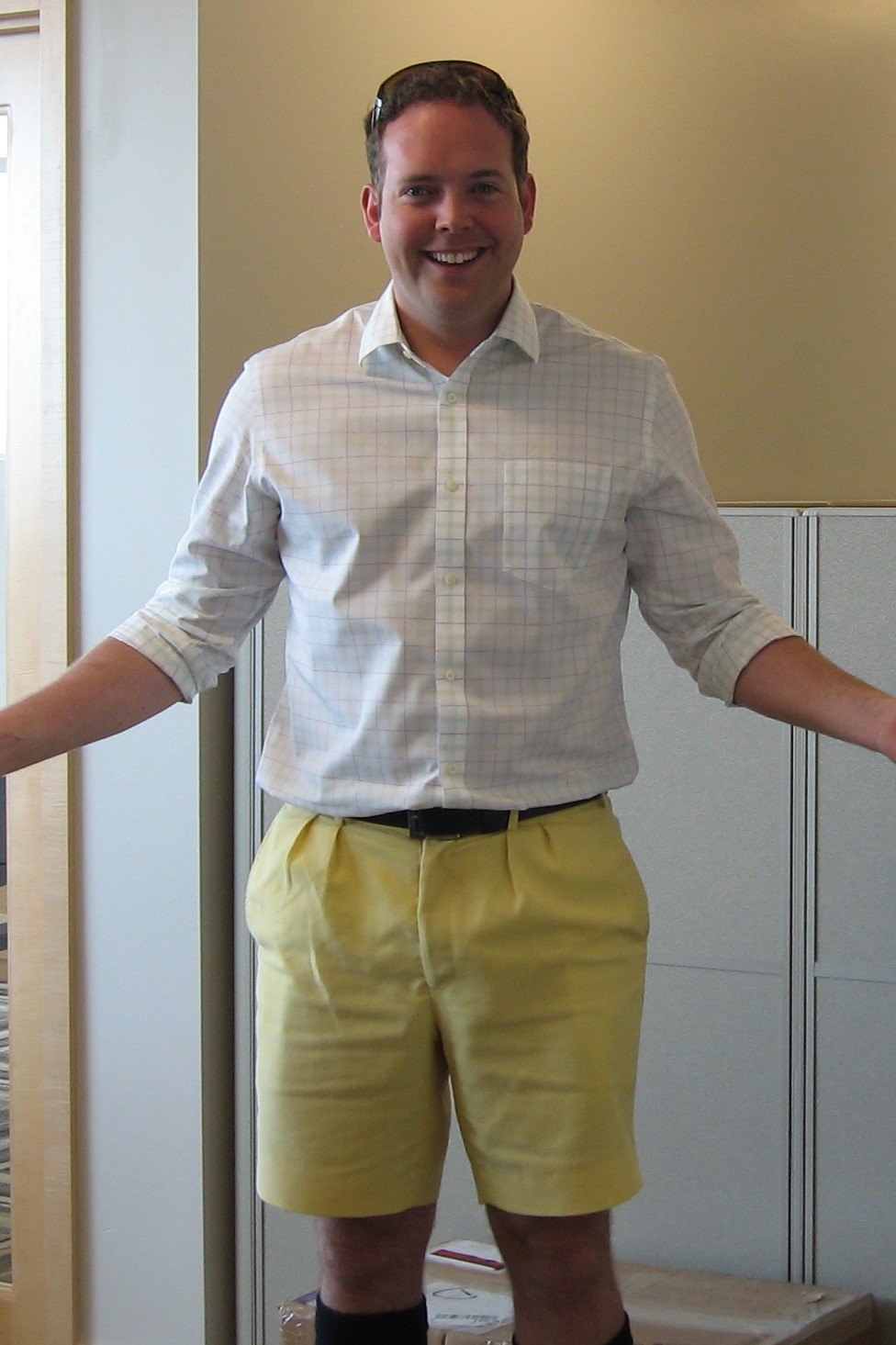
The 9-inch inseam lands at or just above the top of the kneecap, and it is the length that demands the most care. At 9 inches the margin for error disappears, because one more inch puts the hem over the knee and changes the garment entirely. A 9-inch short needs structure to survive: twill or denim rather than mesh, a leg opening that follows the thigh rather than flaring away from it, and a top half with enough presence to keep the outfit from looking bottom-heavy. Worn well, it is the closest shorts get to the tailored tradition behind the Bermuda shorts worn with blazers, the knee-length style that became formal summer dress in Bermuda and still anchors the smarter end of shorts dressing. Worn badly, with a wide leg and a soft fabric, it reads as trousers that were cut off in a hurry. Height matters here. Shorter men generally look better at 5 or 7 inches, because the exposed leg lengthens the silhouette, while taller men can carry 9 inches without the hem swallowing the knee. These are proportions, not rules handed down, and the mirror is a better judge than the size chart: the hem should end at a point where the leg still looks like a leg, not at the widest part of the knee itself.
Two related measurements decide as much as the inseam and get a fraction of the attention. The first is the leg opening. A wide opening on a short inseam creates a skirt effect that flares with every step, while a narrow opening on a long inseam binds when you sit. The opening should roughly follow the line of your thigh with a small amount of breathing room, wider for cargo and workwear cuts, closer for tailored ones. The second is the rise, the distance from the waistband to the crotch seam. Shorts sit naturally a little lower than tailored trousers for most men, but a rise that is too low drags the whole garment down and adds phantom length to the inseam, which is how a 7-inch short ends up covering a knee it was never meant to reach. When you try a pair on, sit down, walk and check the hem in motion rather than standing still in front of the mirror. Shorts are moving clothing. They ride up when you sit, settle when you stand and swing when you walk, and a pair that only looks right in one frozen pose will spend the whole day being adjusted. The general background on shorts as a garment category shows how recently shorts became ordinary adult clothing at all, which explains why the conventions are still looser than for trousers. That looseness is freedom, but it puts the judgement on you.
Fabrics That Make or Break Shorts
Fabric decides whether a pair of shorts holds its shape at six in the evening or gives up by noon. Ripstop nylon is the streetwear workhorse. The weave behind ripstop and its reinforced grid was developed to stop small tears spreading through lightweight cloth, and in shorts it delivers a rare combination: very light weight, real durability and a crisp, technical hand feel that keeps cargo and utility styles looking structured. Ripstop dries fast, shrugs off a long day and carries the slight sheen that marks technical clothing, which is why it pairs naturally with trail runners and modern sneakers. Cotton twill is the traditional alternative, the same family of cloth as chinos and work pants. Twill is softer against the skin, quieter in appearance and better suited to tailored shorts and classic cargos, but it absorbs sweat, holds it longer than nylon and creases through the day. Neither is better in the abstract. Ripstop belongs to the technical side of your wardrobe and twill to the classic side, and mixing the signals inside one outfit is where things start to look accidental.
Mesh is a structure as much as a fabric, and its virtue is simple: the holes do the cooling. A mesh basketball short moves more air than any woven cloth can, which makes it the honest choice for the hottest days and for anything athletic. The cost is that mesh shows everything underneath it, drapes rather than holds a line and cannot be dressed up by even one notch. Wear it as sportswear and it is perfect. Ask it to pass as casual tailoring and it fails in public. Denim sits at the opposite end. It is the heaviest common shorts fabric, the slowest to dry and the warmest against the skin, and jorts survive those drawbacks because denim brings something no other shorts fabric does: the fading, weight and familiarity of jeans. The story of jorts as cut-off denim begins with people shortening jeans they already owned, and the best modern versions keep that spirit, a real denim with some body, a hem that is either cleanly finished or honestly frayed, and a fit borrowed from the jeans you already like. Our guide to streetwear jeans covers the washes and fits that translate best when the legs get shorter.
Sweat shorts live in fleece and French terry, and the difference between the two matters more than the labels suggest. Fleece is brushed on the inside, warmer and softer, and it suits sweat shorts worn in the morning, in the evening and in the shoulder months. French terry has a looped, unbrushed back, feels cooler and lighter, and is the better choice for high summer. Both share the same weakness: they soften and sag with wear, so a sweat short that fits perfectly in the shop may sit lower and longer by the end of the month. Buy them neat rather than oversized and let the fabric relax into the fit you want. A final word on blends and stretch. A small amount of elastane in twill or denim, one or two percent, genuinely helps shorts move when you sit, cycle or climb stairs, and it is worth having in tailored and cargo styles. In mesh and ripstop it matters less, because those cuts already carry room where you need it. What no blend can fix is a fabric that is wrong for the job, and the quickest shop-floor test is still the oldest one. Hold the shorts up, look at how the cloth falls and ask whether it hangs like the garment you want or drapes like a different one. Shorts have so little cloth that the fabric is most of the garment. There is nowhere for a bad choice to hide.
Footwear and Sock Rules
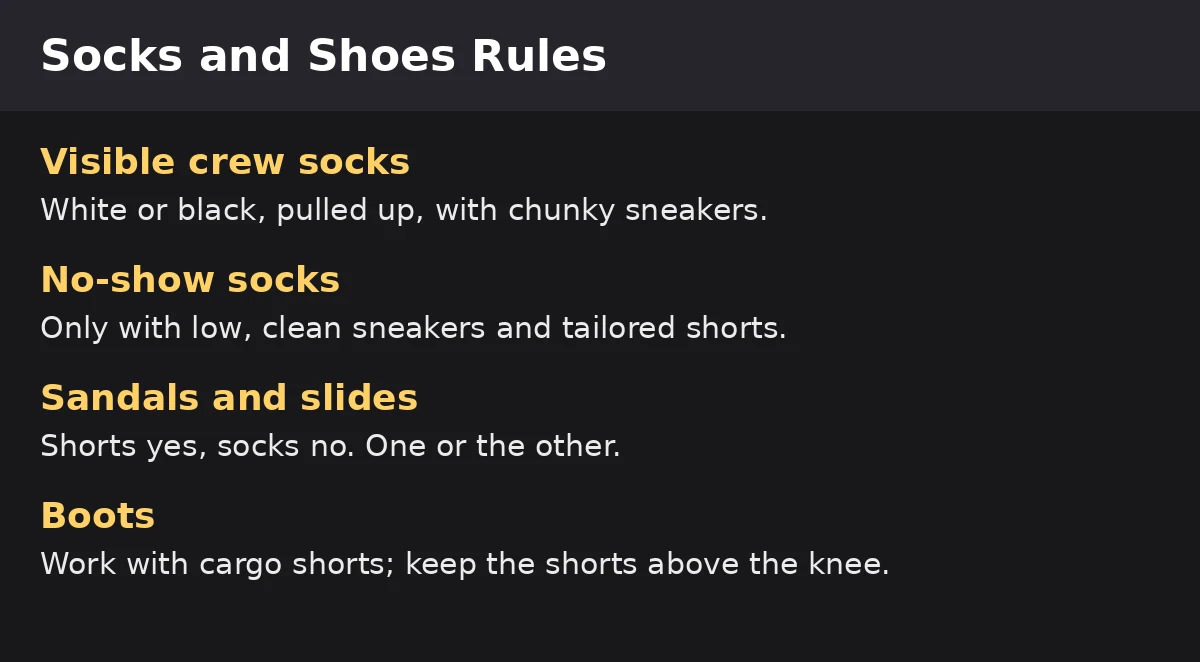
Shorts move the visual weight of an outfit down to the feet, so the shoe and the sock stop being finishing touches and become half the look. The governing principle is bulk. Shorts expose the whole leg and end the clothing line early, which means a substantial shoe grounds the outfit and a flimsy one leaves it floating. Chunky sneakers, retro runners and basketball shoes all carry the right amount of presence under cargo, mesh and sweat shorts, because their volume answers the volume of the leg opening above them. Slim low-top sneakers work too, but they belong with the slimmer, tailored end of the shorts drawer, where the whole silhouette is narrower. The mismatch to avoid is a wide, relaxed short over a thin, minimal shoe: the leg opening flares, the foot disappears and the outfit looks top-heavy at exactly the wrong end. Sandals and slides have a real place, narrower than their fans claim and wider than their critics admit. With tailored shorts or clean sweat shorts, a simple sandal reads as a deliberate summer decision. With baggy cargos or long mesh shorts, slides tip the outfit toward the locker room. Context decides, and the honest test is whether the rest of the outfit looks chosen. If it does, the sandal is part of a look. If it does not, the sandal is just what was by the door.
Socks are where shorts outfits are won and lost in public, because shorts make socks fully visible and therefore fully part of the styling. The current default, a white or black crew sock pulled up cleanly, works because it is intentional: it adds a band of contrast between the hem and the shoe, echoes the proportions of the shorts themselves and gives retro runners and basketball shoes the framing they were designed with. The rules are about condition and consistency. Crew socks should be clean, matched, pulled to an even height on both legs and free of the grey sag that old elastic brings. Ankle and trainer socks still have their place with tailored shorts and minimal sneakers, where the cleaner line suits the smarter garment, and no-show socks belong in loafers and low canvas shoes. What fails is the accidental middle: a sock that peeks a centimetre above the shoe, neither hidden nor shown, reading as an oversight rather than a choice. Pick a lane. Either the sock is a visible, deliberate band or it disappears entirely. The footwear traditions covered in our look at Korean streetwear shoes make the same point from the Seoul side of the culture: the sock is treated as a layer of the outfit, chosen with the shoe rather than grabbed on the way out.
Dress shoes are the bright line in this section, and it deserves to be drawn plainly. Oxfords, derbies worn formally and polished dress shoes of any kind do not belong with streetwear shorts. The two halves of the outfit belong to different dress codes, and no amount of confidence reconciles a cargo short with a cap-toe shoe. The narrow exception lives at the tailored end: a clean loafer with a chino-style short and a knit polo is a long-standing summer combination in smarter casual dressing, and it works precisely because every piece in it agrees about the occasion. That exception does not stretch to sneakers’ opposite number, the heavy boot, in high summer either. Boots with shorts have a genuine workwear and festival history and can look right in the shoulder months with jorts or cargos, but in real heat they trap warmth, swamp shorter inseams and pull the outfit toward costume. Save them for the evenings and the first cool weeks. The practical summary is a short ladder. The more casual the short, the more athletic the shoe can be. The more tailored the short, the cleaner and simpler the shoe should be. Move one step at a time along that ladder and the footwear will never fight the shorts, which is all this section is really asking.
Balancing the Top Half
Shorts change the proportions of everything above them, because an outfit is read as a balance of volumes and the lower volume just got much smaller. In trousers, the leg carries fabric all the way to the shoe, so a fitted tee and a pair of jeans divide the body into two roughly equal blocks. Replace the jeans with shorts and the lower block becomes mostly skin, which the eye reads as lightness, and the top block suddenly carries all the clothing weight in the outfit. This is why the standard streetwear pairing works so well: a boxy or oversized tee, a relaxed shirt or a hoodie in the evening has the body to answer for both halves. The volume up top is not decoration. It is ballast. The same logic explains why shorts sit so naturally inside streetwear as a style culture, a world built on generous top-half proportions, dropped shoulders and tees cut with room. Shorts were absorbed into that silhouette easily because the silhouette already had the answer to the balance problem built in.
The failure mode is the tiny top over huge shorts. A slim, fitted tee or a cropped vest paired with wide, knee-length cargos inverts the balance until the outfit looks like it was assembled from two different people’s wardrobes. The shorts billow, the top clings, and the eye cannot settle on which half is meant to lead. The reverse failure is subtler: a very long top over short shorts. A longline tee that ends below the hem of a 5-inch short hides the shorts entirely from the front, and the outfit reads as a dress over bare legs. If you wear longer tops with shorts, the hem of the top should end clearly above the hem of the shorts, with a visible band of shorts beneath it, so both garments register. Tucking is the simplest tool for restoring the line. A full or front tuck on a shirt or tee marks the waist, lengthens the leg on view and stops a relaxed top from swallowing a shorter inseam. It works especially well with tailored shorts and jorts, the two types with a proper waistband, and less well with drawstring sweat and mesh shorts, where the elastic waist is part of the casual signal and should be left alone.
Layering follows the same balance in miniature. An open camp-collar shirt over a vest or tee is the most useful summer layer with shorts, because it adds top-half presence without meaningful warmth and its hem, worn open, frames the shorts rather than covering them. A lightweight overshirt does the same job on cooler evenings. What to keep closed and long is nothing: a zipped jacket that ends at the hip is fine, but a coat-length layer over shorts breaks the silhouette in the same way the longline tee does. Accessories pull weight around too, and a crossbody bag or a cap from the streetwear accessories rotation can add the small amount of upper-body detail that a plain tee and shorts outfit sometimes needs. The check for all of it takes five seconds in a mirror. Look at the outfit as two halves. If one half is doing all the visual work while the other looks borrowed, adjust the volume of the quieter half, not the louder one. Balance is rarely about replacing a piece. It is about sizing the pieces you already chose so they agree with each other.
Shorts in Real Heat
Shorts are heat equipment before they are a style choice, and wearing them well in serious heat means understanding what the exposed leg can and cannot do for you. Bare legs help because they give sweat a large surface to evaporate from, and evaporation is the body’s main cooling mechanism once the air approaches skin temperature. The overview of how the body regulates temperature explains why moving air matters so much to that process: sweat that sits on skin in still, humid air cools far less than sweat carried away by a breeze. This is the practical case for shorter inseams and lighter fabrics on the worst days, and for loose leg openings that let air travel rather than sealed, tight ones that trap a warm layer against the thigh. It is also the case for choosing mesh and ripstop over denim when the forecast is extreme. Jorts are a fine garment, but on the hottest day of the year they are the wrong tool, and no styling argument changes the physics of heavy cotton against the leg.
The trade for all that airflow is sun exposure, and shorts expose more skin to manage than any other everyday garment. Thighs that spend the rest of the year under trousers burn faster than forearms that see daylight daily, and the backs of the knees and the tops of the feet are the classic forgotten spots. Follow the standard guidance on sunscreen and how it works: apply it to the legs, knees and feet before dressing, give it time to settle, and reapply after heavy sweating, because a long walk in shorts is exactly the kind of steady exposure that builds up without ever feeling like sunbathing. A cap shades the face, and shade itself remains the most underrated styling accessory in summer. Walking on the shaded side of the street costs nothing and lowers the temperature of everything you are wearing. None of this needs to interrupt the outfit. It is the background discipline that lets shorts stay comfortable for a full day rather than a good first hour followed by regret.
The safety floor is the same one that governs all hot-weather dressing, and it is worth stating in a shorts guide because shorts are what people wear on the days it matters most. The National Weather Service heat safety guidance sets out the basics clearly: drink water regularly instead of waiting for thirst, take breaks in shade or air conditioning, and learn to recognise the difference between ordinary overheating and the early signs of heat illness. Its companion advice on coping during extreme heat adds the practical steps for the worst days, including pacing activity and checking on the people around you. Translated into a day out in shorts, that means carrying water on long walks, planning the longest exposed stretch for the morning or evening where you can, and treating dizziness, nausea or confusion as a stop signal rather than something to push through. Shorts, light fabric and shade will keep you comfortable through most summer days. On the extreme ones, comfort is a plan, not a garment, and the best-dressed move available is still the oldest one: get out of the sun for a while.
Mistakes That Kill the Look
Most shorts outfits that fail do so for one of a handful of repeatable reasons, and nearly all of them are proportion errors rather than bad purchases. The first and most common is the below-knee basketball short worn with a longline tee. Each piece extends the other in the wrong direction: the shorts pass the knee and keep going, the tee passes the waist and keeps going, and together they erase the leg almost entirely, leaving a long torso floating over a few inches of shin. It reads as pyjamas at a distance and as indecision up close. Either piece can be worn well separately. The shorts, in a shorter cut, are fine athletic clothing, and the longline tee works over slim trousers where the leg line stays visible. Together they cancel out. The second mistake is the dress shoe error covered earlier, worth repeating in the mistakes list because it keeps happening: polished formal shoes under casual shorts, usually an attempt to dress the shorts up. Shorts cannot be dressed up by the shoe. They can only be dressed up by being a more tailored type of short, and forcing the footwear to do that job alone just splits the outfit into two occasions.
The third mistake is the tiny top over huge shorts, the inverted balance from the previous section, and it earns its place here because it is the error most often mistaken for a trend. Wide shorts are a legitimate current proportion. A fitted top is a legitimate choice. The combination is the problem, and the fix is almost never buying anything: swap in the boxy tee you already own, or choose the slimmer pair of shorts, and the outfit resolves. Fourth is pocket abuse. Cargo pockets invite carrying, and a phone, wallet, keys and earbuds case distributed across two bellows pockets will pull the shorts out of shape, swing as you walk and turn a clean utility line into luggage. Carry the minimum in the shorts and put the rest in a bag. The pockets are a design detail that can carry things, not an obligation to carry everything. Fifth is neglecting the hem and the crease. Shorts are small garments, so their condition shows: a fraying hem that was meant to be clean, a twisted leg, a deep crease from being folded in a drawer all register immediately on a piece of clothing with this little fabric to distract from them. A ten-second check and, for twill and denim, an occasional press of the hem keeps a pair looking chosen rather than found.
The last mistake is wearing the wrong type for the setting and hoping nobody notices. Sweat shorts at a smart-casual dinner, mesh shorts anywhere that expects actual clothing, tailored shorts with a gym vest: each is a small category error, and category errors are what people register as an outfit not working without being able to say why. The defence is the two-pair rotation from the start of this guide, one casual pair and one tailored pair, which between them cover nearly every setting a summer produces. Notice that none of the mistakes in this section are about taste, price or brands. They are about length, volume, condition and category, which means they are all fixable with the clothes already in your wardrobe. That is the encouraging truth about shorts. The distance between a pair that looks careless and a pair that looks deliberate is usually an inch of inseam, a different sock, a tucked hem or a quieter pocket. Small garment, small corrections, large difference.
Our View
Our view is that shorts fail or succeed on decisions most men never consciously make: an inseam chosen by habit, a sock grabbed in the dark, a shoe picked because it was by the door. Make those three decisions deliberately and shorts become one of the strongest pieces in a summer rotation rather than its weakest. Start with a 7-inch cargo or tailored short, pair it with a top that has some body and a shoe with some presence, and you have a formula that carries the whole season. The rest is refinement.
Shorts are a small garment with nowhere to hide. Get the length right, respect the fabric, finish it with the right shoe and sock, and the look takes care of itself.
— Brian Ka
Frequently Asked Questions
What inseam length is best for men’s streetwear shorts?
Seven inches is the most versatile length for most men: it lands above the knee, works across cargo, denim and tailored styles, and suits almost every setting. Five inches reads sharper and more athletic, while nine inches needs a structured fabric and a closer leg to avoid looking dated.
Can you wear socks with shorts without looking wrong?
Yes, provided the sock is a deliberate choice. A clean crew sock pulled to an even height is a standard part of the current look with sneakers, and no-show socks are right for tailored shorts and minimal shoes. What looks wrong is the accidental sock that barely peeks above the shoe.
Are cargo shorts still in style for men?
Yes, in their modern form: flat pockets, an above-knee hem and ripstop or twill fabric rather than the baggy, below-knee versions of the past. Styled with a boxy tee and chunky sneakers, cargo shorts remain one of the most reliable streetwear pieces in summer.
What shoes should you never wear with shorts?
Polished dress shoes such as Oxfords are the clearest no, because they belong to a different dress code entirely. Heavy boots in high summer and very thin, minimal shoes under wide shorts also break the outfit, one by overwhelming it and the other by disappearing under it.
How do you stop shorts looking too casual?
Choose a tailored chino-style short in twill, keep the hem clean and pressed, pair it with a shirt or knit top rather than a gym tee, and finish with clean minimal sneakers or loafers. Structure in the garment, not formality in the shoe, is what raises the level.
Questions About Building Your Wardrobe?
Not sure which inseam suits your build, or which of your current shorts can be styled up instead of replaced? Send us your questions and we will point you in the right direction.
Sources
- Wikipedia — Shorts
- Wikipedia — Bermuda Shorts
- Wikipedia — Jorts
- Wikipedia — Ripstop
- Wikipedia — Cargo Shorts
- Wikipedia — Streetwear
- Wikipedia — Sunscreen
- Wikipedia — Thermoregulation
- National Weather Service — Heat Safety
- National Weather Service — During a Heat Wave
- GQ — The Best Shorts for Men