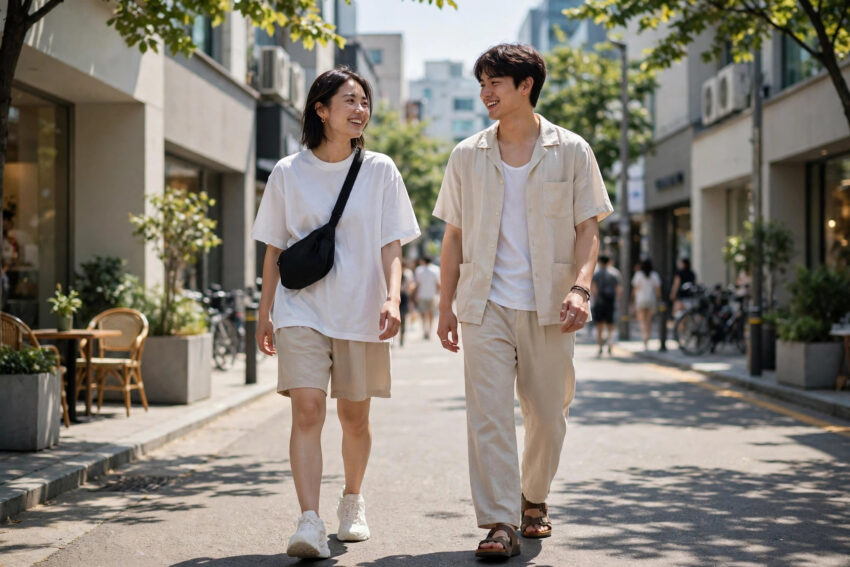
Summer is the season that strips Korean street style down to its working parts. The long coats, the layered hoodies and the careful stacks of spring and fall all come off, and what is left has to survive a Seoul July: average highs around 29 to 30 degrees, humidity above 70 percent, and a monsoon that can turn a clear morning into a downpour by lunch. Seoul dressers do not solve this by dressing down. They solve it the same way they solve every season, with proportion and fabric discipline, applied to far less clothing. The oversized tee gets wider and lighter, the trousers stay wide but switch to linen and rayon, the shorts grow longer and looser, and one thin open layer does the job that a jacket does in October. This guide breaks the hot-weather system down into formulas you can run in any city where summer is a physical problem, not just a date on the calendar.
Start Here
Key Takeaways
- Seoul summer is a fabric problem before it is a style problem: July averages highs near 29°C with humidity around 76 percent and the year’s heaviest rain, so every piece must move air or dry fast.
- Linen is the lead fabric because it is strong, absorbent and dries faster than cotton; cotton, rayon and open mesh fill the supporting roles.
- The summer silhouette keeps the Korean proportions, wide on top or wide through the leg, but cuts the cloth down to one or two layers.
- The three working formulas are the oversized tee with wide shorts, the open camp shirt over a tank or tee, and the sleeveless or light top with wide-leg linen trousers.
- Footwear stays light but present: chunky sneakers, sport sandals and breathable runners, never a heavy boot or a thick leather shoe.
- Sun is a layer too: a cap, a light overshirt for shade, and shade-seeking routes through the city are part of the outfit system.
Contents
- The Heat Problem: What a Seoul Summer Actually Demands
- Fabrics That Breathe: Linen, Cotton, Rayon and Mesh
- The Oversized Tee and Wide Shorts Formula
- The Camp Shirt Formula: One Open Layer
- Wide-Leg Trousers in Summer
- Sun Layers, Shade and Summer Shoes
- Building a Small Hot-Weather Wardrobe
- Our View
- Frequently Asked Questions
- Sources
- Recommended
The Heat Problem: What a Seoul Summer Actually Demands
Summer dressing in Seoul starts from the weather data, not the mirror. The long-term climate record for the capital, set out in the KMA climate normals for the Seoul station and summarised in the climate record for Seoul, describes a season with three separate pressures. Heat comes first: June averages a high of about 27.6°C, July about 29°C and August about 30°C, with August the hottest month at a daily mean of 26.1°C. Humidity comes second: relative humidity climbs to about 76 percent in July and stays above 70 percent through August, which is why a cotton tee that feels fine at nine in the morning is soaked and heavy by noon. Rain comes third: July alone averages about 414mm of precipitation, the bulk of the monsoon season Koreans call jangma, and August adds roughly another 348mm. An outfit for this season has to breathe in still air, stay decent when it gets wet, and dry on the body or on a hanger overnight.
| Month | Average high | Average humidity | Average rain | What it demands |
|---|---|---|---|---|
| June | 27.6°C | About 66% | About 130mm | Light layers, first shorts weather |
| July | 29.0°C | About 76% | About 414mm | Monsoon rules: fast-drying, rain-ready |
| August | 30.0°C | About 74% | About 348mm | Peak heat: minimum cloth, maximum airflow |
The cultural machinery around the season matters as much as the numbers. Korean fashion runs on a fast, trend-led retail cycle, and the global attention that cycle receives was mapped by the V&A Hallyu exhibition, which traced how music, screen culture and fashion reinforced one another out of Seoul. The same story reached American museum audiences through Hallyu at MFA Boston, where everyday Korean dressing was shown as a designed system rather than a set of accidents. Summer is where that system is most visible, because there is so little clothing left to hide behind. What remains, the width of a tee, the length of a short, the openness of a weave, is all decision. If you are coming to this from the colder half of the year, our Korean streetwear in winter guide covers the opposite extreme, and the transitional formulas sit between the two; this page is only about the heat end of the scale.
There is a fourth pressure the data hides: the temperature cliff between outside and inside. Seoul summers are lived between a street at 31 degrees and a subway car, cafe or office held near 22, and the swing is enough to make a bare-arms outfit feel underdressed for half of every day. This is why the summer system always includes one carryable layer, an open shirt, a light overshirt, a thin knit over the shoulders, even when the forecast promises unbroken heat. The layer is not for the street. It is for the hour you spend sitting still in cold air with wet skin, which is when summer outfits actually fail. Plan for the cliff and the season’s other three pressures become manageable; ignore it and you will spend July either overheating outdoors or shivering through every indoor hour, in an outfit that was technically correct for the weather and wrong for the day.
Fabrics That Breathe: Linen, Cotton, Rayon and Mesh
Fabric choice is the whole game in summer, and linen wins it. The flax fibre behind linen is unusually well suited to hot, humid weather: as the reference entry on linen and its properties puts it, linen is very strong and absorbent and dries faster than cotton, which is why linen clothing has been the hot-weather standard for centuries. In a Seoul July that translates into a shirt that takes on sweat without collapsing against the skin, holds its shape through a wet afternoon, and is dry again by morning. Linen also wrinkles, honestly and immediately, and Korean summer dressing accepts the wrinkle as part of the look rather than fighting it. A creased linen camp shirt reads as summer; a creased polyester shirt just reads as hot. Buy linen in relaxed cuts, because the fabric has almost no stretch and a tight linen garment is worse than a loose cotton one.
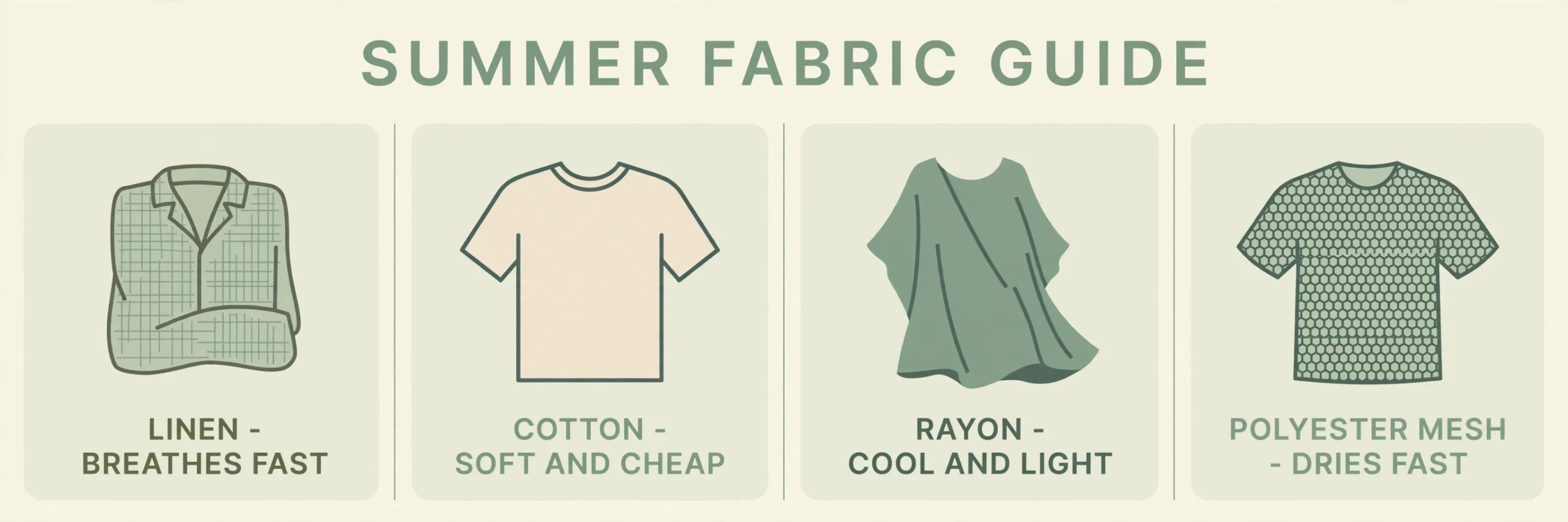
Cotton keeps its place as the second fabric, with conditions. A heavy cotton tee is a winter garment wearing a summer costume; in humidity it absorbs moisture, holds it, and stays heavy for hours. The cotton that works in a Seoul summer is thin, loosely woven or cut so oversized that air moves between cloth and skin, which is why the Korean oversized tee is a functional object and not just a silhouette preference. Rayon, sold across Korean retail under names like cool rayon or inyeon blends, is the third fabric: it feels cool on contact, drapes softly, and dries quickly, which makes it the default for wide summer trousers and loose shirts on platforms like the Musinsa newsroom describes as Korea’s central fashion marketplace. Open mesh and perforated knits are the fourth, used for tees, overshirts and shoe uppers where drying speed matters more than softness. The rule across all four is the same: if the fabric cannot move air or release water, it does not belong in the outfit, whatever it looks like on the rail. Our guide to streetwear essentials covers the year-round base pieces these summer fabrics replace.
Care is part of the fabric decision, because summer clothes are washed constantly and cheap versions of good fabrics die young. Linen improves with washing and can be treated roughly; buy it once, in a cut with room, and it will outlast several summers. Rayon is the fragile one: it weakens when wet, shrinks in hot water, and should be washed cold and dried flat or on a hanger, never wrung. Mesh and technical knits want the opposite treatment, cold and quick, and they repay it by drying overnight even in a humid room. Cotton sits in the middle and forgives almost everything except being left damp in a pile, which in monsoon humidity means mildew within days. A summer wardrobe in Seoul is therefore also a laundry rhythm: wear, wash, hang in moving air, rotate. The formulas below assume that rhythm, because a perfect outfit that is still wet from yesterday is not an outfit at all.
The Oversized Tee and Wide Shorts Formula
The first formula is the one you will see ten thousand times on a Seoul street in July. An oversized t-shirt, wide through the body with a dropped shoulder, worn over shorts that end at or just above the knee and are cut wide through the leg. The proportions are the Korean signature carried into summer: volume on top, volume below, and nothing tight anywhere, so air circulates through the whole outfit as you walk. The tee does the expressive work. Korean labels have built this piece into a design object in its own right, and coverage of Ader Error’s design collective shows how an ordinary garment gets reworked with displaced seams, asymmetric hems and graphics until a plain tee carries a whole outfit. Choose the graphic or the plain version according to the day, but keep the cut: a fitted tee with wide shorts breaks the formula, because the top half stops moving air and the silhouette collapses into gym clothes.
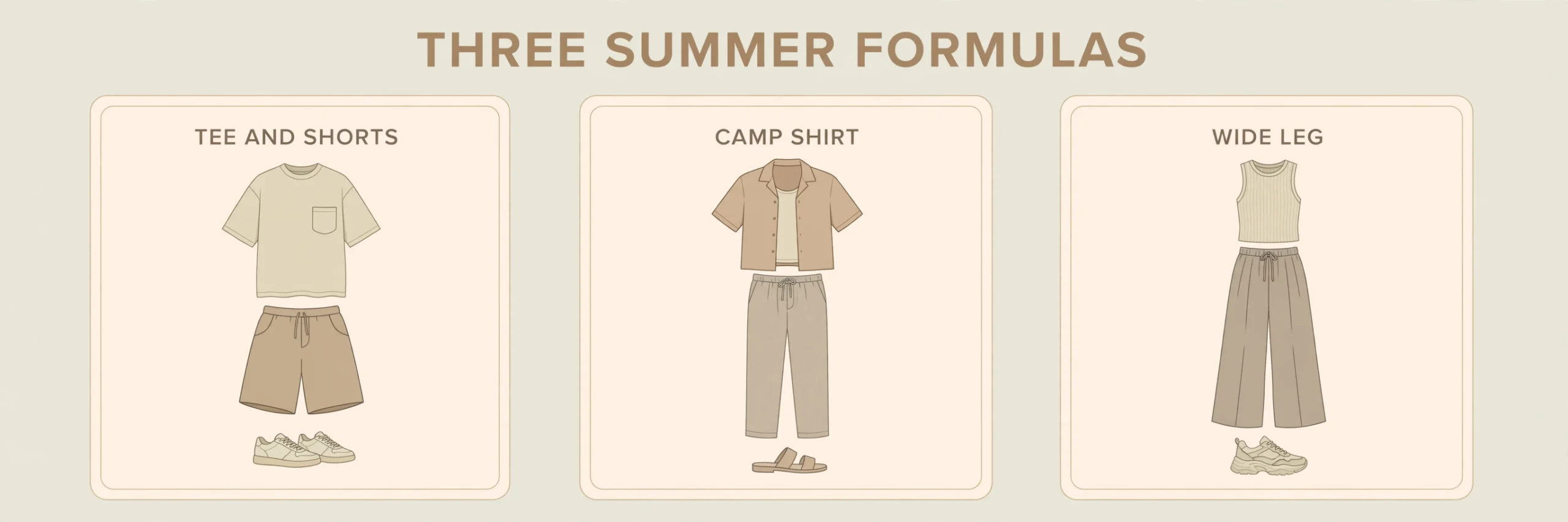
The shorts matter more than visitors expect. Seoul summer shorts are longer and wider than the athletic short that dominates American summer dressing, usually in cotton twill, linen or a dry synthetic, with a drawstring or elastic waist worn at the natural waist rather than low on the hips. The extra length is what keeps the outfit in streetwear territory: it gives the leg a column of fabric to balance the wide tee, and it makes the outfit workable in the air-conditioned interiors, cafes, trains and offices, where summer outfits actually spend most of their day. Colour follows the wider Korean palette that our complete Korean streetwear guide breaks down in full: white, cream, light grey, washed black and one soft colour at a time. The women-specific version of this formula, with its own proportions and pieces, is covered in Korean street style for women, and the men’s wardrobe frame sits in Korean streetwear for men. Finish the formula with chunky sneakers or sport sandals, never a slim runner, because the shoe has to hold its own against two wide pieces; the footwear logic gets its own full treatment in our guide to Korean streetwear shoes.
One adjustment separates the Seoul version of this formula from the same pieces worn anywhere else: the tee is almost always longer than visitors expect, worn untucked and falling past the waistband of the shorts, so the outfit reads as two stacked volumes rather than a top and a bottom. Tucking is reserved for the wide-trouser formula, where the waist needs definition. Colour blocking follows the same stacking logic: a light tee over darker shorts, or the reverse, with the break placed at the hip where the two volumes meet. Prints, when they appear, sit on the tee’s chest or back and nowhere else, because the shorts and shoes are doing structural work and should not be asked to do decorative work too. Run the formula this way and it survives the full range of a summer day, market, metro, cafe, evening street, without a single change of clothes.
The Camp Shirt Formula: One Open Layer
The second formula adds the one layer summer allows: a short-sleeve shirt worn open. The camp collar shirt, in linen, rayon or a light cotton blend, sits over a tank top or a plain tee and does three jobs at once. It shades the shoulders and arms through the strongest sun of the day. It gives the outfit a finished, deliberate line that a bare tee cannot match, which is why this is the formula Seoul reaches for when the day includes a restaurant, a gallery or anyone whose opinion matters. And it creates airflow: an open shirt over a base layer works like a loose sail, moving as you walk and pulling air across the body in a way a single layer never does. The city’s fashion calendar underlines the point. The Seoul Fashion Week anniversary coverage from the Seoul Metropolitan Government describes an industry built around two seasonal showcases, and the street style around those shows has normalised the open overshirt as the summer equivalent of the spring trench.
Wear it with the proportions the formula needs. The shirt should be boxy and a little long, ending around the hip, with the base layer tucked or cropped so a clean line shows at the waist. Below it, either the wide shorts from the first formula or the wide-leg trousers from the next section work; a slim trouser under a boxy open shirt reads unfinished. The pattern rules are simple. One print per outfit, worn on the shirt, with everything else plain; or a plain shirt over a graphic tee, letting the base layer carry the image. The wider story of how Seoul brands turned these everyday pieces into a global language is told in roundups like the Highsnobiety Seoul brands guide, and our own Korean brands and Musinsa buying guide covers where to buy them. For a second open-layer option with sleeves, the light overshirt versions in hoodie outfit ideas in Korean style show the same layering logic in a different garment family.
The camp shirt is also the monsoon formula’s insurance policy. When a July afternoon turns, the open shirt comes off the shoulders and over the head for the dash between stations, goes back on damp without staining or losing its shape if it is rayon or a linen blend, and dries on the body within the hour. A tee alone gives you nothing to work with in the rain; the shirt gives you a tool. This is a recurring pattern in the Seoul system: the piece that looks like a styling choice is usually also the practical one, and the camp shirt is the clearest summer example. Buy it in a fabric that tolerates water, size it to be worn open rather than buttoned, and it will be the most-used garment in the summer wardrobe.
Wide-Leg Trousers in Summer
The third formula keeps the trousers and changes everything about them. Not everyone wants to wear shorts, and Seoul’s answer is not a slimmer trouser but a wider one in a summer fabric. The wide-leg summer trouser, in linen, rayon or a light cotton blend, hangs from the waist and moves air with every step, and in direct sun it is often cooler than shorts because the skin is shaded while the cloth stays off it. This is the formula that carries Korean street style into offices, evening plans and anywhere shorts feel underdressed, and it is the closest summer relative of the wide trousers that anchor the streetwear jeans and trouser guides. The hem should break just above the shoe or pool slightly over a chunky sneaker; a wide trouser hemmed short reads as a mistake, and one that drags will be destroyed by the first monsoon puddle of the week.
On top, the formula takes a sleeveless top, a fitted short tee or a tucked oversized tee, with the waist defined so the wide leg has a starting point. The K-pop pipeline that carries these proportions around the world is well documented, and the Dazed account of K-pop fashion traces how idol styling turned wide trousers and cropped or tucked tops into a default silhouette far beyond Korea. A longer view helps too: the Seoul fashion history in the Korea JoongAng Daily shows a city that has been adapting global garments to its own climate and proportions for generations, and the summer wide-leg trouser is the current chapter of that habit. Evening is where this formula earns its keep: when the temperature drops after sunset and the shorts crowd starts to feel the air conditioning, the wide-leg outfit is still complete. Our streetwear inspo page collects the wider outfit references this formula draws on.
Fit is where this formula is most often ruined, so it is worth being exact. The waist should sit at the natural waist, not dropped, because the whole line of the outfit is measured from that point. The leg should be genuinely wide, straight from the hip with no taper, because a tapered wide trouser reads as a carrot shape and breaks the column the formula depends on. And the fabric must be light enough to move when you walk: if the trouser stands still while you move, it is a winter cloth cut wide, not a summer trouser. Test it in the shop by walking the length of the floor. The right pair swings. That swing is not decoration; it is the ventilation system, pumping air up the leg with every stride, and it is the reason this formula can beat shorts at their own game on the hottest days of the year.
Sun Layers, Shade and Summer Shoes
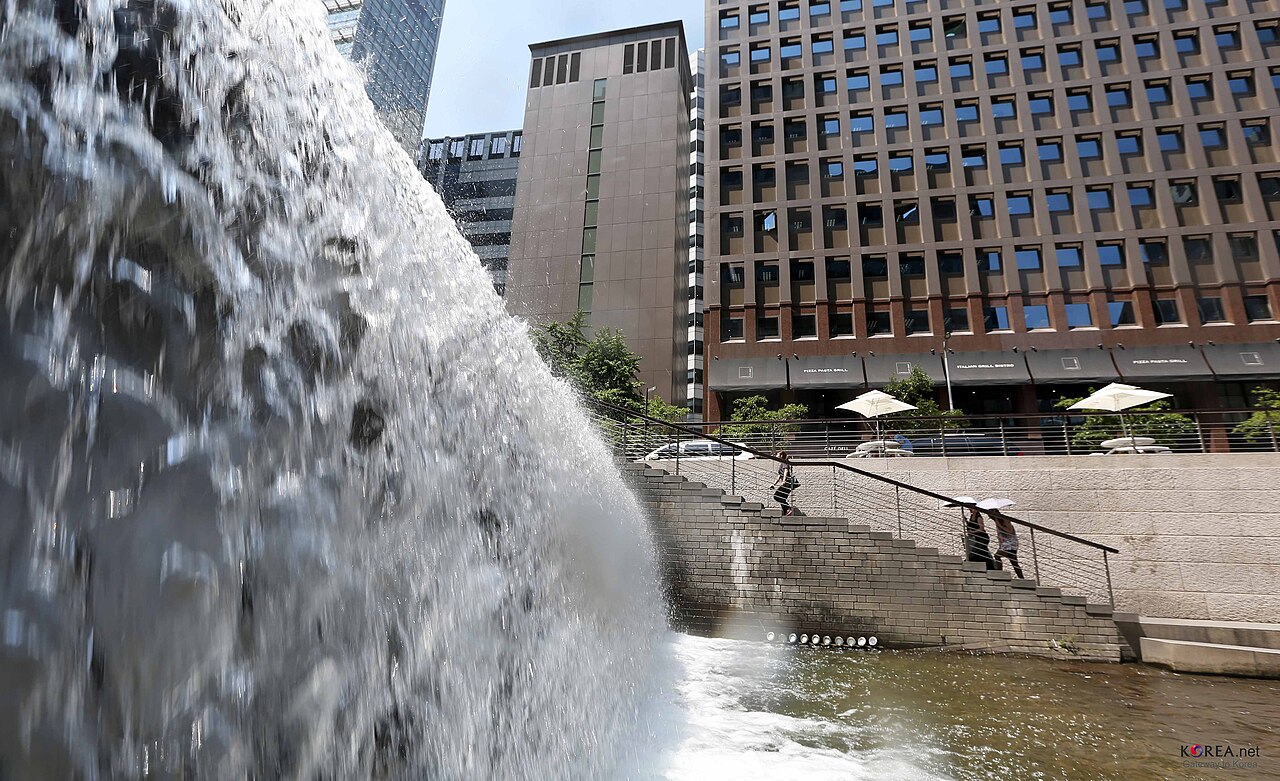
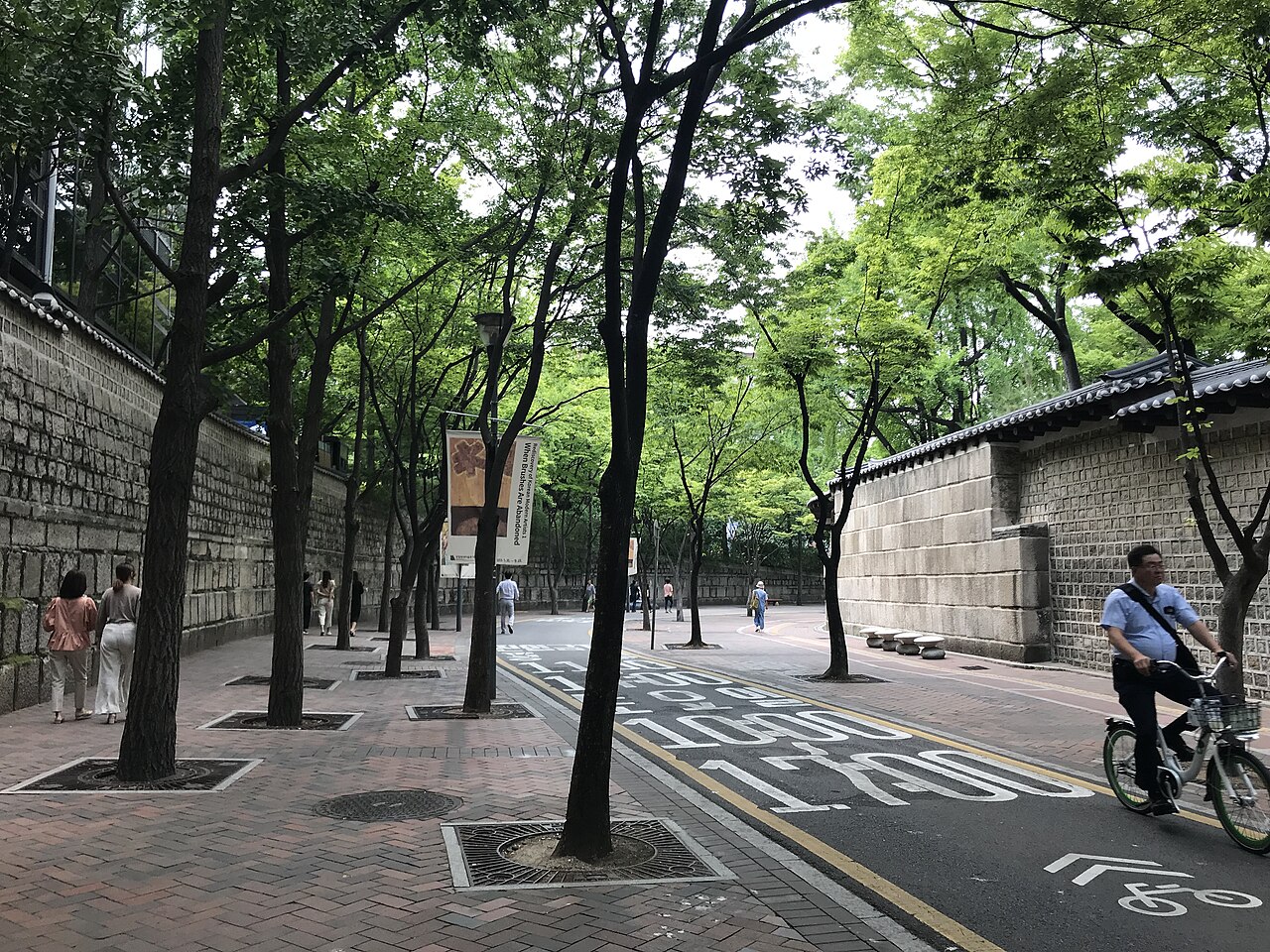
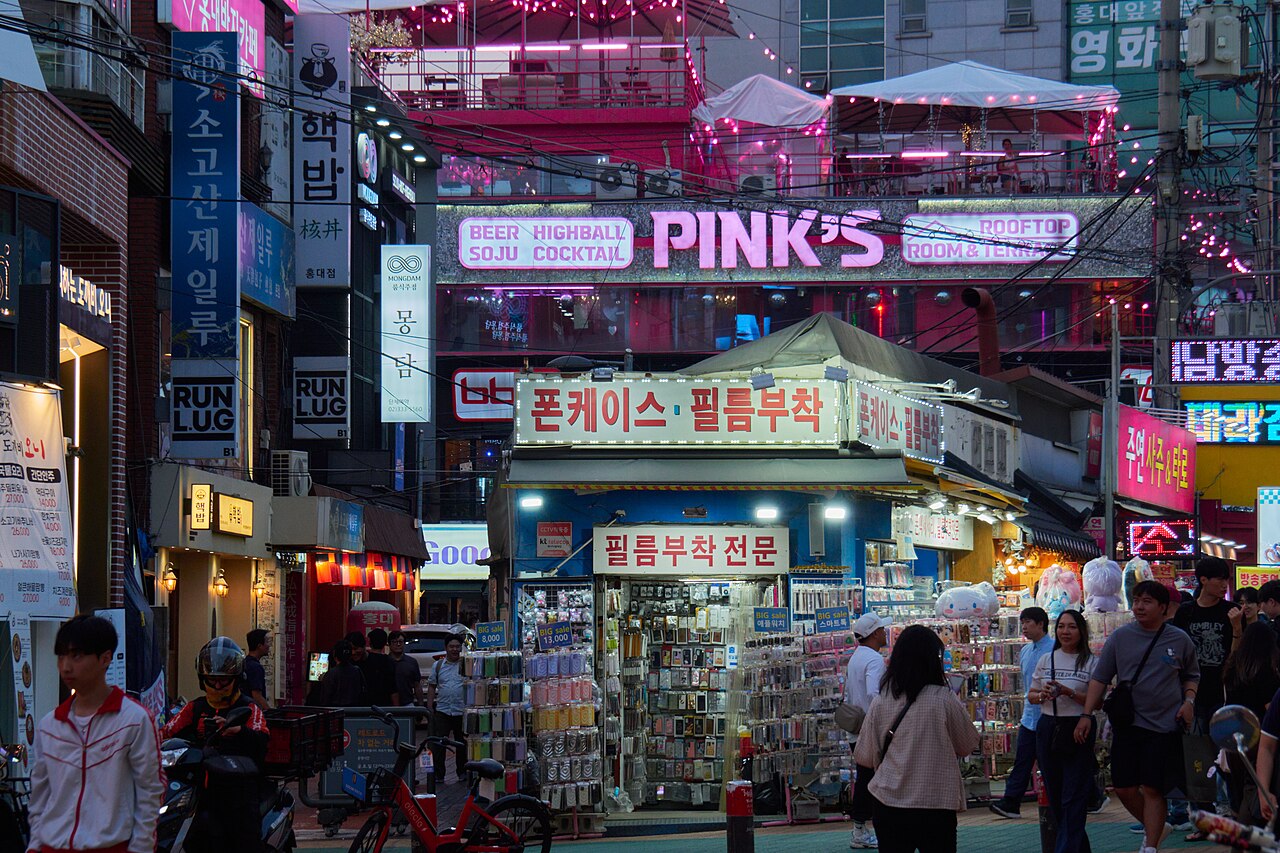
The finishing system in a Seoul summer is about the sun as much as the heat. A cap is standard equipment, worn with every formula, because it shades the face and completes the top of the silhouette the way a beanie does in winter; our streetwear hats guide covers the shapes that work. Sunglasses, a small crossbody bag worn close, and a light overshirt carried for shade or for cold indoor air complete the kit. The venues matter as well: the Seoul Metropolitan Government’s plan to connect Seoul Fashion Week landmarks as runways, from Dongdaemun Design Plaza to Lotte World Tower, reflects a city where summer fashion life moves between shaded plazas, malls and metro stations, and outfits are planned for that movement. Shade is infrastructure in this system, not luck: routes are chosen along tree-lined streets and covered arcades, and the outfit only has to survive the gaps between them.
Shoes follow the same minimum-cloth logic with one exception: they still need presence. Chunky sneakers in mesh uppers are the default, because the wide silhouettes above them need a shoe with visual weight and the mesh keeps feet workable in humidity. Sport sandals with a real sole are the second option, worn with the shorts formula and with wide trousers hemmed to clear them. Breathable knit runners are the third, for the longest walking days. What does not appear: heavy leather boots, thick-soled dress shoes, and any shoe that traps a full day of monsoon water against the foot. Socks stay short and visible only where the formula wants them, and a spare pair in the bag is a genuine Seoul habit during jangma, because a wet sock ruins an outfit faster than a wet shirt. The general summer frame for men, beyond the Korean formulas, sits in streetwear outfit ideas for men in summer, and the accessory layer is covered in streetwear accessories.
Building a Small Hot-Weather Wardrobe
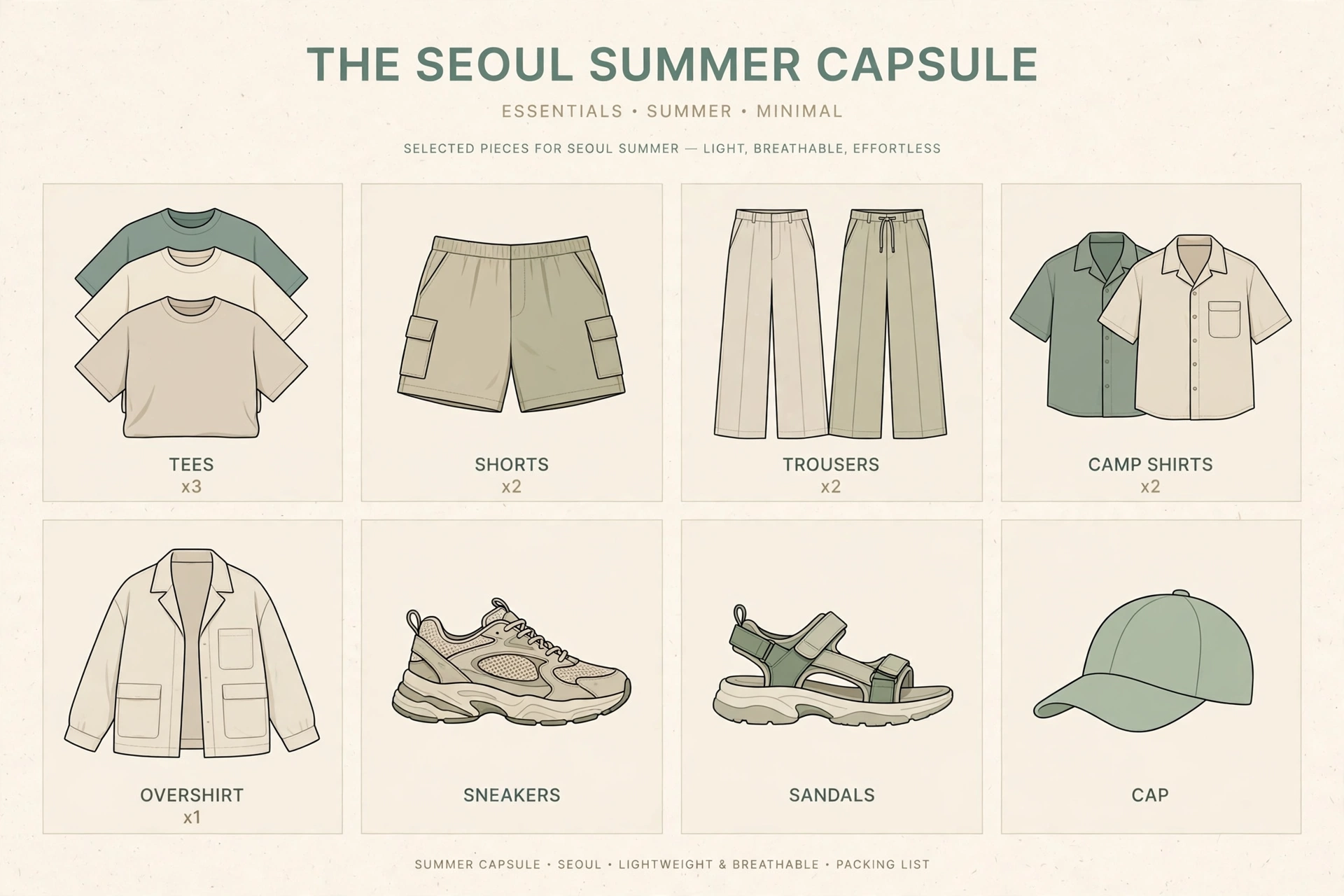
A working Seoul summer wardrobe is smaller than most people expect. Three oversized tees in rotation, one graphic and two plain. Two pairs of wide shorts, one cotton twill and one linen or dry synthetic for rainy weeks. Two pairs of wide-leg trousers, one linen and one rayon, in neutral colours that take every top you own. Two camp shirts, one plain and one printed, which convert the tee formulas into finished outfits. One light overshirt for shade and cold interiors. Two pairs of shoes, a mesh chunky sneaker and a sport sandal, plus the cap. That is the whole system, and every piece in it combines with every other piece, which is the real Korean discipline: not owning the look, but owning a small set of clothes in which the look cannot fail. Buy the fabrics first and the graphics second, replace the tee that has gone heavy and grey, and let the wardrobe stay small enough that every item earns its place before the monsoon arrives. The district guide to Hongdae vs Gangnam style shows where in Seoul this wardrobe gets worn, at both the budget and the polished end of the city.
Budget follows the same discipline as the clothing. The expensive mistakes in a summer wardrobe are almost never the statement pieces; they are the fifth tee, the third pair of shorts, the sandals bought for one trip. Seoul’s own market structure rewards the small-wardrobe approach, because the fast domestic retail cycle means a replacement tee or a better camp shirt is available within days at every price point, so there is no reason to stockpile. Buy the rotation, wear it hard for a season, note which two pieces you reached for every week, and let next summer’s small budget replace exactly those, better. A hot-weather wardrobe built this way costs less each year while working better, which is the quiet economic logic underneath the whole Korean approach to getting dressed.
Our View
Our view is that summer is the honest season for Korean street style, because it removes the layers the style is famous for and shows what is underneath: proportion, fabric judgement and restraint. Anyone can look considered in a long coat. Looking considered in a tee, wide shorts and sneakers, in 30-degree humidity, takes the same system run with less material, and that is why the summer formulas are worth learning properly rather than treating hot weather as a dressing-down season. Get the fabrics right, keep the width, and let one open layer do the finishing work.
In summer the outfit has nowhere to hide. Buy the fabric, keep the width, and the heat stops being the enemy of the look.
— Brian Ka
Frequently Asked Questions
What do people actually wear in Seoul in summer?
Oversized tees with wide shorts, open camp shirts over tanks or tees, and wide-leg linen or rayon trousers with chunky sneakers or sport sandals. The palette stays soft and light, and a cap is near-universal in strong sun.
Is linen really better than cotton in humid heat?
For most summer pieces, yes. Linen is strong and absorbent and dries faster than cotton, so it stays wearable through a humid day and is dry again by morning. Thin, loose cotton still works well for oversized tees; heavy cotton is the fabric to avoid.
How do the outfits survive the monsoon?
By choosing fast-drying fabrics, keeping hems clear of the ground, and wearing mesh sneakers or sandals that can get wet without being ruined. July in Seoul averages about 414mm of rain, so rain is planned for, not treated as an exception.
Can I wear wide-leg trousers instead of shorts all summer?
Yes, and many people in Seoul do. In linen or rayon, a wide trouser shades the leg and moves air as you walk, and it keeps the outfit workable for offices and evenings where shorts feel underdressed.
What shoes work with Korean summer outfits?
Chunky sneakers with mesh uppers, sport sandals with a real sole, and breathable knit runners. The shoe needs enough visual weight to balance wide shorts or trousers, and an upper that can handle humidity and rain.
Questions About Building Your Wardrobe?
Tell us which formula you are trying, what is not working, and where you live — proportion advice is always specific to the outfit and the day it has to survive.
Sources
- V&A — Hallyu! The Korean Wave exhibition
- MFA Boston — Hallyu! The Korean Wave
- Korea Travel Note — Seoul weather by month (KMA climate normals)
- Wikipedia — Climate of Seoul (KMA 1991–2020 normals)
- Wikipedia — Linen: properties and hot-weather use
- Musinsa — Newsroom
- Seoul Metropolitan Government — Seoul Fashion Week marks 25 years
- Seoul Metropolitan Government — Seoul Fashion Week landmarks
- Highsnobiety — Seoul fashion brands
- Hypebae — Ader Error, Korean design collective
- Dazed — How K-pop changed fashion
- Korea JoongAng Daily — Seoul fashion history