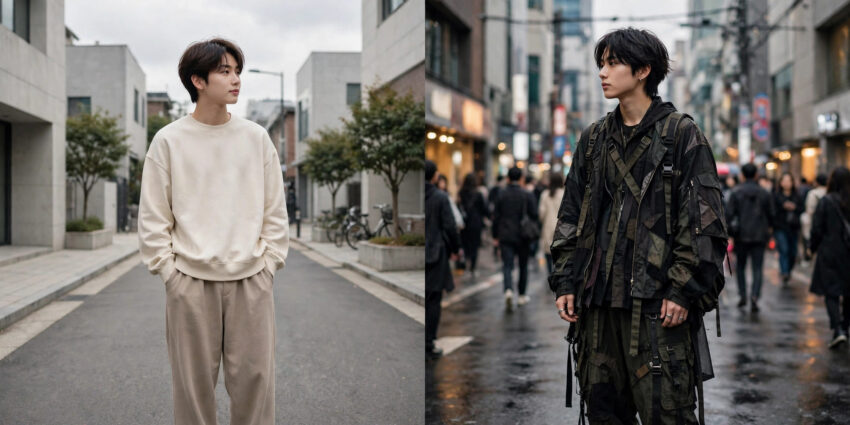
Korean and Japanese streetwear get lumped together constantly, usually under one vague label, and the lumping hides the most interesting thing about them: they are built on opposite instincts. Seoul’s scene optimises for a shared, wearable silhouette, soft volume, muted colour, outfits that a whole city can adopt at once and a retail machine fast enough to dress it. Tokyo’s scene optimises for depth and difference, layered construction, archival knowledge, subcultures that split and split again, and shops that reward the patient hunter. Both grew out of the same ingredients, American workwear, sportswear, hip-hop and skate culture, and both now influence the whole world. But the clothes feel different on the body, the shops feel different to buy from, and the rules a wearer follows are different in kind. This comparison works through the two scenes side by side: silhouette, palette, brands, retail and shopping culture, and what each one is actually for.
Start Here
Key Takeaways
- Silhouette is the fastest tell: Korean streetwear uses one soft volume in muted colour; Japanese streetwear layers contrasting volumes and textures on one body.
- Korea’s palette is low-saturation and shared across the city; Tokyo’s runs from monochrome designer black to subculture colour, street by street.
- Retail differs in kind: Seoul is platform-led and fast, built around Musinsa and Dongdaemun speed; Tokyo is shop-led and deep, built on Ura-Harajuku independents and a vast vintage and archive trade.
- The cultural engines differ: K-pop and K-drama carry Korean looks globally as complete outfits; Japanese scenes spread through subculture, magazines and designer lineage.
- Neither is better. Korea is easier to wear well quickly; Japan rewards knowledge and patience. Most good wardrobes end up borrowing from both.
Contents
- Two Systems at a Glance
- Silhouette: Soft Volume vs Constructed Layers
- Palette and Graphics: Muted vs Bold
- Brands and Retail: Platform Speed vs Archive Depth
- Shopping Culture: How Each City Buys
- What Each Scene Borrows From the Other
- Which One Fits You: Choosing and Mixing
- Our View
- Frequently Asked Questions
- Sources
- Recommended
Two Systems at a Glance
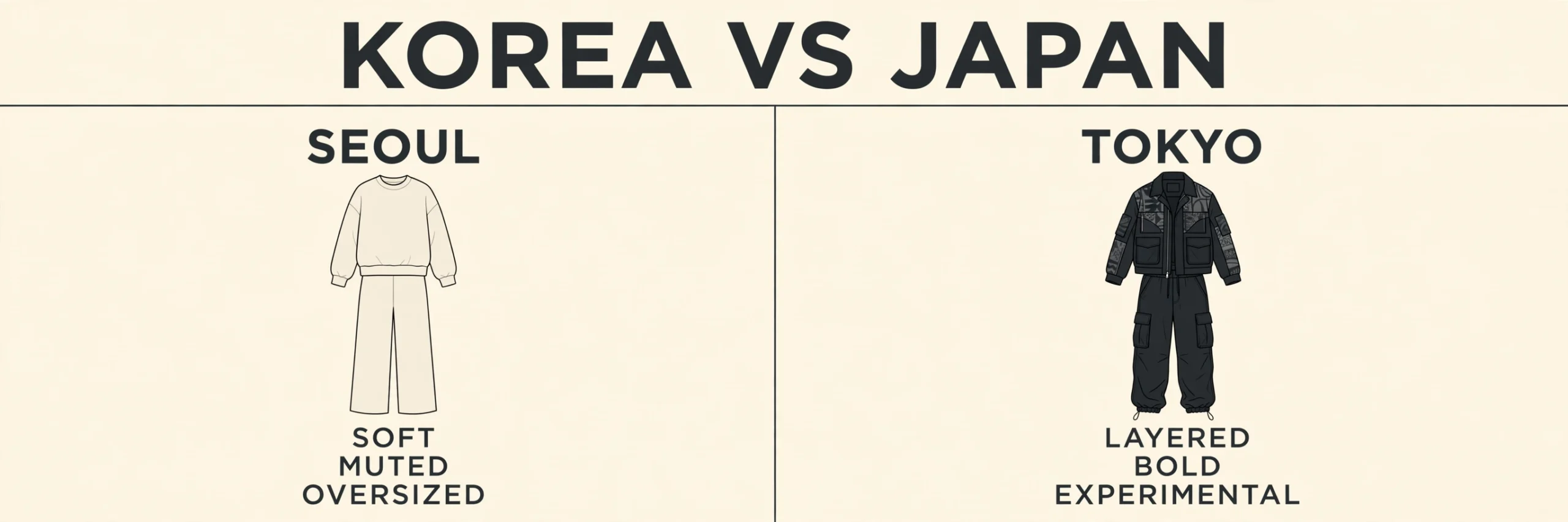
Start with the table, because the differences are systematic, not anecdotal. Each scene makes a consistent choice at every level of the outfit and the industry behind it, and the choices line up: what Seoul simplifies, Tokyo complicates; what Seoul standardises, Tokyo specialises. The Korean system is described in full in our complete Korean streetwear guide; the Japanese system’s roots in youth districts like Harajuku are set out in the history of Harajuku as a centre of youth culture and fashion. Read the rows as tendencies, not laws, because both cities contain multitudes, but as tendencies they hold up remarkably well on any street in either capital.
One more row belongs in the table even though it resists a cell: how each scene treats the wearer who gets it wrong. In Seoul, the shared formula is forgiving, because dressing like everyone else, slightly better, is the game, and a newcomer can join it with a single platform order. In Tokyo, the scenes are plural and specific, and wearing the signals of a scene you do not belong to reads instantly to the people inside it. That difference, low social risk against high social information, explains a great deal about how the two cities’ styles travel. The Korean look exports as a kit anyone can assemble. The Japanese look exports as individual pieces and ideas, carried by people who studied them, because the whole outfit rarely survives the trip out of its context. Keep that in mind as the sections below go level by level: at every level, Seoul is optimising for adoption, and Tokyo is optimising for meaning.
| Dimension | Korean streetwear (Seoul) | Japanese streetwear (Tokyo) |
|---|---|---|
| Silhouette | One soft volume: oversized top or wide leg, balanced and clean | Layered construction: contrasting volumes, lengths and textures stacked |
| Palette | Low saturation: cream, grey, washed black, soft pastels | Polarised: designer monochrome at one end, subculture colour at the other |
| Graphics and logos | Restrained: small marks, occasional statement graphic | Central: graphic identity and collaboration artwork as the point of the piece |
| Retail engine | Platforms and fast domestic production: Musinsa, Dongdaemun | Independent shops and deep stock: Ura-Harajuku, vintage and archive stores |
| Cultural engine | K-pop and K-drama: complete outfits broadcast worldwide | Subcultures and print: scenes, magazines and designer lineage |
| Buying behaviour | Fast, trend-synchronised, price-aware, mobile-first | Slow, knowledge-led, condition- and provenance-aware |
| Barrier to entry | Low: the formula is learnable in a week | Higher: rewards study, hunting and scene knowledge |
Silhouette: Soft Volume vs Constructed Layers
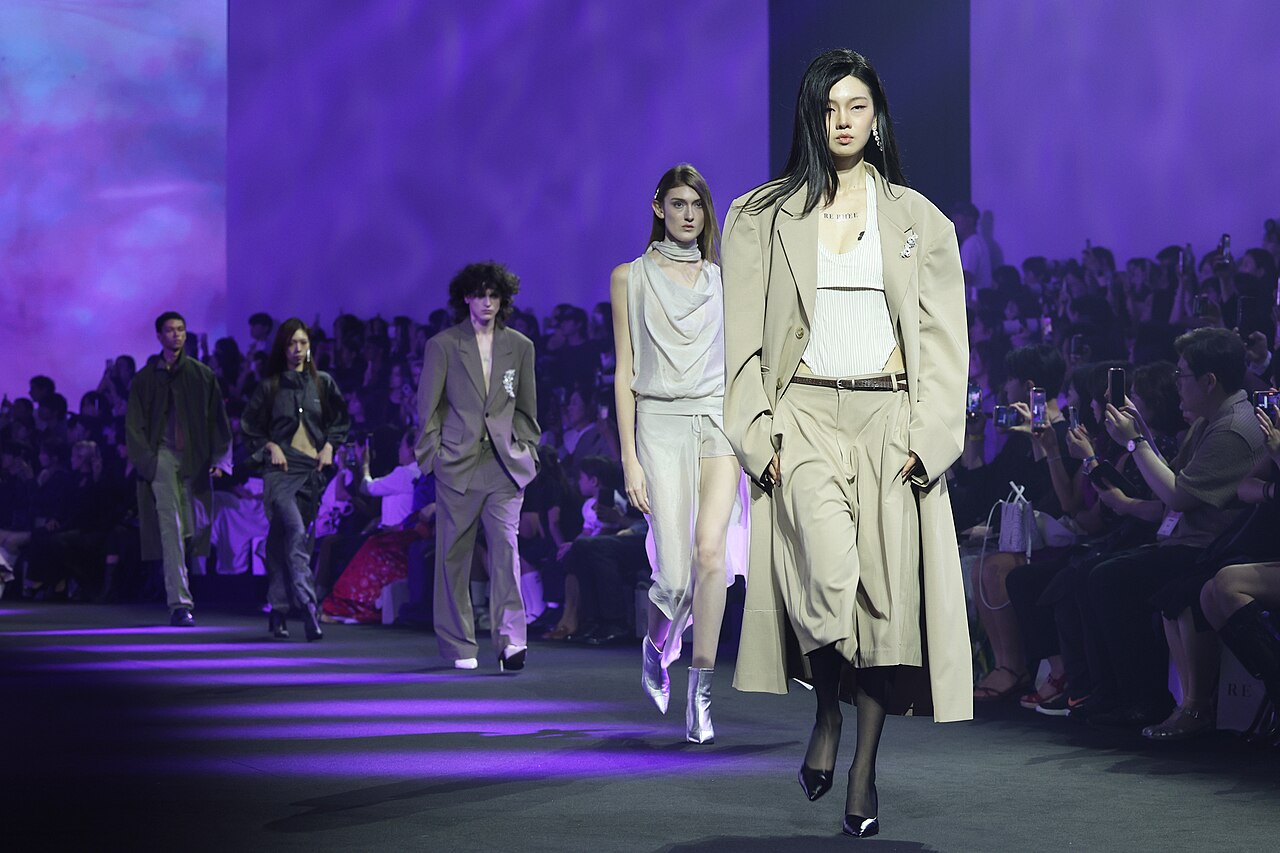
Put a Seoul outfit and a Tokyo outfit in the same room and the outline gives them away first. The Korean outline is a single gesture: one volume, placed high or low, with everything else quiet around it. An oversized sweatshirt over straight trousers. A fitted top over a wide leg. The volume is soft, the edges are clean, and the outfit reads as one shape from across the street. This is the proportion system the V&A Hallyu exhibition presented as a defining feature of the Korean wave, and it is why Korean outfits are so easy to adopt: the rule fits in one sentence, and it flatters almost every body. The Tokyo outline is a construction. Lengths are staggered, a long shirt under a cropped jacket over wide trousers; textures are set against each other, nylon against knit against denim; asymmetry is used deliberately. The reference survey of Japanese street fashion describes styles considered extreme and imaginative even by catwalk standards, and the layering is where that imagination is built. Neither outline is a refinement of the other. They are different answers to the same question, how much complexity an outfit should carry, and the answers are: as little as possible, and as much as the wearer can control.
The practical consequence is about failure modes. A Korean outfit fails quietly, by being slightly off-proportion, and it is fixed by adjusting one piece. A Japanese-style outfit fails loudly, by collapsing into clutter, and it is fixed by knowledge: knowing which layer to remove is a skill the scene teaches over years. This is also why the two cities shop differently, a thread the retail section below picks up. For the timeline of how both scenes grew out of the shared streetwear rootstock, our streetwear evolution history walks the decades in order, and the shared foundation itself is defined in our streetwear definition.
Footwear shows the same split in miniature. The Seoul shoe system, chunky sneakers grounding wide legs, loafers for polish, boots for winter, is a short list of defaults that the whole city shares, and it works because the silhouettes above the shoes are shared too. Tokyo footwear is scene equipment: the boot, the archive sneaker, the designer shoe and the subculture platform each belong to particular looks and carry particular histories, and choosing among them is a statement about which Tokyo you are dressing for. Neither approach is more considered. They are considered about different things: Seoul about the whole outfit’s balance, Tokyo about each piece’s meaning. A traveller standing in a shoe shop in either city can feel the difference in the stock on the shelves before a single word is exchanged.
Palette and Graphics: Muted vs Bold
Colour is the second tell, and it follows the same logic as silhouette. Seoul dresses in a shared, low-saturation palette, cream, off-white, light grey, washed black, sage, dusty blue, soft pink, mixed freely because nothing in it clashes. The palette is social: it lets a whole city’s outfits harmonise in a crowd photo, and it makes individual pieces interchangeable across a wardrobe. Tokyo’s colour splits by scene. The designer end runs on black and monochrome, the tradition associated with the Japanese designers who reshaped Paris fashion in the 1980s with monochrome palettes and unconventional design, as the Japanese street fashion survey records. The street end runs the other way, into the saturated colour and print of the Harajuku subcultures, where an outfit can be a single colour worn head to toe as a statement. Graphics follow the split: our streetwear graphics guide and streetwear logos guide cover the shared language, but in Seoul the graphic is usually one element in a quiet outfit, while in Tokyo it is often the outfit’s reason to exist.
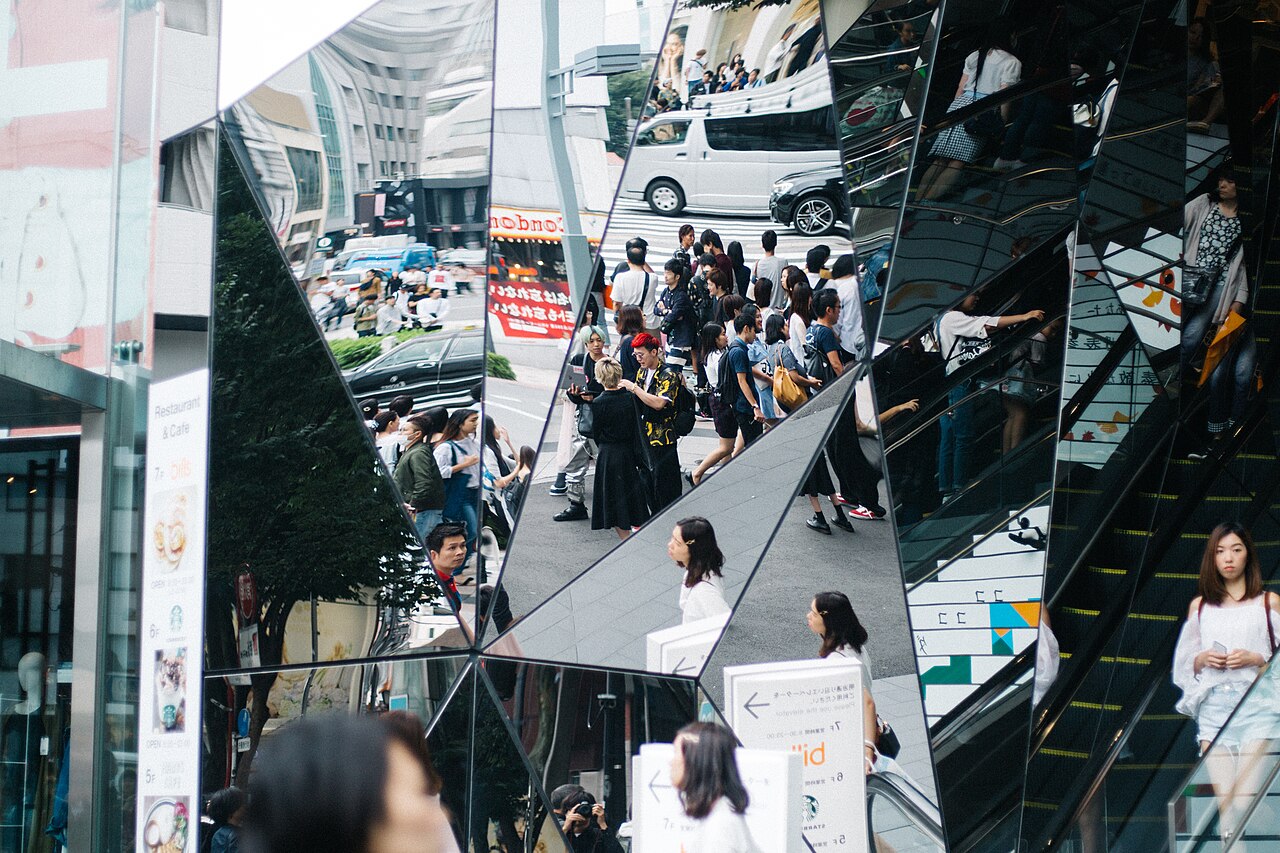
The brand that proves the Tokyo rule is the one founded in its backstreets. A Bathing Ape’s history records a label started by Nigo in Ura-Harajuku in 1993, built on camouflage, character graphics and collaboration artwork, selling identity as much as clothing. Korean labels certainly use graphics, and the K-pop pipeline documented in the Dazed account of K-pop fashion can make a single printed piece famous overnight, but the graphic sits inside the Korean proportion system rather than replacing it. In practice: a Seoul wearer asks whether the colour works with the rest of the wardrobe; a Tokyo wearer asks whether the piece says something. Both are good questions. They are just not the same question.
Denim and workwear, the shared raw material of all streetwear, get handled differently too. In Seoul, denim is washed into the palette: light, even, soft finishes that sit quietly inside the muted system, cut wide and worn as a neutral. In Tokyo, denim is a connoisseur’s field in its own right, with raw fabric, vintage fades and reproduction workwear treated as collectible craft, and a pair of jeans can be the most considered item in the outfit. The same garment, two relationships: ingredient versus subject. Watch how a city’s shoppers handle denim in a vintage store and you can predict most of the rest of its streetwear culture, because the attitude to the base material, use it or study it, is the attitude the whole scene is built from.
Brands and Retail: Platform Speed vs Archive Depth
The deepest difference between the two scenes is not aesthetic at all. It is industrial. Seoul built a fashion system optimised for speed: the Dongdaemun garment district can turn a design into a rail garment in days, and the platform layer described in the Musinsa newsroom puts thousands of domestic labels in front of the whole country at once, ranked, reviewed and discounted in public. A trend that appears on a Seoul street on Monday is buyable by Friday and ordinary by the end of the month, which is exactly how a whole city stays synchronised. Our Korean brands and Musinsa buying guide works through that system tier by tier. Tokyo built the opposite machine. The backstreets described in the Ura-Harajuku entry, a network of small, mostly pedestrianised lanes of independent shops off Omotesando, became the nursery of labels that released slowly, in small runs, to people who knew. Around that nursery grew the world’s deepest vintage and archive trade, where a twenty-year-old jacket is not old stock but a document, priced on provenance and condition.
The brand shapes match the machines. Korean labels, surveyed in the Highsnobiety Seoul brands guide, tend to design complete wearable outfits at accessible prices, with the silhouette as the signature. Japanese labels tend to design worlds: a fabric, a graphic language, a collaboration history, with the individual piece as an entry point into the world. Designer-led Korean labels exist, and the treatment of Ader Error’s design collective shows a Seoul label playing the world-building game as well as anyone. But the centre of gravity differs, and a shopper feels it immediately: in Seoul you buy the outfit; in Tokyo you buy into the label, the season or the archive. The museum framing agrees, with Hallyu at MFA Boston presenting Korean fashion as a popular system, worn by everyone, rather than a collector’s field.
Price culture completes the industrial picture. Seoul’s system competes in public: the same silhouette appears at five price points within a week, reviews accumulate in the open, and the shopper’s skill is choosing the right point on a visible ladder. Tokyo’s system competes on scarcity and knowledge: the price of an archive piece is set by what the buyer knows about it, and two apparently identical jackets can sit at wildly different prices because one carries a season, a collaboration or a condition grade the other lacks. Neither market is more honest. They reward different virtues, judgement of value in one, judgement of significance in the other, and they train their shoppers accordingly, which is why a Seoul wardrobe and a Tokyo wardrobe age so differently: one is refreshed, the other accrues.
Shopping Culture: How Each City Buys
Follow the shoppers and the contrast sharpens. The Seoul shopper buys on the phone, at speed, inside a trend cycle measured in weeks: a look appears on a drama or an idol, the platform surfaces twenty versions by the weekend, reviews and fit photos accumulate within days, and the price settles fast. Shopping districts support the same rhythm in person, and our Hongdae vs Gangnam guide compares the budget, fast end of the city with its polished end. The Tokyo shopper, in the streetwear districts at least, buys on foot and slowly. The Harajuku district’s history describes a compact area of small, youth-oriented independent boutiques, and the culture those boutiques created is a hunting culture: know the shops, know the stock, know the archive references, and be there when the right piece surfaces. Secondhand is not a compromise in this culture but a primary channel, with condition graded and priced like a collectible market.
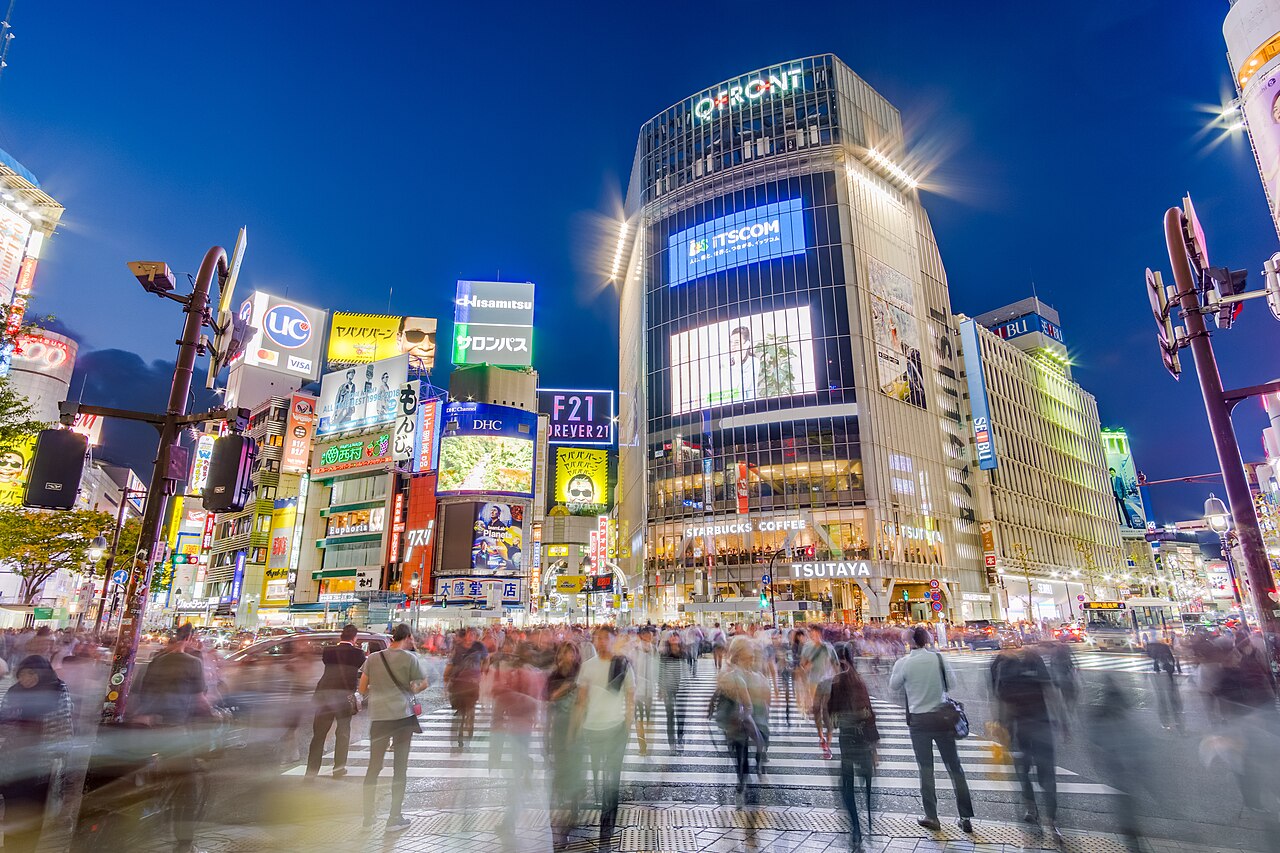
Neither habit is a character flaw, and both produce real skill. The Seoul habit produces proportion skill: a shopper who has tried the same silhouette at five price points knows exactly what a wide trouser should do. The Tokyo habit produces knowledge skill: a shopper who has handled a decade of archive pieces knows fabrics, eras and labels by touch. The traveller’s version of the difference is simpler. Seoul is the easier city to leave dressed well: one afternoon, one platform order, one formula. Tokyo is the more rewarding city to shop in slowly, and the easier one to leave with a single extraordinary piece you will keep for a decade. The longer Seoul view, set out in the Korea JoongAng Daily fashion history, shows a city that industrialised its taste early; Tokyo’s districts kept the workshop scale, and the clothes still show it.
There is also a generational rhythm to the difference. Seoul’s cycle is deliberately short: the platform economy rewards the new, the idol styling cycle refreshes every comeback, and last season’s formula is cleared at a discount without ceremony. Tokyo’s cycle is deliberately long at its core: the archive trade exists because the scene believes its own past is worth keeping in circulation, and a shopper can build a wardrobe in which the oldest piece is the most valued. A young dresser in either city feels the pull of the other’s rhythm, which is one reason the borrowing in the next section never stops. Speed without memory becomes disposable; memory without speed becomes a museum. Each scene is the other’s corrective.
What Each Scene Borrows From the Other
The two scenes are rivals, but they are not sealed. Korean streetwear’s foundations include Japanese influence from the start: the hip-hop and workwear ingredients arrived in Seoul partly through Tokyo’s earlier adoption, and Korean stylists have always watched Harajuku. The flow runs the other way now with equal force. The Korean takeover of the global streetwear conversation, tracked in the SNKRDUNK magazine account, is visible in Tokyo itself, where Korean labels occupy rails that would once have held only domestic names, and where the soft Korean silhouette has become one of the standard options in the city’s own shops. Seoul Fashion Week’s growth into a global platform over its 25 years is the institutional version of the same export. What each side borrows tells you what it lacks: Seoul borrows depth, archive and designer edge; Tokyo borrows ease, wearability and speed. The borrowing is the health of both scenes, and the wearer standing between them gets the best of the exchange.
Music shows the exchange in its clearest form. Korean popular music exports the complete outfit: a styling team builds a look, the performance broadcasts it, and the retail system sells it within the month, which is why Korean trends arrive abroad as finished formulas. Japanese scenes grew through slower media, the street magazine, the shop photograph, the designer’s seasonal show, and they export as sensibilities rather than outfits: a way of layering, a respect for a fabric, a label’s whole worldview. The first kind of export is faster and reaches further. The second kind lasts longer and goes deeper. A wearer who understands both kinds of influence can read any new trend and predict, usually correctly, whether it will be a season’s uniform or a decade’s reference point, and spend accordingly. That predictive skill, more than any single garment, is what studying the two scenes side by side actually gives you.
It is worth naming the one area where the two scenes barely differ, because it keeps the comparison honest: both are built on American foundations, and both know it. The hoodie, the sneaker, the denim jacket and the graphic tee arrived in both cities from the same sources, through music, film and imported media, and neither scene claims to have invented the ingredients. The originality is entirely in the handling, which is why this comparison has been organised around handling at every level: how a silhouette is balanced, how a colour is chosen, how a shop is run, how a shopper is trained. Ingredients are global now, and any city can buy them. Systems are local, earned over decades, and they are the thing worth travelling for, studying and, in the end, choosing between. Everything below is about learning to see those systems clearly, so the choice is made on evidence rather than on whichever city’s marketing reached you first, loudest, or most often.
Which One Fits You: Choosing and Mixing
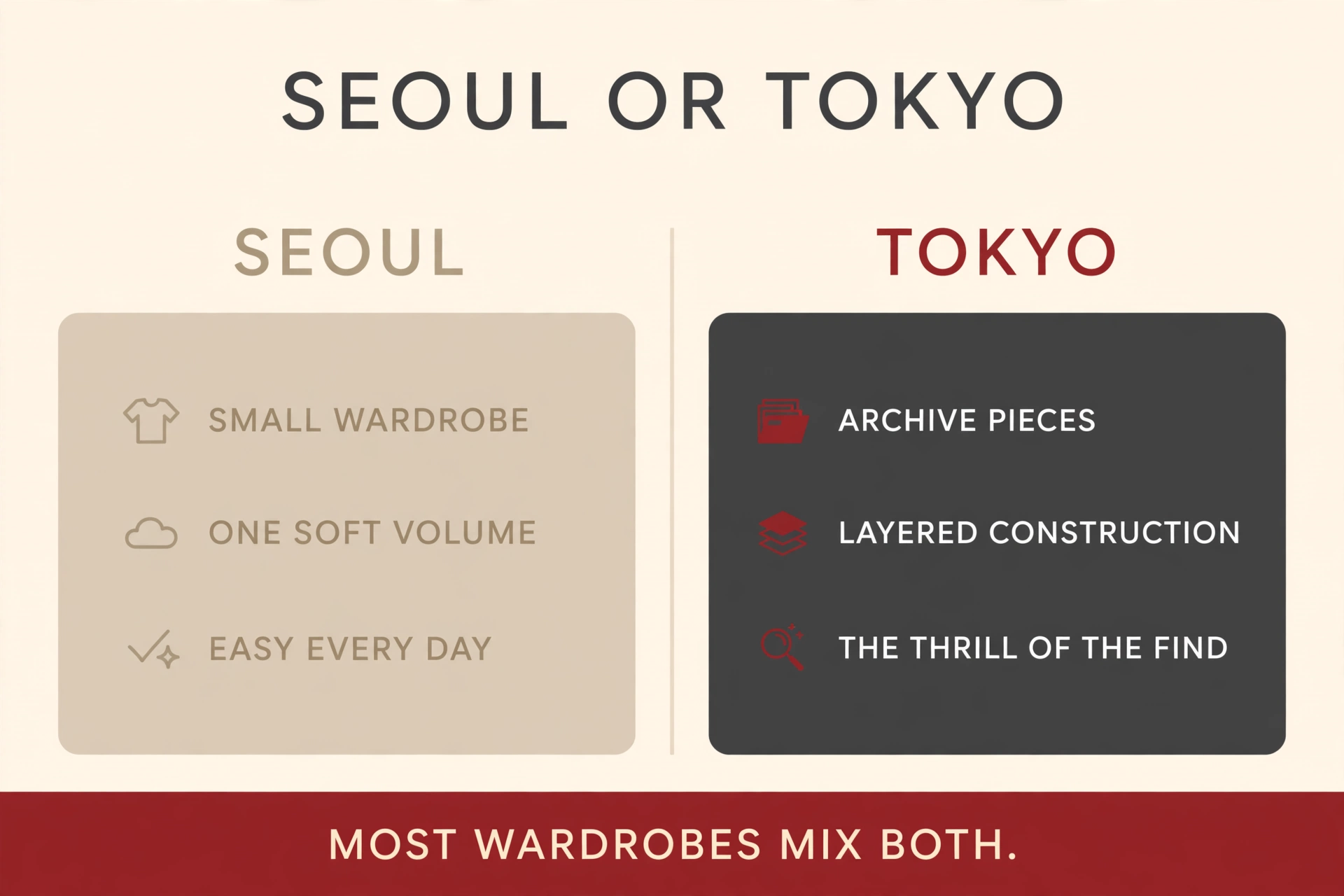
Choose by the problem you are solving, not by loyalty. If you want to look good every day with a small wardrobe and a learnable system, the Korean side is the answer: take the silhouette rules from Korean streetwear for men or Korean street style for women, add the seasonal formulas such as Korean streetwear in summer, and the wardrobe runs itself. If you want clothing as a field of interest, pieces with histories, labels with lineages, the thrill of the find, the Japanese side rewards the investment the way any deep hobby does. Most wardrobes we would actually want to wear mix the two: a Korean base of proportions and palette, because it makes every day easy, with Japanese pieces used the way the Tokyo system itself uses them, one at a time, as the point of an outfit. A single archive jacket over a Seoul formula outfit is not a compromise between the scenes. It is both scenes working at once, each doing what it does best. More mixed references are collected on our streetwear inspo page.
A simple travel test settles most arguments between the two. Pack for a week in a small case. The Korean system wins without contest: a handful of muted, wide pieces that all combine, two shoes, and every day is dressed. Now dress for one night that matters, a gallery opening, a dinner you want to remember, a photograph you will keep. The Tokyo instinct wins: one piece with a history and a point of view, built around rather than blended in. A complete wardrobe needs both weeks and nights, which is the practical reason the mixing advice above is not fence-sitting. It is how the two systems, built by two cities solving different problems, complete each other in a single closet.
Our View
Our view is that the Korea-versus-Japan question is usually asked wrong. It is not a contest between two cities producing the same product at different quality levels. It is a choice between two philosophies of getting dressed: one that perfects a shared formula until a whole city can wear it beautifully, and one that protects difference until every street can hold a dozen scenes at once. Seoul’s philosophy is more useful to more people, which is why this site builds on it. Tokyo’s philosophy is the necessary reminder that a formula is a floor, not a ceiling. Learn the Korean system first, because it will dress you well while you learn everything else, then borrow from Japan deliberately, one piece and one idea at a time.
Seoul teaches you the formula. Tokyo teaches you what to do once the formula is yours. Learn them in that order.
— Brian Ka
Frequently Asked Questions
What is the main difference between Korean and Japanese streetwear?
System and instinct. Korean streetwear runs on one soft, muted, oversized silhouette that a whole city shares, sold fast through platforms. Japanese streetwear runs on layered construction, stronger graphics and subculture difference, sold slowly through independent shops and a deep vintage trade.
Which is easier to wear, Korean or Japanese streetwear?
Korean, for most people. The formula is one volume, a muted palette and clean shoes, and it is learnable in days. Japanese streetwear rewards knowledge of layers, labels and scenes, and its failure mode, clutter, takes experience to avoid.
Where does Japanese streetwear come from?
Tokyo’s youth districts, above all Harajuku and its Ura-Harajuku backstreets, where independent boutiques from the 1990s onward incubated labels like A Bathing Ape, founded there in 1993, alongside subcultures documented in magazines such as Fruits.
Do the two scenes influence each other?
Constantly. Japanese adoption of American streetwear fed into Korea early on; today Korean labels and the soft Seoul silhouette are stocked and worn in Tokyo, and Korean retail speed is studied worldwide. Each borrows what it lacks: depth one way, ease the other.
Can you mix Korean and Japanese streetwear in one outfit?
Yes, and it is the strongest way to wear both. Use the Korean system as the base, proportion and palette, and let one Japanese piece, an archive jacket, a graphic label piece, a layered construction, be the outfit’s single point.
Questions About Building Your Wardrobe?
Tell us which formula you are trying, what is not working, and where you live — proportion advice is always specific to the outfit and the day it has to survive.
Sources
- V&A — Hallyu! The Korean Wave exhibition
- MFA Boston — Hallyu! The Korean Wave
- Wikipedia — Japanese street fashion
- Wikipedia — Harajuku, centre of Japanese youth culture and fashion
- Wikipedia — Ura-Harajuku backstreets
- Wikipedia — A Bathing Ape, founded in Ura-Harajuku in 1993
- Musinsa — Newsroom
- Highsnobiety — Seoul fashion brands
- Hypebae — Ader Error, Korean design collective
- Dazed — How K-pop changed fashion
- SNKRDUNK Magazine — The Korean takeover of streetwear fashion
- Korea JoongAng Daily — Seoul fashion history