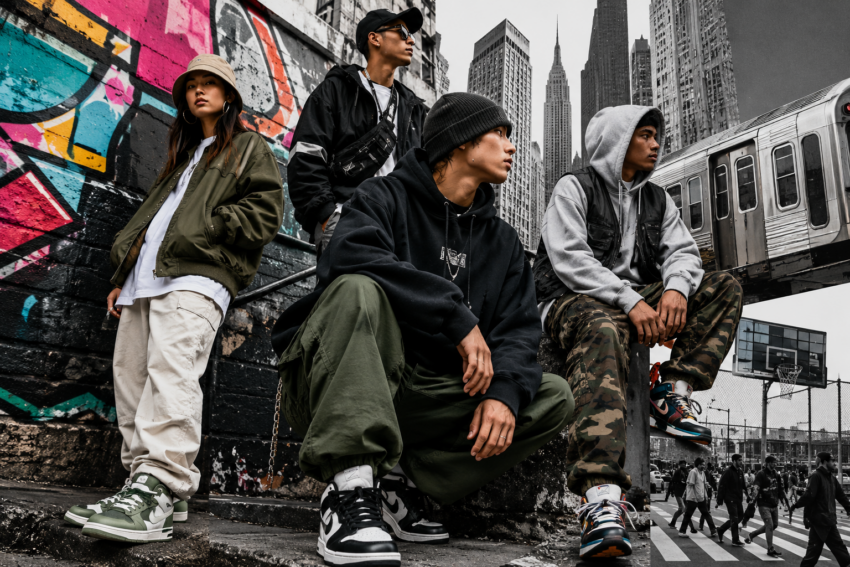
Defining streetwear is harder than it might seem. Ask ten people who dress in the aesthetic what streetwear is and you will get ten different answers — some will point to specific brands, others to specific silhouettes, others to the cultural communities from which the clothing emerged, and others will simply say that streetwear is a feeling, an attitude, a way of approaching getting dressed that resists any single definition precise enough to satisfy everyone who practices it. All of those answers contain some truth, and none of them is complete on its own.
What is clear is that streetwear is one of the most culturally significant fashion movements of the past half century. It began in the margins of American popular culture — in the skateparks of California, the hip-hop culture of New York, the basketball courts of cities across the country — and spread from those origins to become a global phenomenon that has influenced luxury fashion houses, reshaped the sneaker industry, created a multi-billion dollar resale market, and permanently changed how the world thinks about the relationship between clothing, culture, and identity. Understanding where streetwear came from and what it actually means gives anyone who wears it — or wants to — a foundation for doing so with genuine awareness rather than superficial imitation.
The Most Useful Definition of Streetwear
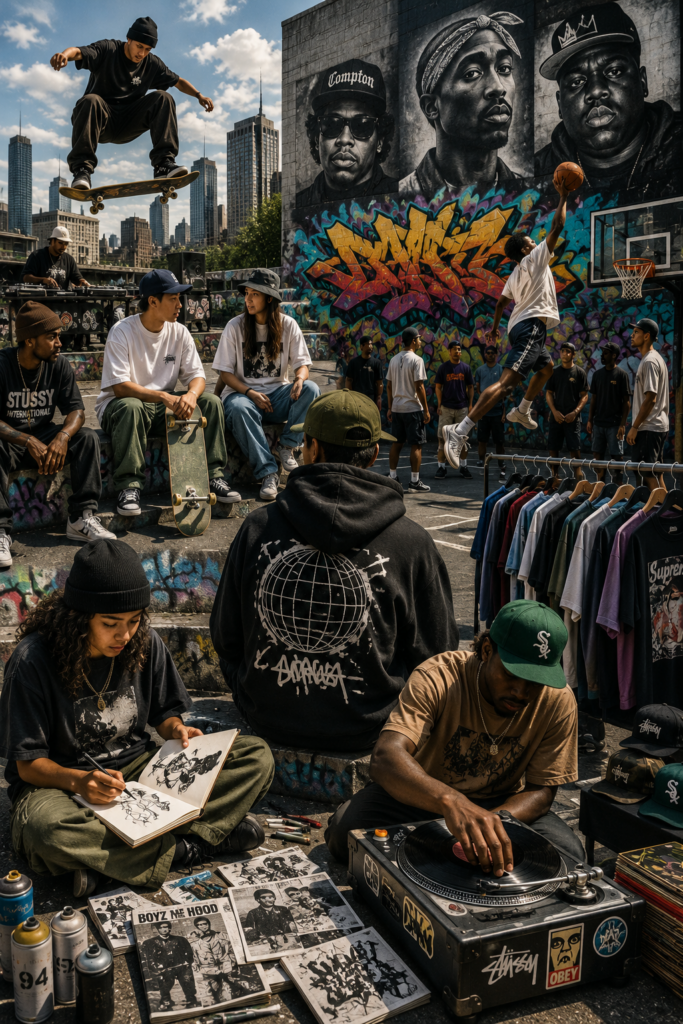
The most useful definition of streetwear is not about specific brands, specific silhouettes, or specific price points. It is about a set of values and a relationship between clothing and culture that has remained consistent even as the specific expression of those values has changed dramatically over the decades.
Streetwear is clothing that emerges from street culture rather than from the traditional fashion industry — from the communities, subcultures, and everyday lives of people who wore clothes for function, self-expression, and cultural belonging before the fashion world noticed what they were doing and gave it a name. It is democratic rather than hierarchical — historically more concerned with cultural authenticity than with luxury price points or institutional fashion credibility, though that relationship has complicated significantly as streetwear has become a global commercial phenomenon.
Streetwear is also defined by its relationship to youth culture, music, sport, and art. The aesthetic has always been most alive at the intersection of these cultural forces — where the clothes people wear to skate, to listen to music, to play basketball, and to make art have come together into a coherent visual language that communicates something specific about who they are, where they come from, and what they care about.
Finally, streetwear is defined by its emphasis on personal expression within a shared cultural framework. Unlike uniform-based dress codes or purely trend-driven fashion, streetwear gives individuals enormous room to express their specific cultural affiliations and personal aesthetic within a recognizable overall aesthetic language. This combination of shared framework and individual expression is what has made streetwear so durable and so globally resonant.
Where Streetwear Came From — The Origins
The origins of streetwear as a distinct aesthetic and cultural phenomenon can be traced to several specific communities and geographic locations in the late 1970s and early 1980s, though its roots extend further back into the broader history of youth culture and subcultural dressing.
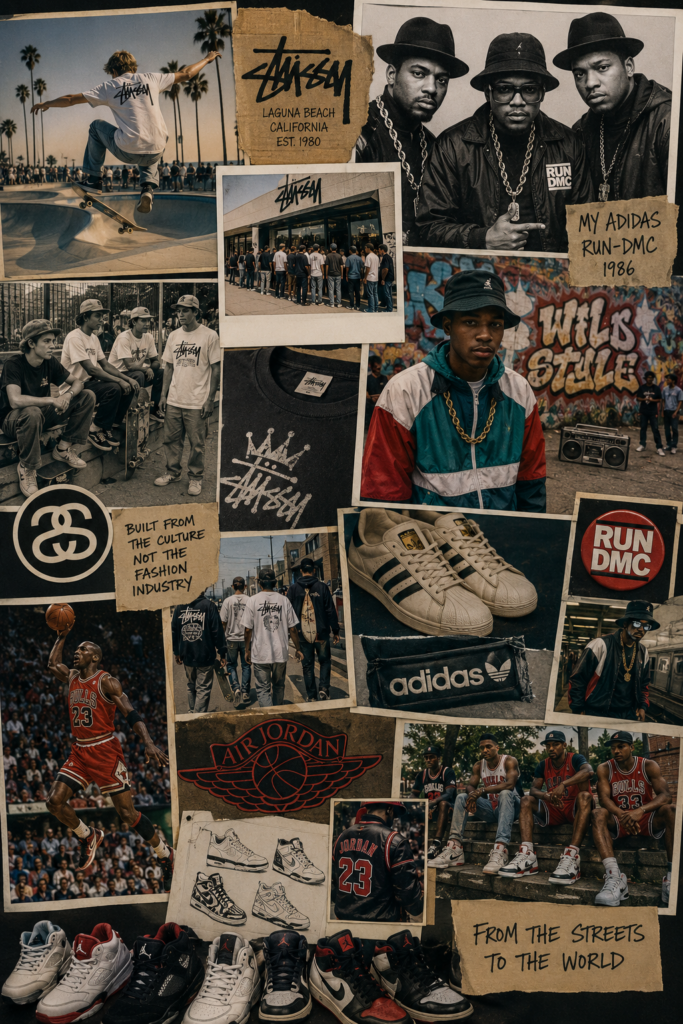
Skate culture on the West Coast of the United States is one of the primary origin points of streetwear. Skateboarding in its early years was a genuinely subcultural activity — practiced by young men and women who existed outside the mainstream of American youth culture and who developed their own visual language in clothing, music, and art that reflected the values of their community. Oversized tees, baggy jeans, low-top canvas sneakers, and hooded sweatshirts were practical choices for skating — loose enough to allow full range of motion, durable enough to withstand falls, and casual enough to reflect the anti-establishment attitude of skate culture. These practical choices became aesthetic choices when brands like Stüssy began producing clothing specifically for the skate community that combined subcultural authenticity with graphic design sensibility drawn from surf culture, hip-hop, and punk.
Shawn Stussy, a surfboard shaper in Laguna Beach, California, began selling t-shirts and shorts decorated with his distinctive signature in the early 1980s as a way of promoting his surfboard business. The clothing quickly developed its own following that extended far beyond the surf community into skate culture, hip-hop culture, and the broader youth culture of Southern California cities. Stüssy’s model — limited production runs, subcultural authenticity, graphic identity, and deliberate distance from mainstream fashion retail — established many of the practices that would define streetwear culture for decades.
Hip-hop culture on the East Coast, and particularly in New York City, developed its own parallel visual language during the same period that would merge with West Coast skate culture influences to create the broader streetwear aesthetic that eventually went global. The clothing choices of early hip-hop artists and their communities — tracksuits, shell-toe sneakers, gold chains, bucket hats, bomber jackets, and eventually the graphic hoodies and oversized denim that would become central to the aesthetic — were expressions of genuine cultural identity that communicated something specific about community, aspiration, and self-determination in urban America.
The relationship between hip-hop and sneaker culture is one of the most important threads in streetwear’s origin story. The Run-DMC song “My Adidas” in 1986 — written as a genuine expression of the group’s affection for the shell-toe Adidas sneaker that was central to their visual identity — led to a landmark endorsement deal between Run-DMC and Adidas that established the template for the relationship between music culture and sneaker brands that continues to define significant parts of the streetwear industry today.
Basketball culture contributed its own visual language to streetwear’s development — the oversized shorts, the team jerseys worn as casual clothing, the specific sneakers associated with specific players and moments in basketball history, and the broader culture of athletic dressing that crossed over from the court into everyday urban fashion. Michael Jordan’s relationship with Nike and the Air Jordan line beginning in 1985 created a template for sneaker culture that remains the most significant single commercial phenomenon in streetwear’s history.
The 1990s — Streetwear’s First Golden Age
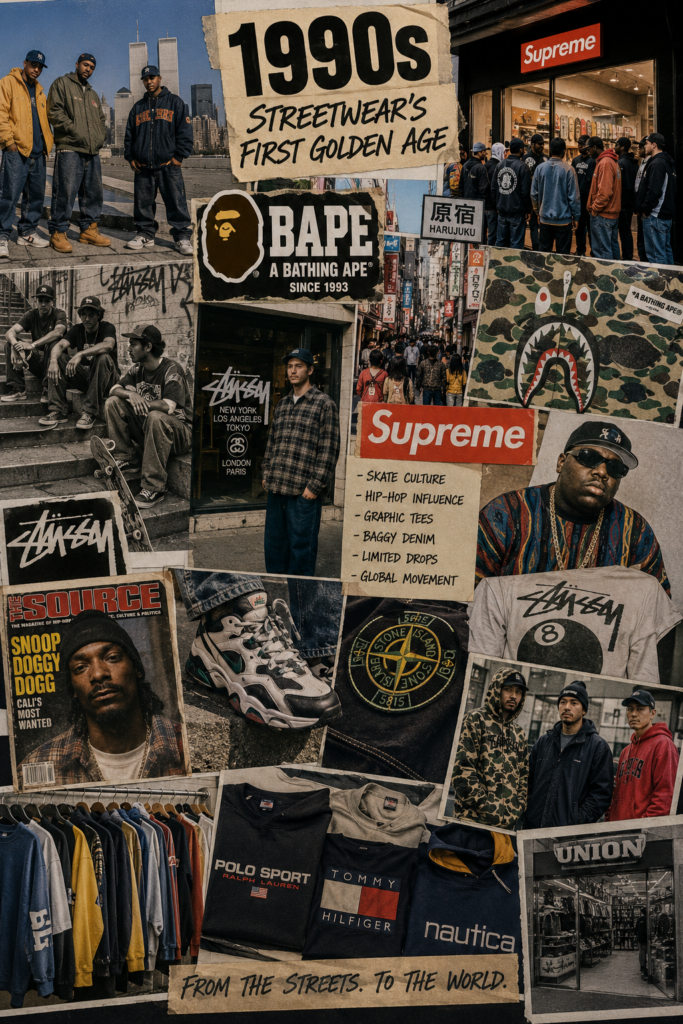
The 1990s represent the first golden age of streetwear as a distinct commercial and cultural phenomenon. The decade saw the consolidation of the aesthetic’s foundational elements — graphic tees, hoodies, baggy denim, chunky sneakers, and outerwear from brands with genuine subcultural credibility — into a recognizable global style that spread from its American origins into Europe, Japan, and eventually the rest of the world.
Japan’s adoption and transformation of American streetwear during the 1990s is one of the most important chapters in the aesthetic’s history. Japanese consumers and designers engaged with American streetwear with an intensity and intellectual seriousness that went far beyond simple imitation — they studied the original sources obsessively, sought out authentic American brands that were difficult to find outside their origin markets, and began producing their own streetwear brands that combined American aesthetic influences with Japanese precision, craftsmanship, and cultural sensibility. Brands like A Bathing Ape, founded by Tomoaki Nagao in Tokyo’s Harajuku neighborhood in 1993, created a template for Japanese streetwear that has been enormously influential on the global development of the aesthetic.
Supreme, founded by James Jebbia in New York City in 1994, established the model of the streetwear brand as cultural institution that has defined the premium end of the streetwear market ever since. Supreme’s combination of genuine subcultural roots in New York skate culture, deliberately limited production runs that created scarcity and desire, graphic design sensibility drawn from art and countercultural history, and retail experience designed to feel like a skate shop rather than a fashion boutique created a template that dozens of subsequent streetwear brands have attempted to replicate.
The 2000s and 2010s — Streetwear Goes Mainstream
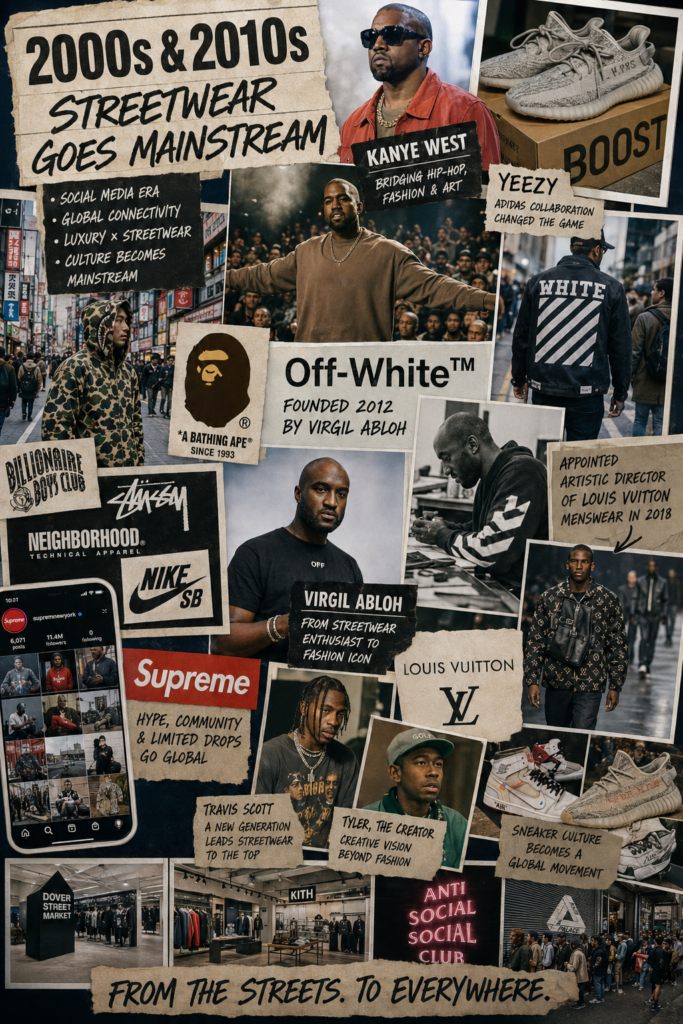
The 2000s and 2010s saw streetwear complete its transition from subcultural practice to mainstream global fashion phenomenon. Several forces drove this transition simultaneously — the rise of social media and the internet, which made subcultural aesthetics globally visible and accessible for the first time; the adoption of streetwear by luxury fashion houses, which gave the aesthetic institutional fashion credibility it had previously lacked; and the emergence of a generation of designers and cultural figures who had grown up with streetwear and brought it into the highest levels of the fashion industry.
Kanye West‘s influence on the relationship between hip-hop culture and high fashion during the 2000s and 2010s was enormous. His Yeezy collaborations with Adidas, his attention to the intersection of music, fashion, and visual art, and his ability to move between hip-hop culture and the institutional fashion world created a template for celebrity-driven streetwear that reshaped the commercial landscape of the aesthetic.
Virgil Abloh‘s trajectory — from streetwear enthusiast and DJ to founder of Off-White to artistic director of Louis Vuitton’s menswear — is perhaps the most dramatic single narrative of streetwear’s mainstreaming. His appointment at Louis Vuitton in 2018 was a moment of genuine cultural significance that signaled how completely streetwear had penetrated the highest levels of the fashion establishment.
Streetwear Today
Contemporary streetwear exists in a more complex and contested space than at any previous point in its history. The aesthetic’s mainstreaming has created genuine tensions with its subcultural origins — when luxury fashion houses produce streetwear-influenced collections at four-figure price points, when mass-market retailers offer streetwear-aesthetic pieces at fast fashion prices, and when the graphic and cultural references of streetwear are reproduced without genuine cultural connection, the question of what the aesthetic actually means becomes genuinely difficult to answer.
What remains consistent is the core of values from which streetwear emerged — authenticity, personal expression, cultural connection, comfort, and the belief that clothing is a meaningful language through which identity, community, and aspiration can be communicated. Those values are as alive in contemporary streetwear as they were in the skateparks of California and the hip-hop studios of New York four decades ago, and they remain the most reliable guide to what streetwear actually is and how to practice it genuinely.
For men who want to dress within the streetwear aesthetic with genuine awareness of its history and values, understanding the origins explored in this post gives every outfit choice a depth of context that purely visual imitation cannot provide. The hoodie you reach for in the morning, the sneakers you choose for the day, the graphic tee that represents something you genuinely care about — all of these choices connect to a cultural history that is richer and more interesting than most people who practice the aesthetic realize.