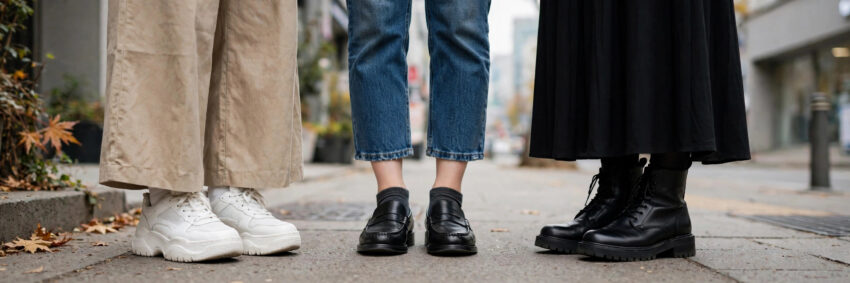
In Korean street style, the outfit is decided at ankle height. The tops and trousers follow a disciplined system, wide, soft, muted, and that discipline deliberately leaves the shoe as the loudest variable in the look. Seoul dressers use that variable hard. A chunky sneaker grounds a wide-leg trouser and keeps the silhouette from floating. A leather loafer tightens a relaxed outfit into something that can walk into a nice restaurant. An ankle boot changes the season of an outfit without changing a single other piece. Get the shoe wrong and the proportions above it stop making sense; get it right and an outfit built from basics looks designed. This guide works through the five shoe families that finish a Seoul outfit, chunky sneakers, platform sneakers, loafers, boots and sandals, and the proportion rules for matching each one to the leg above it.
Start Here
Key Takeaways
- The shoe is the loudest variable in a Korean outfit because everything above it is deliberately quiet: wide cuts, soft colours, minimal branding.
- Chunky sneakers are the default because wide-leg trousers and oversized tops need visual weight at the ground to balance them.
- Platform sneakers add height inside the outfit’s proportions, which is a core part of their appeal in Korea, not a side effect.
- Loafers are the polished option: they tighten relaxed tailoring and wide trousers into an outfit that works beyond the street.
- Boots own the cold half of the year and long skirts and wide trousers year-round; sandals own the monsoon weeks.
- Match sole weight to leg width: the wider the hem, the more shoe it needs underneath it.
Contents
- Why Shoes Decide a Korean Outfit
- Chunky Sneakers: The Default
- Platform Sneakers and Loafers: Height and Polish
- Boots in a Sneaker Culture
- Sandals and Monsoon Shoes
- Match the Shoe to the Leg: Proportion Rules
- Sizing and Buying Notes
- Our View
- Frequently Asked Questions
- Sources
- Recommended
Why Shoes Decide a Korean Outfit
Korean street style is a quiet outfit with one loud decision, and the decision is usually the shoe. The wider system is documented in the V&A Hallyu exhibition, which framed Korean fashion as part of a designed cultural wave rather than a copy of Western streetwear, and in Hallyu at MFA Boston, where the everyday Seoul wardrobe was presented as a coherent aesthetic. Inside that aesthetic, tops and trousers are kept deliberately restrained: oversized, yes, but in cream, grey, washed black and soft pastels, with graphics used sparingly. Restraint at the top pushes the eye down. By the time a viewer reaches the ankle, the shoe is carrying the outfit’s contrast, its colour decision and most of its attitude. That is why Seoul shoppers who will wear the same wide trousers for three years will still queue for a footwear release.
The retail culture reinforces it. Sneaker-led coverage of the Korean market, such as the SNKRDUNK account of Korea’s streetwear rise, describes a scene where footwear collaborations and limited releases sit at the centre of the conversation. The city’s own showcases point the same way: the Seoul Metropolitan Government’s plan for Seoul Fashion Week landmarks turns whole districts into runways, and the street style photographed around those venues is consistently finished with deliberate footwear, never an afterthought pair. Our complete Korean streetwear guide covers the clothing system in full; this page is about the one piece that completes it. The closest older page on this site, joggers with sneakers, covers one pairing family, joggers and their cuffs, in depth. What follows is the wider map: every shoe family, matched to every leg in the Korean wardrobe.
There is a second reason shoes carry so much weight in Seoul specifically: the city walks. Distances between stations, shops and offices are covered on foot and underground, in all weather, which means a shoe is judged on a full day of pavement in a way that car-city footwear never is. A pair that looks right in a mirror and fails at kilometre six is a failed purchase, and Seoul shoppers know it, which is why comfort engineering, cushioned soles, breathable uppers, real arch support, is discussed in the same breath as silhouette. The two judgements are not in tension. The chunky sole that balances a wide trouser is also the sole that absorbs a day of concrete; the mesh upper that lightens a summer outfit is also the one that survives the humidity. In this system, the practical shoe and the correct-looking shoe are usually the same shoe, and the sections below treat them that way.
Chunky Sneakers: The Default
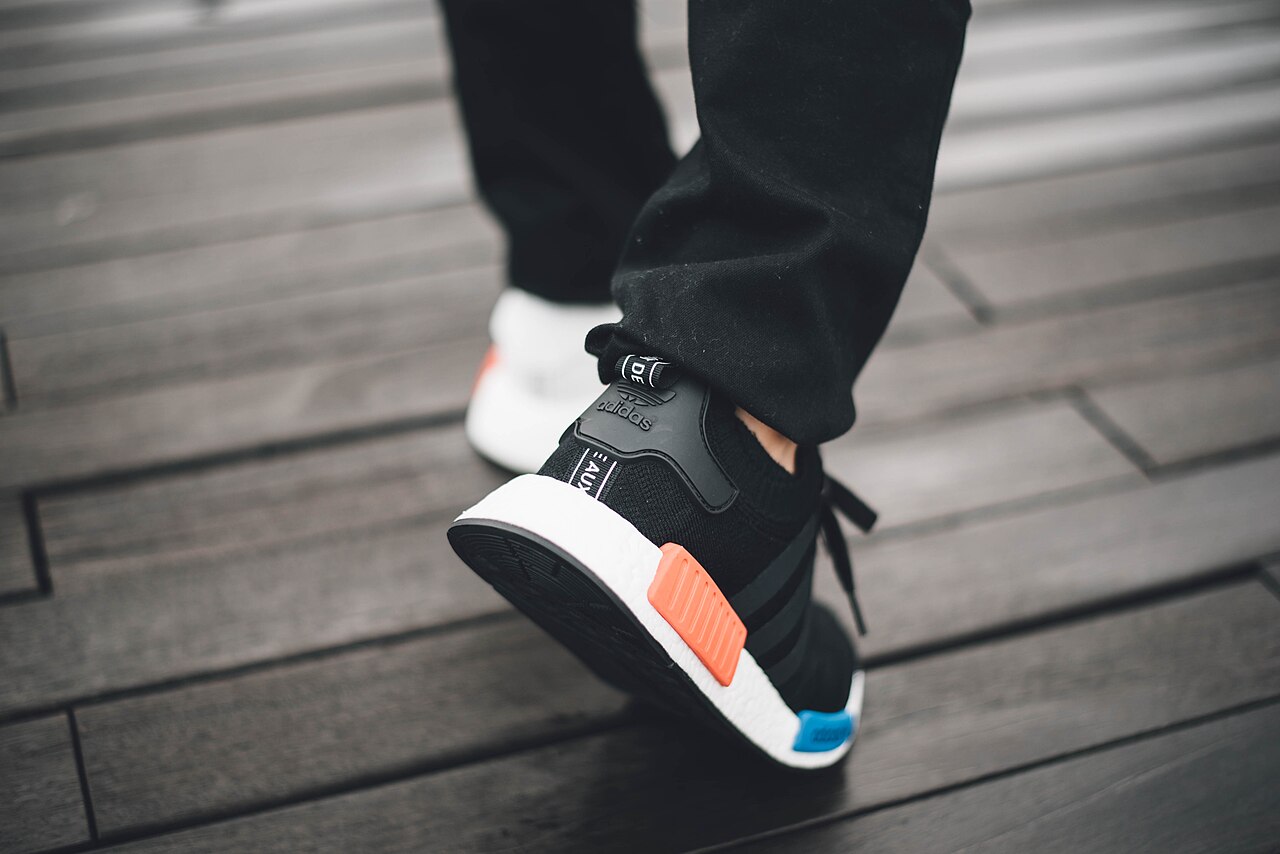
The chunky sneaker is the default shoe of Korean street style because the silhouette demands it. Wide-leg trousers, oversized sweatshirts and long coats all add volume above the ankle. A slim, low-profile shoe under that volume makes the outfit look unfinished, as if the leg simply runs out. A chunky sneaker, with a thick sculpted sole and a padded upper, puts matching weight at the ground and closes the silhouette. Korea has a specific claim on this shoe family: the brand most associated with the chunky revival is headquartered in Seoul, since Fila’s corporate history records that Fila Korea acquired the global brand in 2007 and the company is headquartered in Seoul today. The thick-soled styles that came out of that Korean ownership became a fixture of Seoul street dressing and then of the global chunky wave, which is one reason the proportions feel native to Korean outfits rather than borrowed.
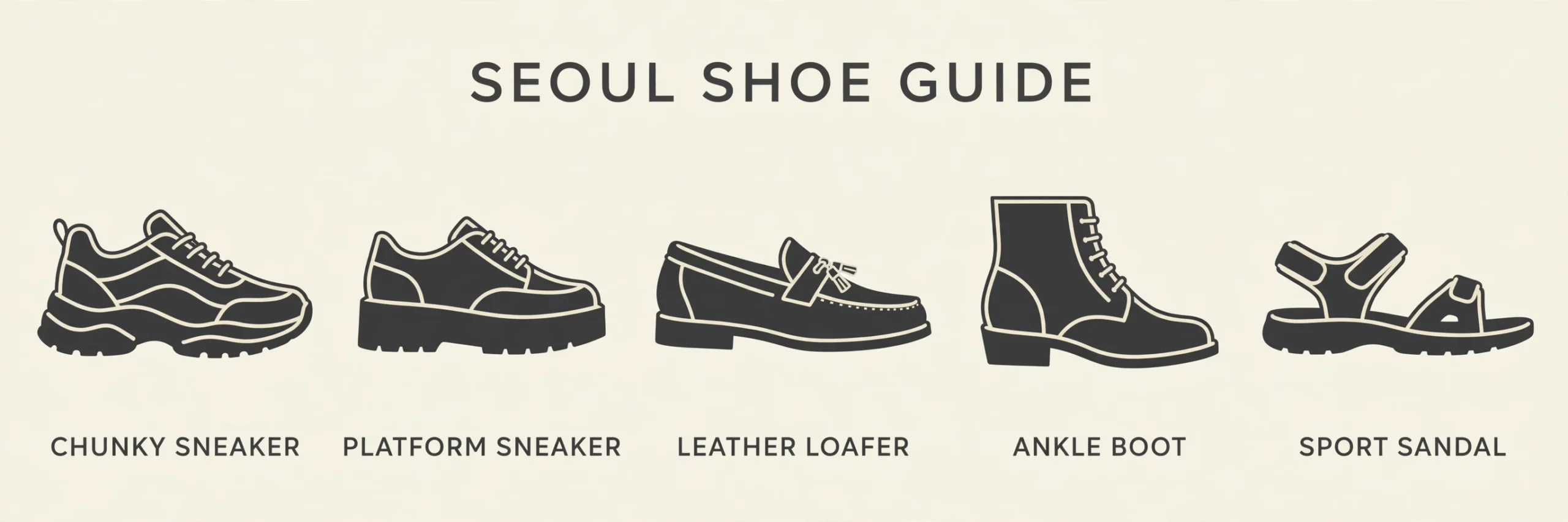
Wear them with the legs they were built for. Wide-leg trousers hemmed to break over the shoe are the first pairing, and the one our streetwear jeans guide approaches from the denim side. Wide shorts in summer are the second, as the Korean summer formulas set out. Long skirts are the third: a chunky sneaker under a long skirt is a standard Seoul combination that keeps a soft outfit from turning formal. Colour discipline matters more than brand. White and cream chunky sneakers carry most outfits; black carries the darker half of the wardrobe; a coloured pair is a deliberate statement and should be the only loud piece in the look. The brand landscape behind these shoes, from Korean labels to the global names stocked beside them, is mapped in the Highsnobiety Seoul brands guide and in our own Korean brands and Musinsa buying guide.
Rotation is the chunky sneaker’s hidden requirement. A thick-soled shoe worn daily compresses its cushioning, picks up the city’s grime faster than any other item you own, and starts to look tired within a season. Two pairs in rotation, one light and one dark, each rested between wears, will outlast three pairs bought and worn in sequence, and they keep both colour stories of the wardrobe available every day. Clean them weekly with a brush and mild soap, dry them away from direct heat, and replace them when the sole’s sculpting starts to round off, because a worn chunky sole loses the sharp ground line that is the entire point of the shoe. Treat the default with this much care and it stops being a trend item and becomes what it is in Seoul: infrastructure.
Platform Sneakers and Loafers: Height and Polish
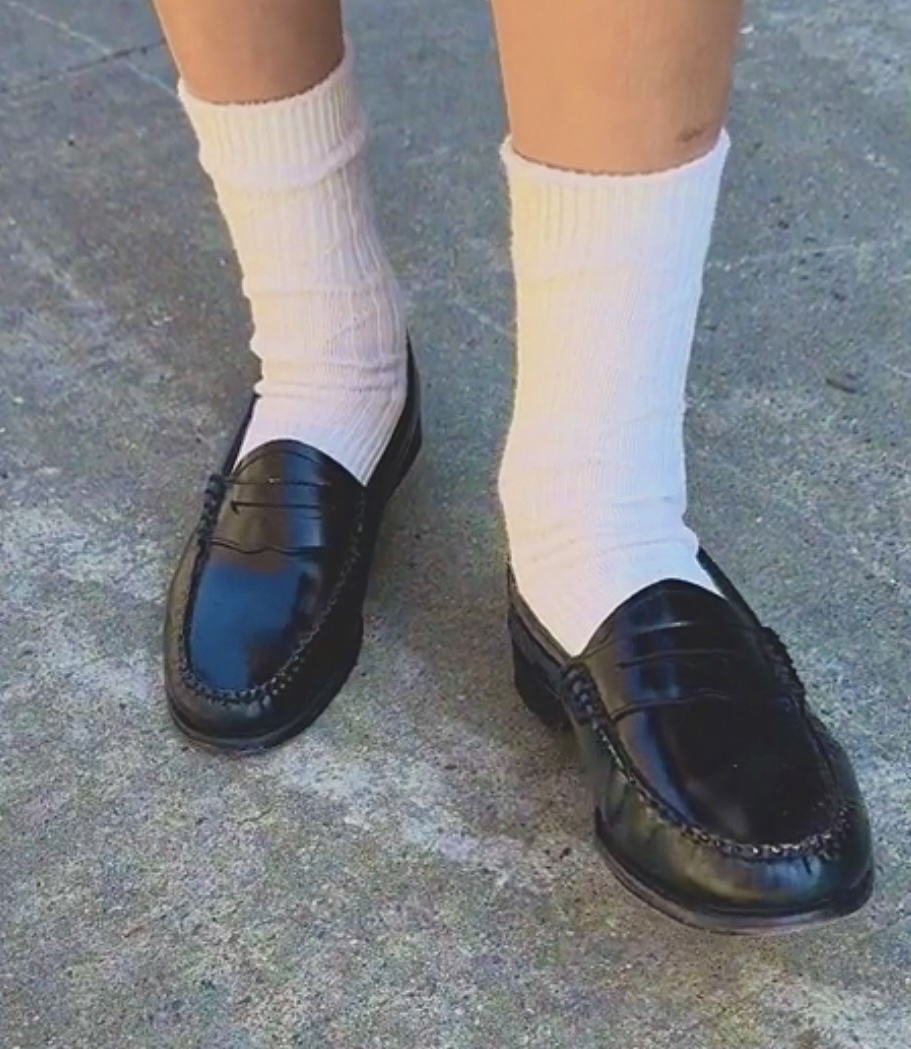
Platform sneakers and loafers solve the two problems chunky sneakers cannot: height and formality. The platform sneaker keeps the casual upper of a trainer and adds a flat, elevated sole, which lengthens the leg line inside an outfit built on long, wide proportions. In Korea this is not a niche taste. Added height inside an otherwise soft outfit is a mainstream styling goal for both men and women, and platform soles deliver it without a heel’s formality or discomfort. They pair best with cropped wide trousers, long skirts and the shorter hemlines of the Korean street style for women formulas, where the extra sole shows and earns its place. The loafer works the opposite direction. A leather loafer, classic or platform-soled, removes the sport signal entirely and tightens everything above it: the same wide trousers and oversized shirt that read as streetwear over sneakers read as relaxed tailoring over loafers.
The loafer is the shoe that lets Korean street style leave the street. Worn with wide tailored trousers, a tucked knit or an oversized blazer, it carries the outfit into offices, galleries and restaurants where a chunky sneaker would set the wrong register, which is the same polished end of Seoul dressing that the Visit Seoul style guide documents in the city’s smarter districts. Socks are the loafer’s styling lever: invisible for a clean summer line, white and visible for the deliberate school-uniform echo that Korean styling uses often, black for the conservative version. Design-led Korean labels treat footwear as part of the outfit’s architecture rather than an accessory, and the approach shows in coverage of Ader Error’s design collective, whose distorted proportions extend all the way down to the shoe. Our Korean streetwear for men lookbook shows both shoes inside complete outfits.
The platform loafer deserves a specific mention because it is the hybrid Seoul reaches for most. It keeps the loafer’s clean, laceless upper and puts it on a thick, level sole, so one shoe delivers both the polish and the height. Worn with wide tailored trousers it reads as intentional rather than dressed up, which is the exact register of Gangnam-side dressing, and worn with a long skirt it gives the outfit a grounded, slightly severe finish that a sneaker cannot. If a wardrobe can only stretch to one non-sneaker shoe, this is the one: it covers offices, evenings and the whole polished half of the Korean wardrobe without ever looking like a compromise.
Boots in a Sneaker Culture
Boots are the seasonal power move in a wardrobe that defaults to sneakers. From the first cold weeks, the ankle boot and the lace-up boot take over the bottom of Seoul outfits, and they do a job no sneaker can: they give a long coat or a wide trouser a hard edge to land on. The winter system in our Korean streetwear in winter guide is built on exactly this landing, long padding above, a substantial boot below. Boots also own one year-round pairing, the long skirt or dress, where a boot closes the gap between hem and ground with more intent than a sneaker and turns a soft outfit sharper. The K-pop styling pipeline has normalised the combination globally, and the Dazed account of K-pop fashion traces how stage styling, boots very much included, becomes street practice within a season.
Choose the boot by shaft height first and material second. An ankle boot that ends just above the ankle bone works under wide trousers and with cropped legs, because the hem can fall over it or stop cleanly above it. A taller lace-up boot is the long-skirt and short-hem shoe, worn where the full boot is meant to be seen. Leather is the default; suede reads softer and suffers in wet weather, which in Seoul is a real constraint for half the year. Keep the toe rounded rather than pointed, because the Korean silhouette is built on soft geometry, and keep the sole lugged or platform rather than slim, for the same proportion reasons that govern the sneakers. A longer historical view helps explain the durability of the formula: the Seoul fashion history in the Korea JoongAng Daily shows the city repeatedly adopting hard-wearing global garments and softening them into its own proportions, and the combat-style boot under a long soft coat is the current version of that habit.
Break-in is the boot’s one real cost, and it should be planned rather than suffered. A leather boot bought at the start of the cold season needs two weeks of short wears before it can be trusted with a full Seoul walking day, and buying it in the last week of fall, on sale, in time to break in before the worst weather, is a standard piece of local timing. Fit them with the socks you will actually wear, because a boot sized over a thin shop sock will punish you over a winter one. Once broken in, the boot becomes the lowest-maintenance shoe in the rotation: it shrugs off rain, hides scuffs as character rather than neglect, and holds its line for years. That durability is the other half of its place in the system. The sneakers rotate and get replaced; the boot is the closest thing Korean street style has to a permanent fixture.
Sandals and Monsoon Shoes
Sandals are the honest shoe of the Korean summer, and the monsoon makes them a practical one. The sport sandal, with a moulded sole and strapped upper, is worn with wide shorts, wide-leg trousers and socks-or-no-socks depending on the wearer’s nerve, through the hottest and wettest weeks of the year. Its virtue is that it can be soaked at noon and dry by evening, which no sneaker in the rotation can promise during jangma. Slides fill the shorter-distance role, convenience-store runs and neighbourhood days, while a leather sandal is the dressed option that pairs with the camp shirt formula. The full hot-weather system, fabrics and formulas included, is set out in Korean streetwear in summer. What sandals cannot do is carry a long or heavy outfit: under a long coat or wide winter trouser they collapse the silhouette, which is why their season is strict. Treat them as a summer specialist, not a year-round shortcut, and the rest of the shoe rotation stays coherent.
The sock question follows the sandal everywhere in Korea, and it is worth answering plainly: socks with sandals are a deliberate, accepted styling choice in Seoul, not a mistake. A clean white or coloured sock under a sport sandal extends the sandal’s season at both ends, protects the foot on long walks, and gives the outfit a small colour decision at the ankle where this whole guide began. The rules are the same as everywhere else in the system: the sock must be clean, fitted and chosen, because a slouched grey sock reads as an accident in any country. Bare feet are the high-summer default; the sock is the considered alternative. Either way, the sandal stays a considered shoe, which is all the system ever asks.
Match the Shoe to the Leg: Proportion Rules
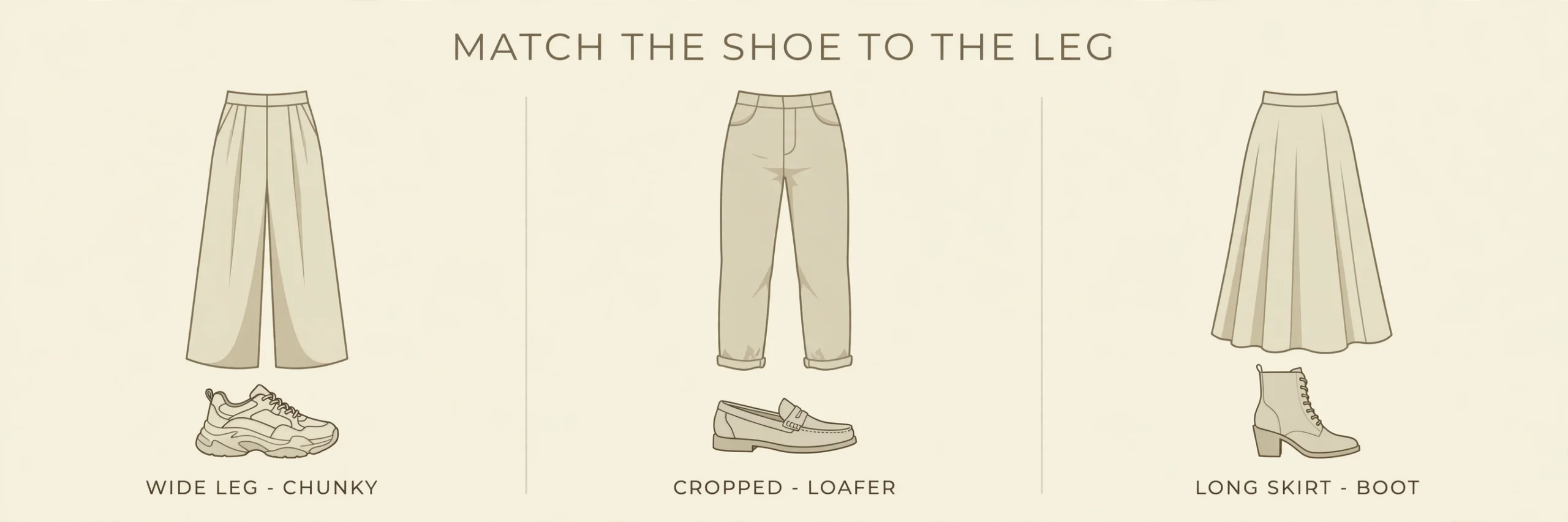
Every pairing above runs on one rule: the shoe’s visual weight must answer the leg’s volume. A wide hem moves more cloth at the ankle, so it needs a shoe with enough sole and upper to hold the frame; a narrow or cropped leg shows more shoe, so the shoe can be slimmer and becomes more visible as a design object. The table below is the working version of the rule for the Korean wardrobe.
| The leg | First shoe choice | Also works | Avoid |
|---|---|---|---|
| Wide-leg trousers | Chunky sneaker | Platform loafer, ankle boot | Slim low-profile runner |
| Cropped wide trousers | Platform sneaker | Loafer with visible sock | Tall boot (hem collision) |
| Joggers with a cuff | High or chunky sneaker | Knit runner | Loafer (register clash) |
| Long skirt or dress | Ankle boot | Chunky sneaker, platform sneaker | Slim sandal in cold months |
| Wide shorts | Chunky sneaker | Sport sandal | Leather boot |
Two secondary rules finish the system. First, one statement at a time: a coloured or sculptural shoe means the rest of the outfit stays in the muted palette, and a graphic top means the shoe goes quiet, the same restraint that governs our streetwear aesthetic guide. A note on colour completes the proportion system. The Seoul shoe palette mirrors the clothing palette, white, cream, black and grey carrying nearly every outfit, with colour used the way graphics are used on clothing: once, deliberately, as the outfit’s single decision. A red sneaker under an otherwise muted wide-leg outfit is a complete styling statement in this system, not an accent, and it should be bought with the same seriousness as a statement jacket. Metallic and pastel shoes belong to the women’s formulas and the summer months, where they lighten the ground line the way a soft colour lightens a top. When in doubt, buy the white version first. It is the version the system was designed around, it shows the silhouette of the shoe most honestly, and it will still be the right answer on the days when nothing else in the wardrobe is.
Second, condition is part of the design. Seoul shoe culture is a clean-shoe culture; a scuffed white sneaker reads as neglect, not patina, so the rotation needs a cleaning habit and enough pairs to rest between wears. The base wardrobe these shoes finish is set out in streetwear essentials, and more finished combinations are collected on our streetwear inspo page.
Weatherproofing deserves one practical paragraph, because Seoul weather tests shoes harder than almost any other fashion capital’s. Leather loafers and boots should be treated before their first wet week, not after their first stain; suede should be sprayed or left at home on forecast-rain days; mesh sneakers should be the pair you are willing to see soaked, because during jangma one pair in the rotation will be. A small shoe dryer or a fan pointed into the hallway rack is standard equipment in Korean homes for a reason: a shoe dried properly overnight keeps its shape and its smell, and a shoe left damp in a corner loses both within a week. None of this appears in lookbooks, and all of it decides whether the rotation in this guide survives its first year.
Sizing and Buying Notes
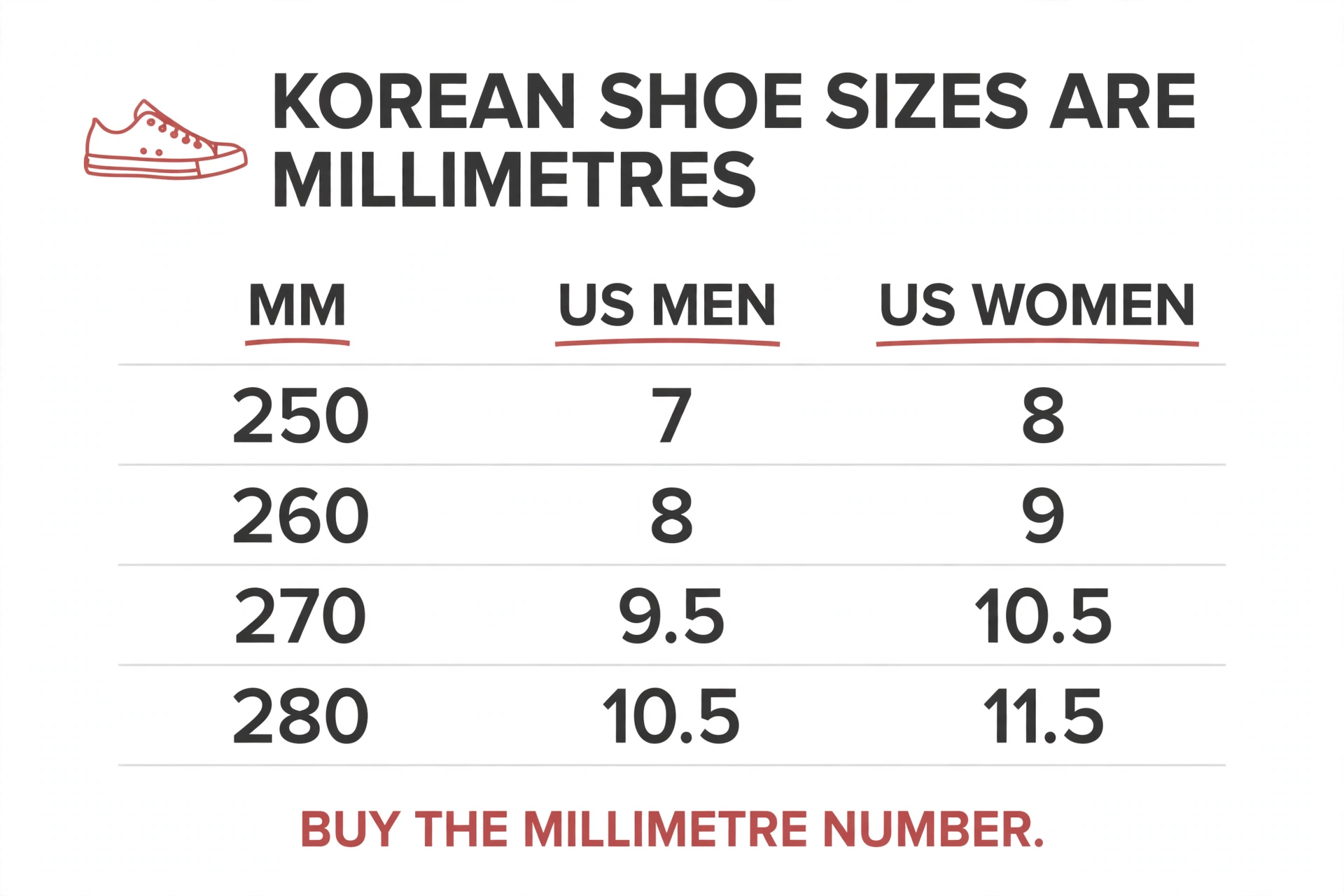
Korean shoe sizing runs in millimetres, and converting carelessly is the most common buying mistake. Korean sizes state foot length directly: 250 is a 25cm foot, roughly a US men’s 7 or women’s 8; 260 is about a US men’s 8; 270 about a US men’s 9.5; 280 about a US men’s 10.5 to 11. Chunky and platform styles add a second trap, because the sole’s visual size is not the fit size, and wide Korean cuts often run generous through the forefoot. Buy your millimetre size, not your converted size, and treat any chart that disagrees with the millimetre number as wrong. The main domestic route is the platform described in the Musinsa newsroom, where Korean and global footwear labels sell side by side with the sizing stated in millimetres throughout; our brands and Musinsa guide covers shipping and returns in full. Buy the default first, a white or cream chunky sneaker in your true size, wear it against every leg in your wardrobe for a month, and only then add the loafer or the boot. Shoe rotations built in that order get worn; rotations bought as a set mostly decorate a hallway.
Finally, try shoes at the end of the day and on both feet, in the socks the shoe will actually be worn with. Feet swell measurably across a walking day, and a chunky sneaker that fits perfectly at ten in the morning can be a size small by evening, which is when Seoul outfits do most of their work. Walk the shop’s hard floor, not its carpet, and check the heel slip with the wide trousers you plan to pair, because hem and heel interact. None of this is glamorous advice. It is, however, the difference between the shoe rotation described in this guide and a shelf of almost-right pairs, and in a system where the shoe decides the outfit, almost-right is the one result the wardrobe cannot use.
Our View
Our view is that footwear is where Korean street style stops being a look you copy and becomes a system you run. The clothing rules are stable enough to learn in a week. The shoe decisions, weight against width, polish against ease, season against silhouette, are made fresh with every outfit, and they are the decisions that separate a wardrobe that photographs well from one that merely contains the right pieces. Start with the chunky default, learn the proportion rule, and add one specialist at a time.
The outfit is decided at ankle height. Choose the shoe like it is the point, because in Seoul it usually is.
— Brian Ka
Frequently Asked Questions
What shoes do people in Seoul wear with wide-leg trousers?
Chunky sneakers first, because the wide hem needs visual weight under it. Platform loafers and ankle boots are the polished and cold-weather alternatives. Slim, low-profile shoes are the pairing to avoid.
Why are chunky sneakers so popular in Korea?
Because the Korean silhouette is wide and soft above the ankle, and a substantial shoe balances it. Korea also has a direct claim on the style: Fila has been Korean-owned since 2007 and is headquartered in Seoul, and its thick-soled shoes helped define the look at home before it spread.
Can you wear loafers with Korean streetwear?
Yes. A leather loafer, classic or platform-soled, is the polished option that tightens wide trousers and oversized tops into relaxed tailoring. It is the standard way to carry the look into offices and restaurants.
How do Korean shoe sizes convert?
Korean sizes are foot length in millimetres: 250 is roughly US men’s 7, 260 about US men’s 8, 270 about US men’s 9.5, and 280 about US men’s 10.5 to 11. Buy by the millimetre number.
When do boots replace sneakers in Seoul?
From the first cold weeks through winter, and year-round with long skirts and dresses. Ankle boots work under wide trousers; taller lace-up boots are worn where the full boot is meant to show.
Questions About Building Your Wardrobe?
Tell us which formula you are trying, what is not working, and where you live — proportion advice is always specific to the outfit and the day it has to survive.
Sources
- V&A — Hallyu! The Korean Wave exhibition
- MFA Boston — Hallyu! The Korean Wave
- Wikipedia — Fila: Seoul headquarters and Korean ownership
- Musinsa — Newsroom
- Highsnobiety — Seoul fashion brands
- SNKRDUNK Magazine — The Korean takeover of streetwear fashion
- Hypebae — Ader Error, Korean design collective
- Dazed — How K-pop changed fashion
- Seoul Metropolitan Government — Seoul Fashion Week landmarks
- Korea JoongAng Daily — Seoul fashion history
- Visit Seoul — Person:able Seoul style guide