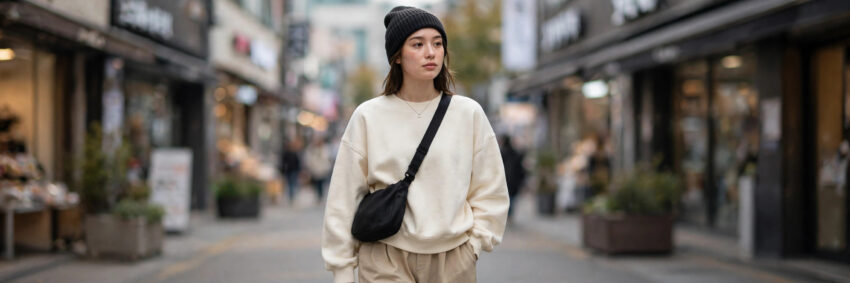
A Korean streetwear outfit rarely fails on the main pieces. The oversized jacket is right, the wide trousers fall correctly, the sneakers carry the weight, and still something looks unfinished when the photograph is taken. What is missing is almost always at the edges: the bag that gives the silhouette a second shape, the beanie or cap that closes the top of the frame, the white sock showing deliberately between hem and shoe, the single piece of plain silver at the neck or wrist. Seoul dressers treat those finishing pieces as a system rather than an afterthought, dosed carefully so one piece leads and the rest stay quiet, and adjusted district by district, looser and more playful in Hongdae, cleaner and more restrained in Gangnam. This guide breaks that system down piece by piece, so the last ten percent of the outfit does the work it is supposed to do.
Start Here
Key Takeaways
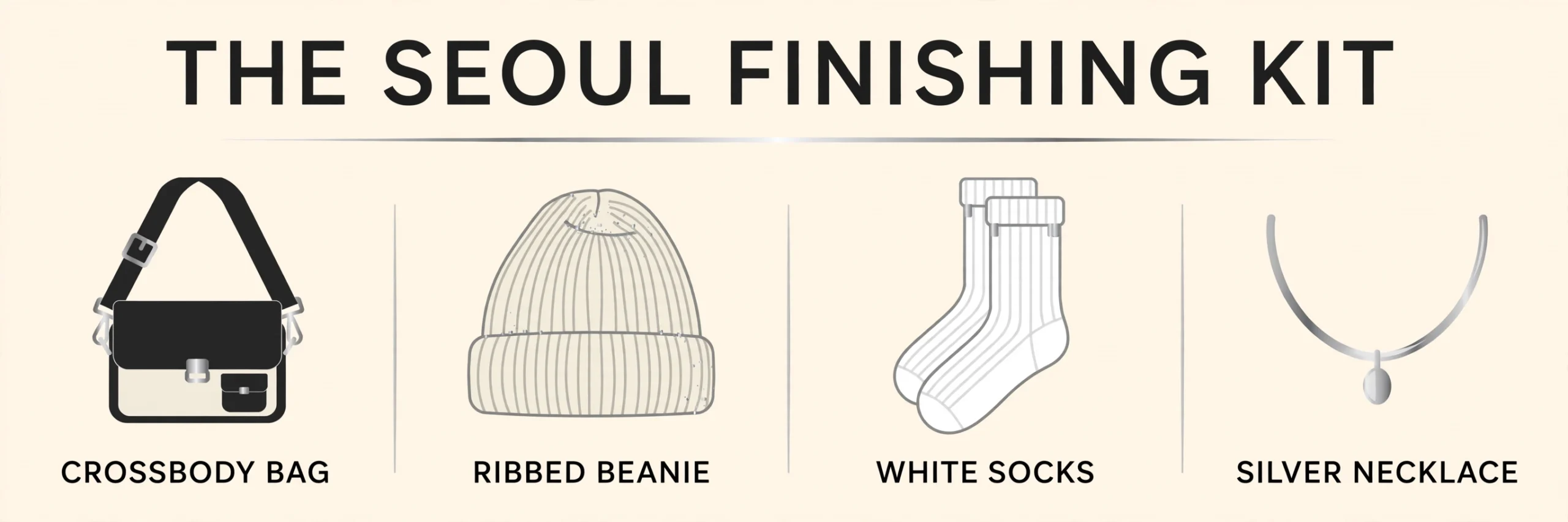
- The Korean finishing system has four working parts: a crossbody bag or tote, a beanie or cap, visible white socks, and minimal silver jewelry.
- Seoul dressers dose accessories by a simple rule: one headline piece leads the outfit and everything else supports it quietly.
- The bag does structural work, adding a second shape and a diagonal line to wide, soft silhouettes that would otherwise read as shapeless.
- White socks are worn on purpose in Seoul, pulled up and visible between a cropped or wide hem and the shoe, never hidden.
- Hongdae accessories run louder, cheaper and more experimental, while Gangnam accessories run cleaner, smaller and more expensive looking.
- Musinsa and the Seoul shopping districts are the natural places to buy the kit, because the pieces are designed to work together from the start.
Contents
- Bags: Crossbody Bags and Totes
- Beanies and Caps
- Socks: The Visible White Sock
- Jewelry: Minimal Silver
- The Dosing Rule: One Headline, Quiet Supports
- Hongdae vs Gangnam: Two Registers
- Buying: Musinsa and the Seoul Districts
- Our View
- Frequently Asked Questions
- Sources
- Recommended
Bags: Crossbody Bags and Totes
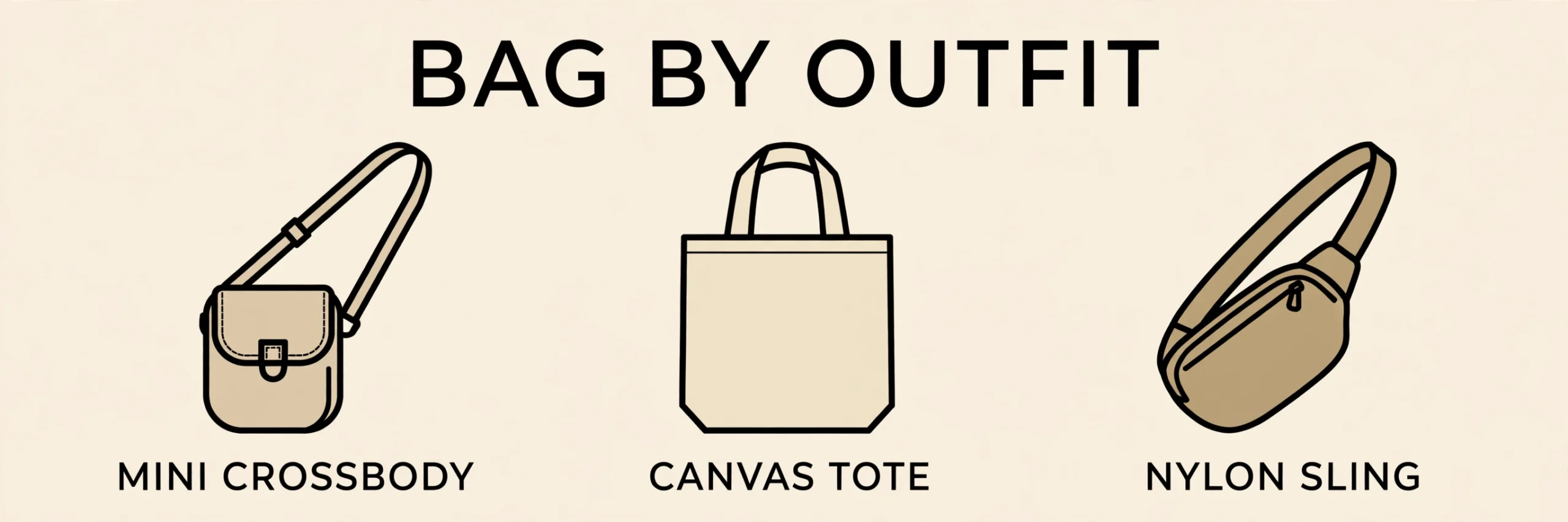
Bags come first in the Seoul system because they change the shape of everything else. A Korean streetwear outfit is built from volume: a wide top, a wide leg, a shoe with presence. Volume alone, worn without anything crossing it, can read as a single soft mass, especially in the plain colours the style prefers. The crossbody bag solves that problem in one move. Worn diagonally across the chest or high on the back, it cuts a line through the volume, gives the eye a second, smaller shape to read against the first, and marks the waist or chest on a garment that deliberately hides both. The Seoul version is compact, usually just large enough for a phone, a wallet and a transit card, in black nylon, washed canvas or plain leather, with the strap shortened so the bag sits high rather than swinging at the hip. That high, tight carry is the detail that separates the Seoul crossbody from the loose messenger bag worn elsewhere. It sits like part of the clothing, not like luggage.
| Accessory | Seoul version | What it finishes |
|---|---|---|
| Crossbody bag | Small, black, worn high and tight across the chest | Cuts a diagonal line through wide, soft volume |
| Tote bag | Plain canvas or nylon, carried by hand or on one shoulder | Adds a clean vertical shape to a relaxed outfit |
| Beanie | Ribbed, close fitting, worn above the ears or slightly back | Closes the top of the frame and sharpens the face |
| Cap | Plain or lightly lettered, curved brim, neutral colour | Adds a casual top note without changing the outfit |
| White socks | Ribbed crew socks, pulled up and shown on purpose | Connects a wide or cropped hem to the shoe |
| Silver necklace | Thin chain, small or no pendant, worn over or under a tee | Adds one point of light at the neck |
| Silver ring or bracelet | Plain band, worn singly | Finishes the hands without competing with the neck |
The tote is the second bag in the system, and it does a different job. Where the crossbody is close and structured, the tote is open and relaxed, carried by hand or hooked on one shoulder over a coat or hoodie. The reference history of the tote bag form is simple, two handles and an open top, and Seoul keeps it that simple: plain canvas in white, cream or black, a small printed logo or a single line of lettering at most, and nothing in the way of hardware or decoration. On a student or office outfit the tote carries what the crossbody cannot, a laptop, a book, a change of shoes, while still reading as part of the look rather than a shopping bag pressed into service. The wider accessories picture behind both bags, including the hip-hop rooted chains, belts and sunglasses tradition, is covered in our general guide to streetwear accessories, and this page deliberately leaves that tradition there. The Korean bag choice is narrower and more disciplined: one of two shapes, in a neutral colour, worn the same way every day until it becomes part of the wearer’s silhouette.
Choosing between the two bags is mostly a question of what the day holds and what the outfit needs. A crossbody day is a moving day: markets, trains, long walks, hands free, nothing to set down and forget. A tote day is a settled day: a campus, a cafe, a workplace, somewhere the bag can rest beside a chair while its owner stays in one place. Many Seoul dressers own both in the same colour and switch without thinking, which is itself a lesson in how the system works. The pieces are interchangeable because they were chosen inside a tight set of rules about size, colour and decoration, so no single purchase can break the wardrobe. If you are building the kit from nothing, start with the black crossbody. It finishes more outfits, in more seasons, than any other single accessory on this page, and it is the piece visitors most often notice in Seoul street photographs without being able to name why the outfit looks complete.
Beanies and Caps
Headwear closes the top of the outfit, and Seoul treats an uncovered head as an unfinished frame. The beanie is the winter default. The standard reference on the beanie and its history describes a close, brimless knitted cap, and the Seoul version stays close to that plain description: ribbed knit, a folded cuff, in black, grey, cream or a single muted colour, worn pulled down above the ears or pushed slightly back so a fringe of hair shows at the front. It does three jobs at once. It keeps the head warm in a winter that regularly sits below freezing, it gives a wide, soft outfit a tight, definite ending at the top, and it frames the face, which matters in a style where hair and makeup are part of the presentation. A slouchy, oversized beanie worn low over the ears belongs to a different tradition. The Seoul beanie is neat, and its neatness against loose clothing is exactly the contrast the outfit is built on.
The cap takes over when the weather turns, and it follows the same discipline. A plain curved-brim cap in black, navy, cream or washed denim, with small lettering or no lettering at all, worn forward and sitting properly on the head rather than perched or tilted. In summer it is sun protection, in spring and fall it is a way to finish an outfit on a day when the hair is not cooperating, and year round it is the fastest way to make a plain tee and wide trousers read as a deliberate look instead of clothes grabbed on the way out. The bucket hat appears in Seoul summers too, especially in Hongdae, but it is a statement piece rather than a default, and it counts as the outfit’s headline when it is worn. That distinction, default against statement, runs through the whole accessories system. Defaults are bought in neutrals and worn without thought. Statements are chosen one at a time, on purpose, and everything else that day stays quiet around them.
Fit is where most people outside the system get headwear wrong. A beanie that is too loose slides, bunches and reads as an accident, while one that is too tight flattens the hair and squeezes the forehead. The Seoul fit sits snug at the cuff with a small amount of room at the crown, enough to keep some height in the silhouette. Caps are adjusted the same way, worn at the natural head size with the brim curved, not flat, because the flat brim belongs to a different streetwear tradition with different rules. Colour choice follows the bag rule: black first, then grey or cream, then one muted colour if the wardrobe can support it. A bright beanie or a heavily branded cap is not forbidden, but the moment it goes on, it becomes the headline piece, and the bag, the jewelry and the socks all have to step back. Worn that way, with the dose understood, even a loud hat stays inside the system.
Socks: The Visible White Sock
No finishing piece surprises visitors more than the sock, because Seoul wears it where everyone can see it. The standard is a ribbed white crew sock, pulled up to mid calf, shown in the gap between the hem of a wide or cropped trouser and the top of the shoe. In much of Western dressing that gap is treated as an embarrassment, something to be closed with a longer trouser or hidden with a low, invisible sock. Seoul treats it as a design space. The white band connects two dark or neutral shapes, trouser above and shoe below, with a clean stripe of light, and it signals that the break in the leg line was planned. The same logic appears with shorts in summer, where the pulled-up white sock and a chunky sneaker make a complete unit, and with skirts and loafers in women’s dressing, where the sock does the same connecting work in a different register.
The sock only works because the shoe underneath it is chosen to support it. Chunky sneakers, retro runners and plain loafers all give the white band something solid to land on, which is why footwear and socks should be planned together rather than separately; our guide to Korean streetwear shoes covers the shoe side of that pairing in full. The rules for the sock itself are short and strict. It must be genuinely white, not grey with age, which means socks are bought in multiples and replaced often. It must be ribbed or textured enough to read as a garment rather than an underlayer. It must be pulled up evenly on both legs, because a sock that has slid down on one side breaks the symmetry the whole detail depends on. Logo socks exist and are common on younger wearers, with a small mark at the ankle, but the plain version is the safer default and the one that finishes the widest range of outfits.
Season changes the sock but never removes it. In the heat covered by our Korean streetwear in summer guide, the crew sock shortens slightly and the fabric thins, yet the visible white band survives even with sandals in the most casual Hongdae registers. In winter the sock thickens, sometimes worn over tights or under a boot where only the top band shows, and that small band still does its connecting work. The deeper point is that the Seoul system does not have a bare-ankle season. The ankle is always dressed. Once you adopt that rule, a surprising number of outfits that looked slightly off resolve themselves, because the leg line now has a beginning, a middle and an end instead of fading out where the trouser stops. Of all the pieces on this page, the white sock is the cheapest, the easiest to copy exactly, and the one that most quickly makes an outfit read as Korean rather than generally casual.
Jewelry: Minimal Silver
Jewelry in the Seoul system is a point of light, not a display. The default metal is silver, the default scale is small, and the default number is one piece, two at most. A thin chain at the neck, worn over a plain tee or tucked under a shirt collar so only a short section shows. A single plain ring. A slim bracelet or a simple watch. That is the whole vocabulary for most outfits, and its restraint is deliberate. The cultural current that carried Korean style around the world, described in the overview of Hallyu, the Korean Wave, put idols and actors in front of enormous audiences, and the jewelry that read clearly on screen and in photographs was rarely the largest piece available. It was the piece that caught light at the neck or the hand while everything around it stayed plain, and everyday Seoul dressing absorbed that lesson thoroughly.
The necklace is the lead piece, and its placement matters as much as its size. Worn over a crew neck tee, a fine chain with a very small pendant, or no pendant at all, sits at the centre of an otherwise empty field of cloth, which is why such a small object can finish an entire top half. Worn under an open shirt, the same chain appears and disappears as the wearer moves, a quieter effect suited to the Gangnam register discussed below. Earrings follow the same scale in women’s and men’s dressing alike: small silver hoops or studs, often a single hoop in one ear on men, close to the lobe rather than dropping or swinging. The women’s version of the full system, including how jewelry doses change with dresses and softer silhouettes, is covered in Korean street style for women, and the principle there is identical. One bright point, deliberately placed, against a calm background.
What the system avoids is as instructive as what it uses. Thick chains, stacked rings on several fingers, multiple bracelets and large pendants all belong to other streetwear traditions, and worn together they pull a Korean outfit out of its own register and into a louder one. Gold is not absent from Seoul, but it reads as a stronger statement than silver and is dosed even more carefully, often as a single thin piece where silver might allow two. Watches sit slightly outside the jewelry rules because they are read as functional objects first: a clean metal or plain leather watch can be worn on a day when no other jewelry is present without counting as the headline piece. The test for any addition is simple. If the eye lands on the jewelry before it lands on the outfit as a whole, there is too much of it, or it is too large, or there are too many pieces sharing the work that one piece should do alone.
The Dosing Rule: One Headline, Quiet Supports
Every piece above obeys one rule, and the rule is the real subject of this guide. One accessory leads. The rest support, quietly. A Seoul outfit might be led by the crossbody bag, with a plain beanie, plain socks and no jewelry at all. Or it might be led by a statement cap, with a small bag and a thin chain stepping back. Or, on the plainest outfit of all, a white tee and wide black trousers, it might be led by the necklace, the single bright point that the whole minimal look is arranged around. What it will almost never do is lead with three pieces at once. That discipline is what separates the Korean finish from the accessorised look built by adding one more thing until the outfit feels done. In Seoul the outfit feels done earlier, and the skill lies in stopping.
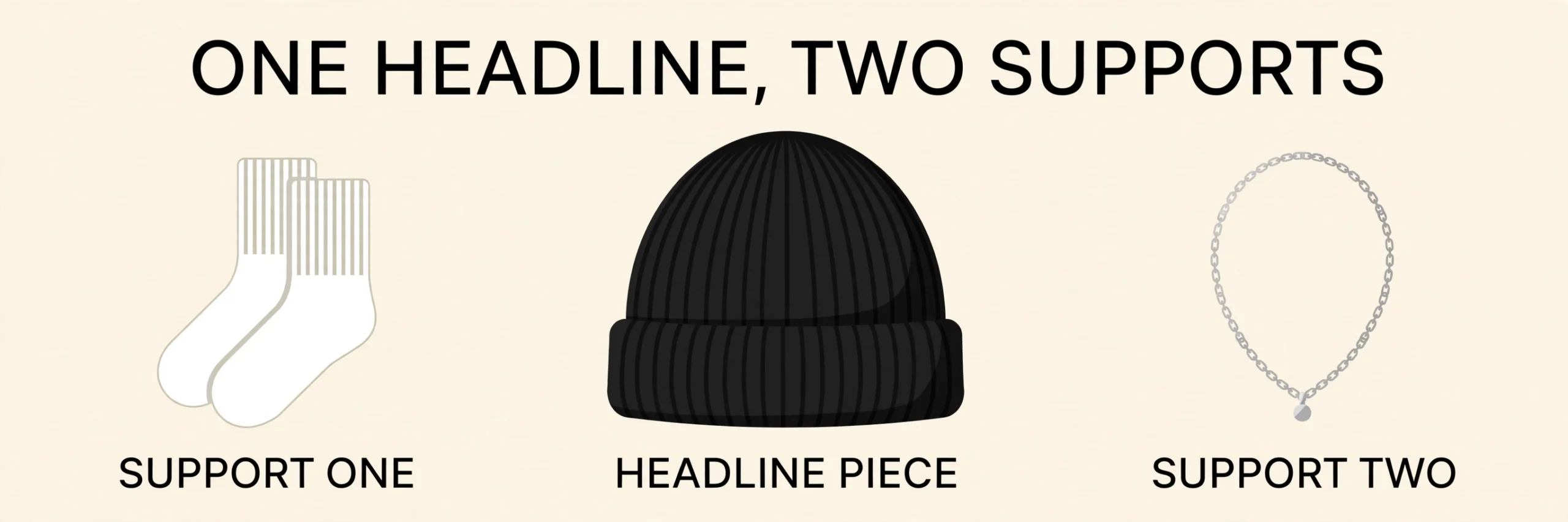
The rule is easier to keep when the supporting pieces are bought as a set of neutrals, which is where a short list of streetwear essentials earns its place in the wardrobe. A black crossbody, a black beanie, a cream cap, white socks in quantity, one silver chain and one silver ring will finish almost any Korean outfit without a single decision being made on the morning itself. The headline piece is then the only variable: a coloured beanie on a grey day, a larger tote when the outfit is very plain, a second ring when the hands will be visible at a table all evening. Museum coverage of the wave that spread this aesthetic, including Hallyu at MFA Boston, presented Korean dressing as a designed system, and the dosing rule is the part of that system most worth copying, because it transfers to any wardrobe. You do not need Korean brands to dress by it. You need a small kit of quiet pieces and the restraint to let one of them lead at a time.
A practical way to learn the dose is to build outfits backwards. Start with the clothes, then ask which single accessory the outfit is missing most: shape, in which case the bag leads; an ending at the top, in which case the hat leads; a point of light, in which case the jewelry leads. Add that piece, then add only the supports that the outfit needs to function, socks because the hem demands them, a plain cap because the weather does. Stop there and look once more. Most failed accessorising is not a failure of taste in individual pieces, nearly all of which are usually fine on their own. It is a failure of arithmetic, four good pieces each asking for attention until none of them receives it. Seoul arithmetic is stricter and kinder at the same time: one plus quiet equals finished, and finished, repeated daily with small variations, is what personal style actually looks like from the outside.
Hongdae vs Gangnam: Two Registers
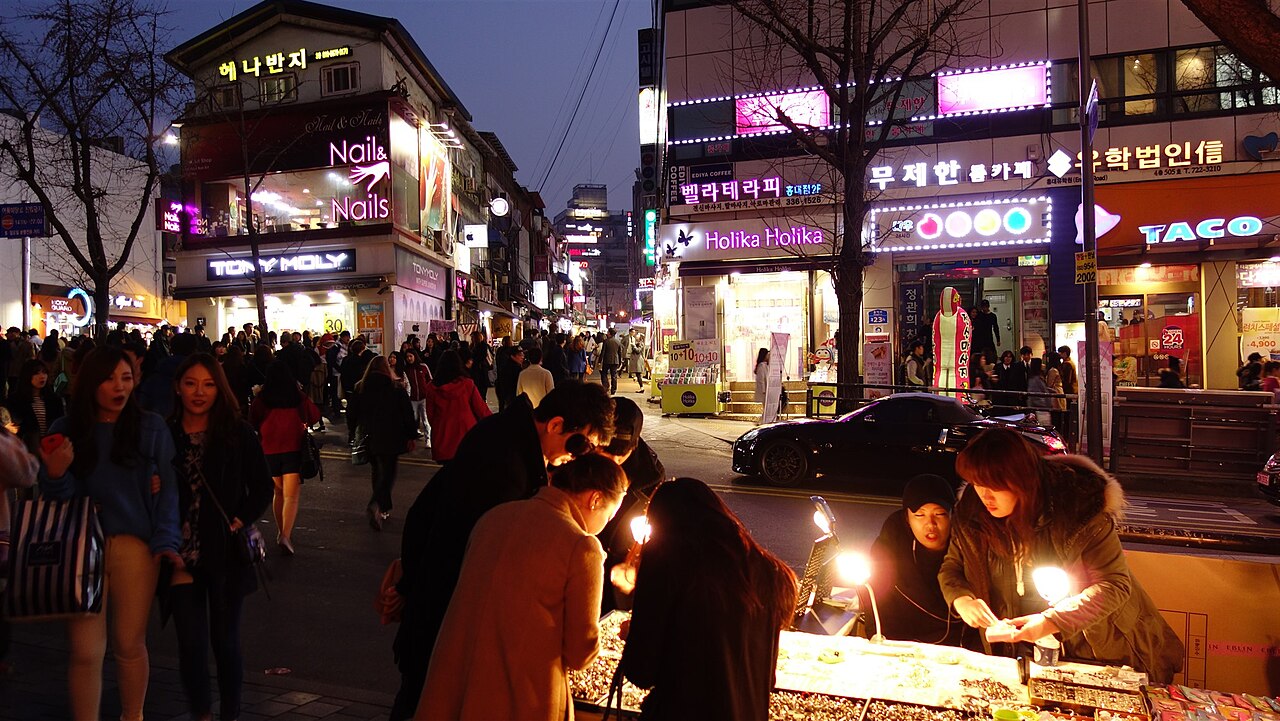
The same kit reads differently on opposite sides of the river, and the difference is a matter of register, not of rules. Hongdae, the university district built around Hongik University, is the experimental end of Seoul dressing. Accessories there run louder and cheaper and change faster: coloured beanies, printed totes, layered thin necklaces, socks with marks and patterns, bags worn in unusual positions. The cost of a mistake is low, the audience is young, and the whole district functions as a testing ground where a finishing idea can be tried for the price of a coffee. Coverage of the city’s fashion energy, from Seoul brands on Highsnobiety to reporting on the wider scene, returns to Hongdae again and again for exactly that reason. It is where the system’s next default is usually invented, worn first by students before it settles into the mainstream.
Gangnam runs the same system at the opposite setting. South of the river, the accessories get smaller, cleaner and more expensive looking: the crossbody becomes plain leather with no visible branding, the beanie disappears in favour of a neat cap or nothing, the jewelry thins to a single fine chain, and the white sock stays, because some rules hold in every register, but it is immaculate. The city itself stages this contrast, with events described by Seoul Fashion Week coverage linking landmarks from Dongdaemun to the towers of the south bank into one fashion geography. Our direct comparison of the two districts, Hongdae vs Gangnam style, covers clothing in full, and the accessories follow the clothing exactly. Hongdae adds, Gangnam subtracts, and both are recognisably the same language spoken at different volumes.
Neither register is the correct one, and most Seoul dressers move between them by occasion rather than living permanently at either end. A Hongdae outfit worn to a Gangnam office dinner is not wrong in its pieces, only in its dose: the printed tote is swapped for the plain one, the layered necklaces become one, the coloured beanie stays home. Men’s dressing shows the shift most clearly, since the base outfit often does not change at all between districts and only the finishing pieces move; the wardrobe frame for that is set out in Korean streetwear for men. Learning to read the two registers gives you a dial rather than a switch. Turn the accessories up for a night market, a concert or a campus. Turn them down for work, family occasions and anywhere formality is being measured. The kit stays the same. Only the dose changes, which is precisely what the system was designed to allow.
Buying: Musinsa and the Seoul Districts
The kit is easiest to buy where it was designed to be sold together. Online, that place is Musinsa, the platform at the centre of Korean fashion retail. The company’s own announcements, such as the Musinsa newsroom release, describe a marketplace that has grown from a street fashion community into the default shopping destination for young Korea, and the background in the Musinsa reference entry traces that same path. For accessories the advantage is practical: bags, beanies, socks and silver jewelry from Korean labels sit in one basket, sized and styled for the outfits on this page, at prices that start genuinely low for the student pieces and rise for the leather and branded versions. The exhibition history at the V&A Hallyu exhibition showed how tightly Korean fashion, music and screen culture are woven together, and Musinsa is where that weave becomes shoppable for a visitor who may never set foot in Seoul.
In person, the districts divide the shopping the same way they divide the dressing. Hongdae and the streets around Ewha and Sinchon are the ground for inexpensive, fast moving accessories: stalls and small shops selling beanies, socks, totes and costume silver in every colour, where the right strategy is to buy the experimental piece cheaply and let it earn a permanent place before spending more. Dongdaemun is the volume district, wholesale halls and late night markets where basics, white socks by the bundle, plain caps, plain canvas totes, can be bought in quantity. Gangnam and the department store districts sell the quiet end: plain leather crossbody bags, fine chains, watches, pieces with no visible branding at prices that assume they will be worn for years. The visitor guidance collected by Visit Seoul on Hallyu places points travellers toward several of these same neighbourhoods, and an accessories route through them doubles as a tour of the registers described above.
Two cautions belong in any buying advice for this kit. The first is about idol influence. Reporting on the runway and idol pipeline, including Dazed on idol fashion, shows how quickly a piece worn by a performer becomes the piece everyone is searching for, and accessories are the easiest idol items to copy, which makes them the fastest to date. Buy the idol’s exact beanie if you love it, but know that the plain version will still be wearable when the exact one is not. The second caution is about quality at the very low end, a point made in scene coverage such as SNKRDUNK on the Korean takeover: a two dollar chain that turns green in a week finishes nothing. Socks and beanies can be bought cheaply without penalty. Anything metal that touches skin, and any bag strap that carries weight daily, deserves the middle of the price range rather than the bottom of it.
Our View
Our view is that accessories are where Korean streetwear is most honest about itself. The wide trousers and oversized tops get the attention, but they are easy to copy badly, and copying them alone produces the familiar result of an outfit that has the right shapes and no finish. The finishing system is the opposite: cheap, small, almost entirely about restraint, and impossible to fake with a single expensive purchase, because its whole effect comes from the dose. One headline piece, quiet supports, a dressed ankle, a point of silver light. Learn that arithmetic and the rest of the Seoul look starts to assemble itself around it, in Hongdae colours or Gangnam neutrals, on a Musinsa budget or a department store one. Skip it, and no jacket, however perfect, will close the gap between dressed and finished.
Finish the outfit at its edges. One piece leads, the rest stay quiet, and the smallest details — a white sock, a thin chain, a bag worn high — are what make a Seoul look complete.
— Brian Ka
Frequently Asked Questions
What is the most important Korean streetwear accessory to buy first?
The small black crossbody bag. It finishes more outfits than any other single piece because it adds shape and a diagonal line to the wide, soft silhouettes Korean dressing is built from. Buy it plain, wear it high and tight, and add every other piece on this page afterwards.
Why do Koreans wear white socks pulled up with streetwear outfits?
The visible white sock is deliberate. It connects the hem of a wide or cropped trouser to the shoe with a clean band of light, shows that the break in the leg line was planned, and completes the leg instead of leaving a bare gap. The sock must be clean, ribbed and pulled up evenly to work.
How much jewelry is too much for a Korean streetwear look?
More than two small pieces is usually too much. The Seoul standard is one thin silver chain, or a chain plus a single plain ring or slim bracelet. If your eye lands on the jewelry before the outfit as a whole, reduce the number of pieces or their size.
What is the difference between Hongdae and Gangnam accessories?
Hongdae accessories are louder, cheaper and more experimental: coloured beanies, printed totes, layered necklaces and patterned socks. Gangnam accessories are smaller, cleaner and more expensive looking: plain leather bags, one fine chain, neat caps and immaculate white socks. The pieces are similar, the dose and finish are different.
Where should I buy Korean streetwear accessories online?
Musinsa is the central platform for Korean fashion and the natural starting point, because bags, beanies, socks and silver jewelry from Korean labels are sold there together and styled for these outfits. In Seoul, Hongdae suits experimental pieces, Dongdaemun suits basics in quantity, and Gangnam suits plain leather and fine jewelry.
Questions About Building the Look?
Tell us which outfit you are trying to finish and we will point you to the right guide. Contact Streetwear Next
Sources
- V&A — Hallyu: The Korean Wave Exhibition
- Museum of Fine Arts Boston — Hallyu: The Korean Wave
- Musinsa Newsroom
- Wikipedia — Musinsa
- Wikipedia — Hallyu
- Highsnobiety — Seoul Fashion Brands
- Dazed — K-Pop Idol Fashion and the Korean Catwalk
- Seoul Metropolitan Government — Seoul Fashion Week
- Visit Seoul — Hallyu Guide
- Wikipedia — Beanie
- Wikipedia — Tote Bag
- SNKRDUNK Magazine — The Korean Takeover of Streetwear Fashion