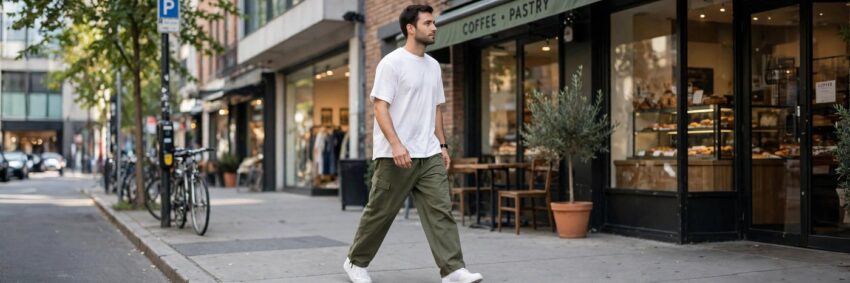
Full-length cargo pants are the easiest streetwear trouser to wear badly and one of the most rewarding to wear well. The difference rarely comes down to the brand on the label. It comes down to decisions most people never make on purpose: how the leg falls from the thigh to the opening, how much volume the pockets add at the side of the leg, which fabric the whole thing is cut from, and what you put on your feet and your top half to balance it. Get those choices right and cargos read as relaxed, deliberate streetwear, the kind of trouser you can wear four days a week without thinking about it. Get them wrong and the same garment slides into fancy dress, a costume assembled from straps, buckles and camouflage that looks like it was borrowed from a film set. This guide covers the full-length, straight or loose leg cargo pant only, and works through fit, pockets, fabric, footwear, proportion, colour and the specific mistakes that tip an outfit over the line.
Start Here
New to utility trousers? Start with the close cousin covered in our guide to cargo joggers, then build the rest of the rotation from the streetwear essentials every wardrobe needs. For complete looks built around relaxed trousers, browse our streetwear outfit ideas for men, and when you want to see proportions rather than read about them, the streetwear inspo gallery shows how the silhouettes sit on real bodies.
Key Takeaways
- This guide is about full-length cargo pants with a loose or straight leg and an open hem, not the cuffed cargo jogger.
- Fit through the thigh and a leg opening that sits cleanly over your shoe decide whether cargos look relaxed or sloppy.
- Flat bellow pockets keep the silhouette clean; bulky patch pockets stuffed full are what push cargos toward costume.
- Ripstop, cotton twill and nylon are the three working fabrics, and each one changes the weight, drape and season of the pant.
- Footwear needs enough substance to hold the leg opening; the top half needs enough structure to balance the volume below.
- Neutral colours and one military reference per outfit keep the look grounded; camo overload and dangling straps undo it.
Contents
- Fit First: Thigh, Leg and Opening
- Pockets: Volume and Placement
- Fabrics: Ripstop, Twill and Nylon
- Footwear That Holds the Hem
- The Top Half: Balance and Proportion
- Colour Choices That Stay Grounded
- Mistakes That Create the Costume Look
- Our View
- Frequently Asked Questions
- Sources
- Recommended
Fit First: Thigh, Leg and Opening
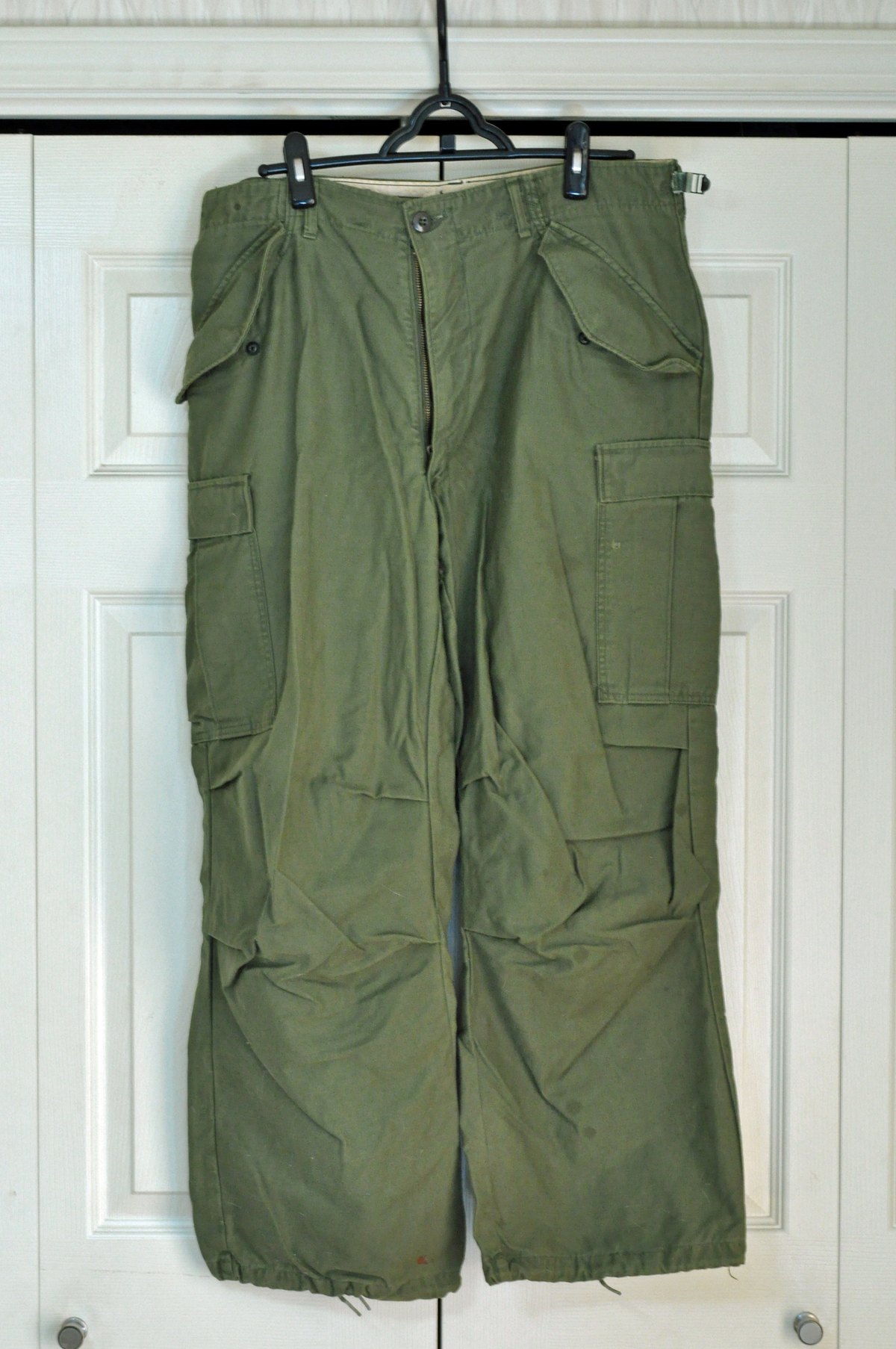
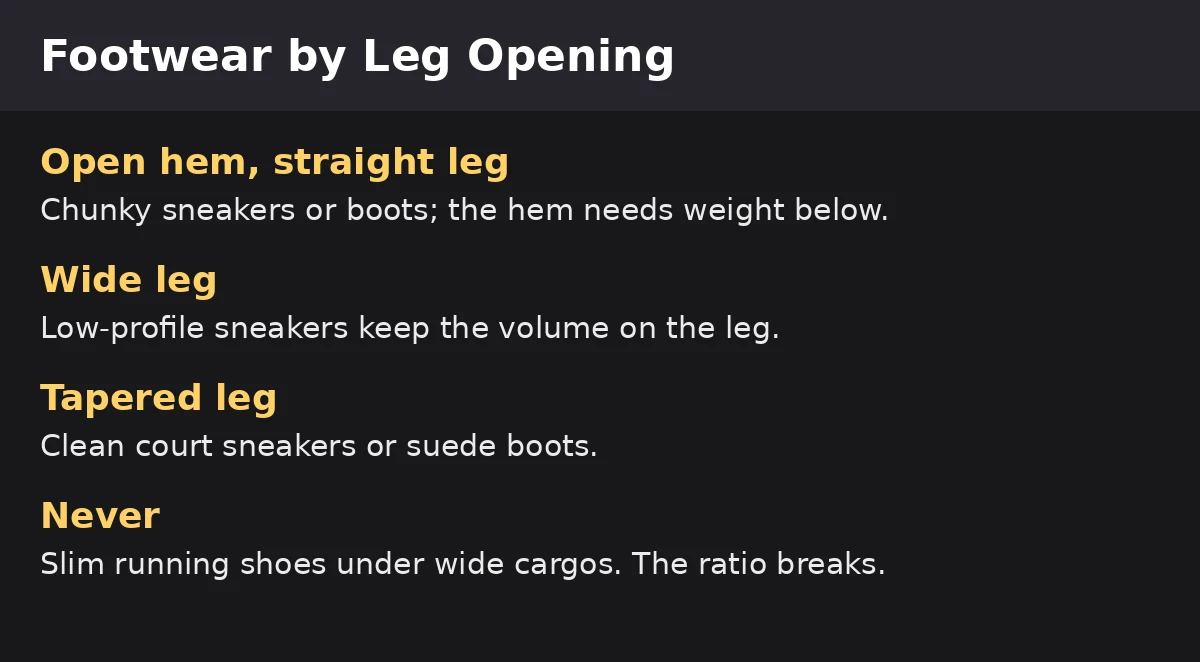
Every cargo outfit is decided at the fitting room mirror by two measurements most shoppers ignore, the room through the thigh and the width of the leg opening. The thigh comes first because it sets the character of the whole pant. A full-length cargo needs ease through the thigh, enough that you can pinch a small fold of fabric at the side and sit down without the pocket seams pulling, but not so much that the cloth billows when you walk. That ease is not sloppiness. It is the original working logic of the garment, since cargo pants began as military dress cut for movement, carrying and long days on foot rather than for a clean tailored line. The modern streetwear version keeps that logic and tidies everything around it. Look for a rise that sits at or just below the natural waist, because a low, dropped rise lengthens the pocket drop, drags the whole leg down and is the fastest route to the sagging silhouette people picture when they say cargos look dated. From a well-placed thigh, the leg should fall in one of two honest directions, straight to the shoe with the same width from knee to hem, or loose and wide with a deliberate, even volume all the way down. What you want to avoid is the accidental middle, a leg that is baggy at the thigh, narrow at the calf and wide again nowhere in particular, because that uneven taper is a manufacturing compromise, not a fit, and it reads as one.
The leg opening is where the full-length cargo separates itself from its cuffed relative, and it deserves a sentence of its own. Our guide to streetwear joggers covers the elastic-cuff family in depth, and the cargo jogger borrows that cuff, gathering the hem at the ankle so the shoe does the visual work. A full-length cargo pant has no cuff to rescue it. The hem has to land correctly on its own, which means length matters more here than in almost any other trouser you own. The hem should meet the shoe and break once, lightly, or sit just on top of the footwear with the opening wide enough to cover the laces without swallowing the whole shoe. Fabric pooling in folds around the ankle adds phantom weight to the leg, drags on wet pavement and instantly makes an otherwise good outfit look borrowed. Too short is the opposite error: a wide opening that ends above the shoe floats, shows a band of sock at the wrong moment and breaks the long line that makes the loose leg look intentional. If you find a pair that fits the thigh and waist but runs long, have the hem taken up before you wear them out. It is the cheapest alteration in tailoring and, on this particular trouser, the one that does the most work.
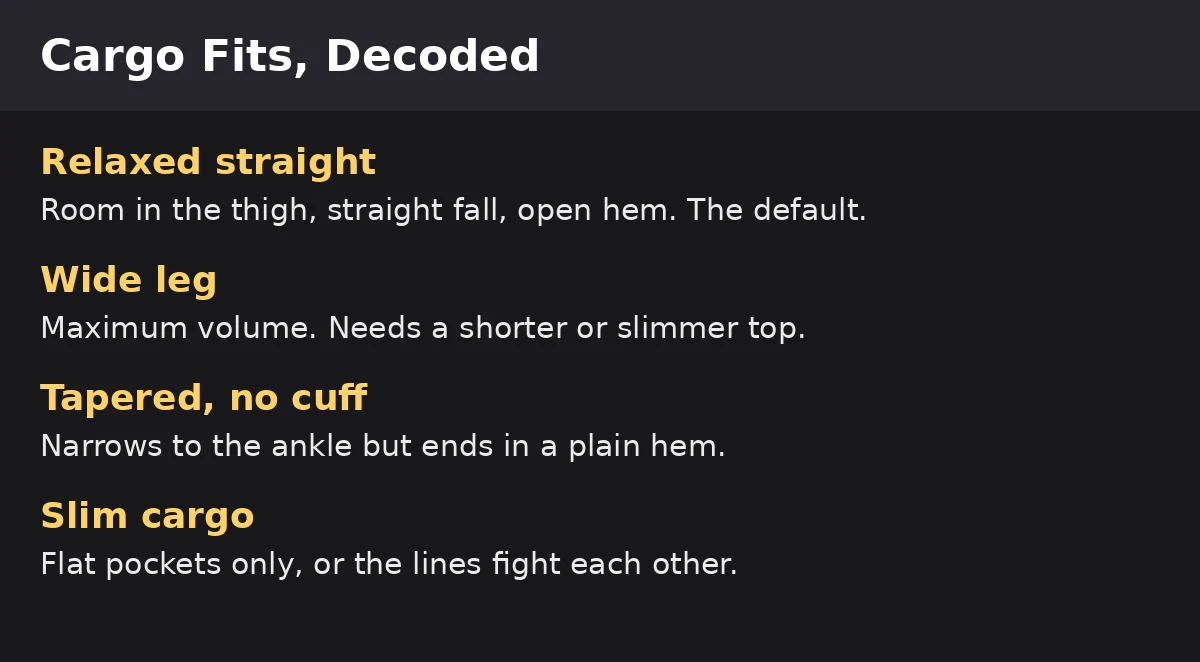
| Fit | Leg opening | Pocket style | Best footwear |
|---|---|---|---|
| Relaxed straight | Medium, sits on the shoe with one light break | Flat bellow, sits flush when empty | Chunky sneakers, retro runners |
| Wide leg | Wide, covers the laces and part of the shoe | Flat or low-profile bellow, kept empty | High-top sneakers, boots, platform soles |
| Tapered, no cuff | Narrower open hem, clears the ankle cleanly | Slim patch or welted cargo pocket | Low-profile sneakers, suede shoes |
| Slim cargo | Narrow, close to a chino opening | Minimal flat pocket, almost tailored | Minimal sneakers, loafers for smarter settings |
Use the table as a starting grid rather than a law, because your own proportions referee the final call. Taller frames carry the wide leg easily, since there is enough inseam for the volume to distribute along, while shorter frames usually look sharper in the relaxed straight fit, where the unbroken vertical line adds rather than subtracts height. Broader builds benefit from the straight leg for the same reason: the column of fabric reads as one shape instead of a series of bulges at thigh, pocket and hem. None of this requires a perfect body or a new wardrobe. It requires trying two fits side by side in the same shop, walking in both, sitting in both, and choosing the one where the leg falls in a clean line from hip to shoe without you adjusting it. A cargo pant you have to keep pulling up, shaking out or re-arranging at the hem will announce itself all day, and an outfit you are visibly managing never looks relaxed, whatever the mirror said in the shop.
Pockets: Volume and Placement
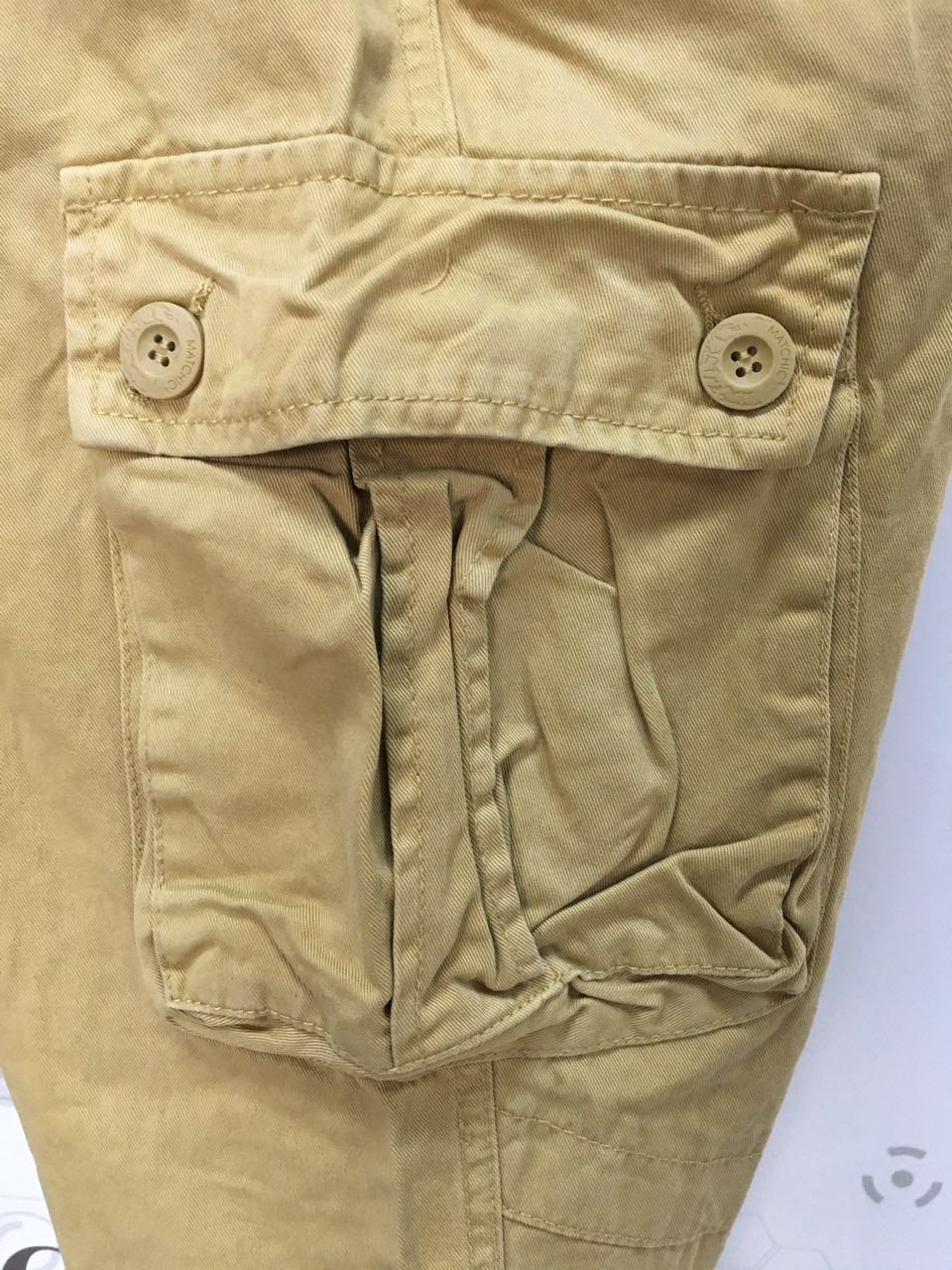
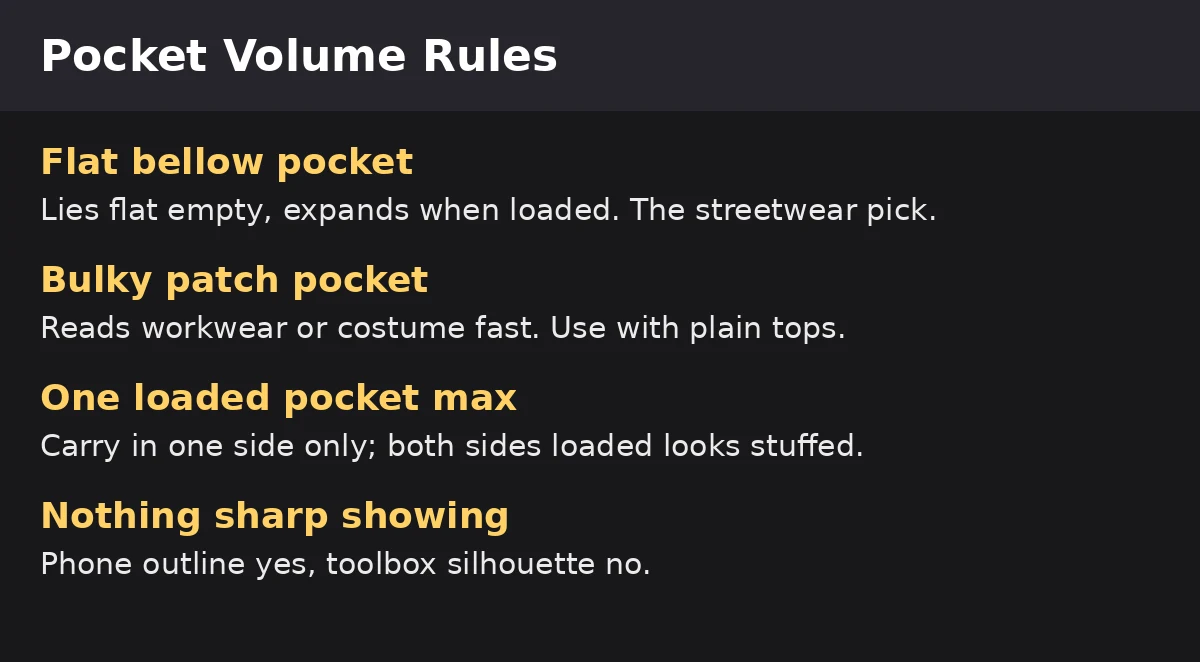
The pockets are the whole point of a cargo pant and also the whole problem, because every pocket is a decision about how much extra width you are willing to wear on the side of your leg. Start with construction. A bellow pocket is pleated at the edges so it lies flat against the leg when empty and expands only when you actually put something in it. A patch pocket is a bag sewn onto the surface of the leg, and even empty it holds its shape, which means it holds its volume too. For streetwear, the flat bellow is the default answer for most people, most days. It keeps the leg line clean from the front, it does not flap when you walk, and it still does the job the pocket exists for when you need to carry a phone, keys or a wallet without a bag. The heritage here is practical rather than decorative. The pleated, expanding pocket comes straight out of military field clothing design, where a soldier’s pockets had to swallow rations and dressings on demand and then disappear flat against the uniform the rest of the time. Civilian cargos kept the shape and often lost the discipline, which is why so many high street pairs carry pockets engineered like luggage on a garment that will only ever carry a phone.
Placement matters as much as construction, and it follows the leg rather than fighting it. A well-placed cargo pocket sits on the outer thigh, high enough that its base stays above the knee and its contents rest against the strongest part of the leg. Pockets that drift low, ending at or below the knee, swing as you walk, bang against the joint and pull the visual weight of the whole outfit down toward the ground. Pockets that sit too far around the front of the thigh distort the line from the front view, which is the view most people actually see. Size follows the same logic. A pocket should be large enough to take a modern phone flat, and not much larger. Once a pocket can swallow a paperback book, it stops being a detail and becomes a feature, and features demand to be noticed, which is rarely what you want from a trouser. Count matters too. The classic arrangement, one cargo pocket on each leg alongside the usual front and back pockets, is classic because it is balanced. Extra pockets stacked up the thigh, zipped compartments on the shin and pouches on the seat each add a claim on the eye, and claims accumulate. Two good pockets, placed high and lying flat, will always look more considered than six mediocre ones scattered wherever the pattern cutter found space.
The final pocket rule is about what you put in them, and it is the rule most often broken in the wild. A flat bellow pocket is only flat while it is empty or nearly empty. Load both legs with a phone, a fat wallet, keys, earbuds and loose change and you have rebuilt the bulky silhouette you paid to avoid, with hard rectangular outlines pressing through the cloth at mid-thigh. Carry the heavy and bulky items the way the rest of your wardrobe already allows, in a jacket pocket, a crossbody or a bag, and let the cargo pockets handle one flat item each at most. The pockets then read as what they are, a design detail with a working history, rather than as storage you are visibly using as storage. This is also where the cargo pant parts company with the workwear trouser in spirit. On a building site, stuffed pockets are a uniform doing its job. On the street, they are the difference between a trouser that references utility and an outfit that looks like you are on your way to fix something. Reference is the whole game with this garment, and the pockets are where the reference is won or lost.
Fabrics: Ripstop, Twill and Nylon
Fabric decides whether a cargo pant drapes like clothing or stands away from the leg like equipment, and three fabrics do nearly all the honest work in this category. Ripstop is the lightest of the three and the most technical in origin. As the explanation of how ripstop is woven sets out, the cloth is built on a grid of stronger reinforcement threads woven at intervals through a lighter base, so a small tear hits the grid and stops instead of running across the garment. In a cargo pant that structure gives you a thin, crisp trouser with a faint squared texture you can see up close, a dry hand feel and very little weight on the leg. Ripstop cargos move well, pack small and suit warm weather and travel, but the same crispness means they hold a crease poorly and can look slightly parachute-like in the widest fits, where acres of thin cloth billow rather than fall. Twill is the traditional counterweight. The diagonal rib described in the background on twill weave structure is what gives cotton twill its combination of toughness and drape: the cloth is heavier than ripstop, hangs in a straighter line, softens with washing and carries the matte, slightly worn surface most people picture when they picture a classic olive cargo. If you buy one pair and wear it for years, it will probably be cotton twill, because it behaves the most like the jeans and chinos already in your wardrobe.
Nylon is the third option and the one that moves the cargo furthest toward modern streetwear. The fibre itself, covered in the history of nylon as a synthetic fibre, was the first fully synthetic textile to reach the market, and in trouser form it brings a smooth, sometimes faintly rustling cloth that sheds water, dries fast and holds deep, even colour, which is why black nylon cargos look so clean. A nylon cargo reads more like a track pant’s grown-up relative than like a soldier’s trouser, and that makes it the easiest version to wear with minimal sneakers and a plain hoodie without any military echo at all. Its weaknesses are honest ones: pure nylon can feel clammy against the skin in serious heat, it picks up static, and the slight sheen turns cheap quickly at the lowest price points, so nylon is the fabric where spending a little more shows the most. Blends split the differences usefully. Cotton ripstop keeps the grid and loses the rustle, cotton and nylon twills gain drape and keep some weather resistance, and a small amount of elastane in any of the three helps the thigh and knee recover their shape across a long day. Read the label the way you would read a spec sheet, because with cargos the composition is not fine print. It is a short description of how the trouser will actually behave on your leg.
Season sorts the three fabrics into a simple order. Summer belongs to ripstop and the lighter nylon blends, worn with the leg opening doing the ventilation work at the hem. Spring and autumn belong to cotton twill, which carries enough weight to hold the leg’s shape against wind and pairs naturally with the jackets and overshirts of those months. Deep winter is the cargo’s weakest season in any of the three, since none of them insulates like denim, flannel or fleece, and the wide opening that serves you so well in July admits cold air at the ankle in January. The honest winter answer is a heavier twill, socks that meet the hem, and boots, or simply rotating to another trouser until the weather turns. What matters more than the calendar is matching fabric weight to fit. Thin cloth needs the straighter fits, where there is less material to misbehave. Heavy twill can carry the wide leg because its own weight pulls the volume into a clean vertical fall. Buyers most often get this backwards, choosing the widest fit in the thinnest fabric because it looked light and easy on the rail, and then wondering why the trouser floats and twists instead of hanging. Weight is structure in a garment with no tailoring to hold it up, and the cargo pant, for all its pockets and history, is an untailored garment that lives or dies by it.
Footwear That Holds the Hem
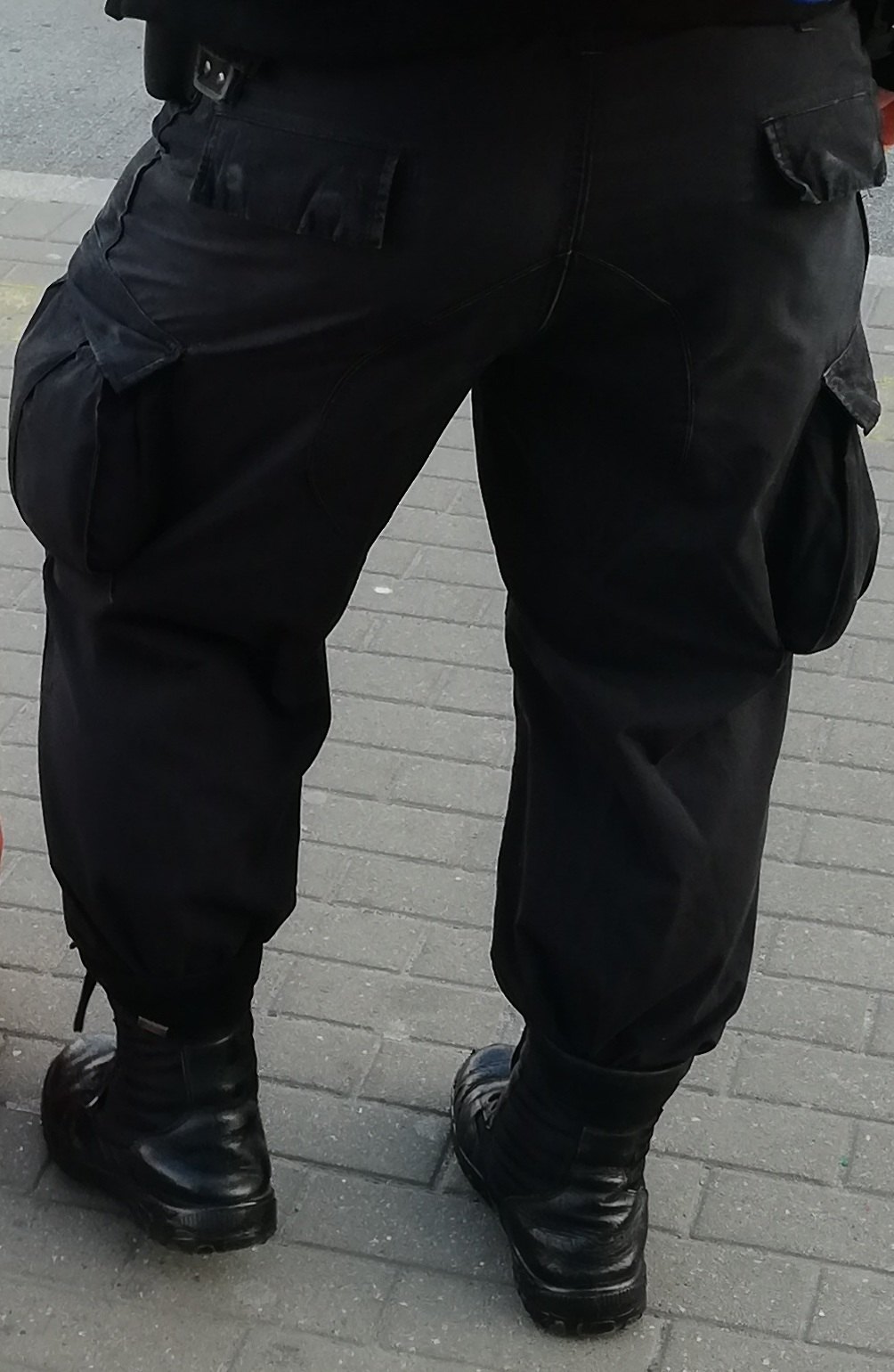
A full-length cargo pant ends at the shoe, so the shoe is not an accessory to the outfit, it is the foundation the whole leg is standing on. The working rule is substance. A wide or relaxed leg opening carries a lot of fabric down to floor level, and a slight, narrow shoe underneath it disappears, leaving the trouser looking like it is melting into the pavement. Chunky sneakers solve this by giving the hem something proportionate to land on: a thick sole, a broad toe and enough height at the collar for the opening to rest against rather than slide over. Retro runners do the same job with a little more shape, and the layered panels and mixed materials of a good runner hold their own against the pocket detail above them. The long partnership between trousers like these and trainers is no accident, since the modern history of sneakers as everyday footwear runs through the same decades and the same streets that turned military surplus into streetwear in the first place. High-tops earn a specific mention for wide legs, because the extra collar fills the opening, stops the hem catching under the heel and gives the longest legs a clean finish line. Whatever you choose, check the pairing from the side in a mirror, not just from above. From above, every shoe looks fine under a hem. From the side, you can see whether the opening sits, stacks or swallows, and the side view is the one the rest of the world gets.
Boots are the second strong option, and they change the register of the outfit more than any other single swap. A plain leather or suede boot under a straight-leg twill cargo gives the trouser a workwear weight that suits autumn and winter, and the boot shaft supports the hem so even a longer leg sits tidily instead of pooling. Keep the boot simple. The moment a boot gains heavy tread, metal eyelets up the shin, straps and a lug sole all at once, it stops grounding the outfit and starts competing with the pockets for the military reference, and two strong references in one outfit is the beginning of the costume problem covered later in this guide. At the other end of the scale, minimal low-profile sneakers work with the slim and tapered fits, where the narrower opening needs less shoe beneath it, and they are the safest choice when the cargos themselves are quiet, black, flat-pocketed and close to tailored. What consistently fails is the middle ground of formal footwear. Dress shoes and loafers ask for a crease, a cropped hem and a smooth cloth, and a cargo pant offers none of the three; the combination reads as two outfits arguing. Sandals and slides sit outside the full-length conversation almost entirely, because an open shoe under a long, wide hem shortens the leg visually and strands the trouser between seasons. Save them for shorts and for the cuffed styles, where the ankle is meant to be seen.
The Top Half: Balance and Proportion
Volume below the waist has to be answered above it, and the most common cargo mistake is not the trouser at all, it is the tight top worn over it. A slim, fitted tee above a wide cargo leg splits the body into two unrelated halves: a small, neat top half and a large, detailed bottom half, with the eye dragged down to the pockets and the hem because that is where all the visual weight sits. The fix is not necessarily an oversized top. It is a top with enough presence to hold its share of the silhouette. A boxy tee with a dropped shoulder, a heavyweight crew neck, an open overshirt or a work jacket all carry the width or the structure to balance a relaxed leg, which is why these are the pieces that recur through the wider world of streetwear as a style, where proportion has always mattered more than decoration. Our guide to streetwear hoodies covers the most useful balancing piece in detail, and the hoodie earns its place here: worn at a natural length, in a fabric with some body, it gives the top half a block of weight that matches the trouser without either half shouting. Length is the detail to watch. A top that ends around the hip bone lets the cargo’s waistband and the top of the leg show, which keeps the outfit’s proportions legible. A top that hangs to mid-thigh hides the waistband, shortens the visible leg and turns the whole outfit into a single column of cloth.
Tucking is the other proportion tool, and with cargos it works best in its loosest form. A full tuck with a belt turns a relaxed cargo into something closer to a tailored trouser, which suits the slim, flat-pocket fits and looks wrong on a wide ripstop leg. A front tuck, just the front panel of a tee or shirt pushed in at the centre, splits the difference: it marks the waist, shows the rise of the trouser and still lets the rest of the top hang with the ease the outfit needs. Shirts follow the same logic as tees. A camp-collar or work shirt worn open over a plain vest or tee adds a layer of structure at the shoulders, which is exactly where a wide leg needs answering, and buttoning it only at the middle keeps the line relaxed. Layers from our guide to streetwear jackets, a denim jacket, a coach jacket or a light field-style jacket worn open, do similar work in cooler weather, with the warning that a jacket covered in its own cargo pockets doubles the outfit’s utility detail and should be paired with the plainest cargos you own. The principle underneath every one of these choices is the one the wider coverage of streetwear coverage at Complex returns to season after season: outfits are read as silhouettes first and garments second. Build the silhouette, a top half with enough block and structure to answer the leg, and the individual pieces can stay as simple as a white tee and a plain overshirt. Simple pieces in the right proportion look considered. Complicated pieces in the wrong proportion look like an accident, whatever they cost.
Colour Choices That Stay Grounded
Colour is where cargo pants either settle into your wardrobe or stay a special occasion you have to plan around, and the grounded end of the palette is not a limitation, it is the point. Olive, stone, khaki, washed black, charcoal and navy carry nearly every good cargo outfit ever assembled, because those shades come from the garment’s own history and sit comfortably beside the whites, greys and blacks of a normal streetwear rotation. The history is worth a sentence, because it explains the palette rather than just asserting it. The cargo pocket entered uniform dress with the British Army battledress of the late 1930s, spread through the Second World War and every conflict after it, and the colours followed the landscapes those uniforms were built for: greens, browns and stones that disappear into ground and foliage. Wearing those shades now is not dressing as a soldier, provided the rest of the outfit is civilian, it is wearing the colours the trouser was designed in, the same way a denim jacket wears indigo. Black deserves its own note because it is the most forgiving and the most modern choice. A black cargo flattens the pocket detail into shadow, which makes it the easiest first pair for anyone worried about looking costumed, and it pairs with everything in the top-half section above without a single colour decision. Washed and faded blacks soften the look further and hide the dust and creasing that black twill collects.
Camouflage is the exception that proves the rule, and it needs handling rather than banning. The patterns collected under camouflage and its military patterns were engineered to break up an outline against a specific landscape, which means a full camo cargo is the single loudest garment in this entire guide, louder than any pocket arrangement or strap. It can work, in a faded, washed-out print, worn with a plain black or white top half and plain sneakers, where the trouser is the outfit’s only statement and everything else has agreed to be quiet. It fails when it is vivid, when it is doubled with a camo jacket or cap, or when it arrives with combat boots, at which point the outfit has crossed from referencing a uniform to reproducing one. Bright colours ask for similar discipline. An orange or cobalt cargo is a deliberate fashion piece, and it survives only with a neutral top, neutral shoes and flat pockets, because the colour is already doing the work that detail would otherwise do. Finally, a word on weather, because colour and heat interact on the leg just as they do on the back. On the hottest days the guidance in the National Weather Service heat safety advice about loose, lightweight, light-coloured clothing applies to trousers too: a stone or pale khaki ripstop cargo will serve you better at midday than a black nylon one, and choosing the pale pair in a heatwave is not a style retreat, it is the same grounded thinking this whole section is about. Build the rotation dark and neutral for most of the year, keep one pale pair for high summer, and let prints and bright colours visit occasionally rather than live in the drawer.
Mistakes That Create the Costume Look
The costume look is never caused by one item; it is what happens when every item in the outfit makes the same military reference at the same volume. Name the ingredients plainly, because they are easy to spot once named. Straps and buckles come first. A single adjustable hem strap or one buckle at a pocket is a functional detail inherited from the garment’s working past. Straps at the knee, straps at the hem, dangling webbing tails, carabiner clips and buckles on pockets that also zip and button is hardware theatre, and it is the fastest single route to looking dressed for an airsoft match. Audit any pair before you buy it by counting the closures. If a pocket needs three systems to stay shut, the designer was decorating, not engineering, and the decoration will date faster than anything else you own. The second ingredient is pocket excess, covered earlier from the construction side and worth repeating from the effect side: stacked pockets, pouches and compartments multiply the trouser’s visual noise, and noise is what separates a reference from a replica. The third is the full matching set, camo or olive from cap to boot, which removes every civilian signal from the outfit. A uniform is, by definition, a set of garments designed to be worn together by a group. Wear one piece of it at a time, surrounded by ordinary clothes, and it is a style choice. Wear the set and it is a uniform again, on the wrong person, in the wrong place.
The quieter mistakes matter too, because they are the ones people make while actively trying to avoid the loud ones. The skinny top over the huge pant, covered in the proportion section, reads as costume for a subtler reason: it looks like the outfit was assembled from two different people’s wardrobes, and assembled outfits always look more like dressing up than dressed. Overloading the pockets with real contents has the same effect, turning a design detail into visible equipment. Boots with heavy tread, a field jacket with its own four bellows pockets, a webbing belt and a cap worn together with cargos is four references deep before colour is even considered, and the fix is subtraction, not substitution: remove pieces until only one military note remains, then let the rest of the outfit be a hoodie, a plain tee, clean sneakers, the ordinary citizens of your wardrobe. This is also why the strongest cargo outfits in the wider roundups of streetwear for men and in our own gallery of baggy joggers and relaxed trousers look almost plain at first glance. The cargo is doing one clear job in an otherwise simple outfit. Nothing competes with it, nothing doubles it, and because nothing doubles it, nobody reads it as a costume. When you get dressed, run the one-reference check in the mirror: one military note, everything else civilian, pockets flat, hardware quiet. Pass that check and the trouser is free to be what it should have been all along, a comfortable, practical, good-looking pair of pants.
Our View
Our view is that the full-length cargo pant is a solved problem disguised as a risky one. The trousers themselves are comfortable, practical and historically grounded, and every bad cargo outfit we have ever seen failed on decisions around the trouser rather than in it: the wrong hem, the loaded pocket, the tiny top, the third military reference nobody needed. Keep the leg clean, the pockets flat and the reference singular, and cargos stop being a trend you participate in and become a trouser you simply own, which is a better fate for any garment.
Wear the cargo like a trouser, not like a uniform. One reference, flat pockets, a hem that lands properly, and let everything else in the outfit be ordinary.
— Brian Ka
Frequently Asked Questions
What is the difference between cargo pants and cargo joggers?
Cargo joggers gather the hem with an elastic cuff at the ankle, so the shoe finishes the leg. Full-length cargo pants have an open hem with no cuff, so the leg’s length and opening have to sit correctly over the shoe on their own. The two garments share pockets and little else.
Should cargo pockets be flat or bulky?
Flat bellow pockets suit most people and most outfits. They lie flush against the leg when empty and expand only when used. Bulky patch pockets hold their volume even when empty, widen the leg visually and push the outfit toward a workwear or costume read.
What shoes work best with full-length cargo pants?
Chunky sneakers and retro runners are the safest pairing for relaxed and wide fits, because they give the leg opening something proportionate to land on. Plain boots work well with straight twill cargos in cooler months. Avoid slight, formal shoes, which disappear under the hem and clash with the trouser’s character.
Can I wear camouflage cargo pants without looking costumed?
Yes, if the print is faded rather than vivid and it is the only military reference in the outfit. Pair camo cargos with a plain top half, plain sneakers and flat, empty pockets. Never double camouflage with a matching jacket or cap.
What top should I wear with wide-leg cargo pants?
Choose a top with enough presence to balance the leg: a boxy heavyweight tee, a hoodie with some body, or an open overshirt or work jacket. Avoid slim, fitted tops, which leave all the visual weight in the trouser and make the outfit look assembled from two wardrobes.
Questions About Building Your Wardrobe?
Trying to work cargo pants into your rotation and not sure which fit or fabric to start with, or which of your current tops will balance them? Send us your questions and we will point you in the right direction.
Sources
- Wikipedia — Cargo Pants
- Wikipedia — British Army
- Wikipedia — M-1965 Field Jacket
- Wikipedia — Ripstop
- Wikipedia — Twill
- Wikipedia — Nylon
- Wikipedia — Sneakers
- Wikipedia — Streetwear
- Complex — Style
- Wikipedia — Camouflage
- National Weather Service — Heat Safety