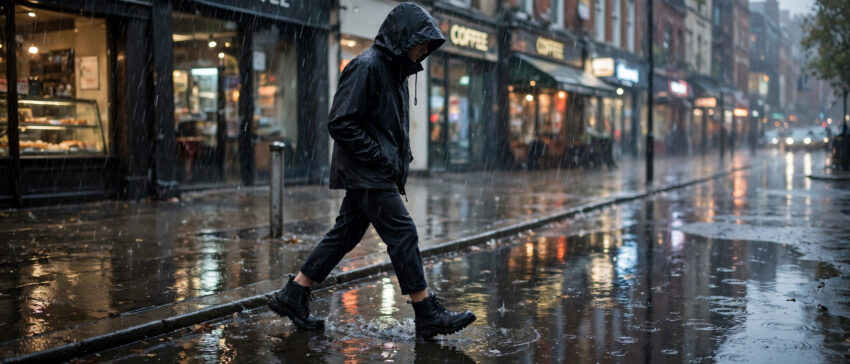
Rain does not ruin a streetwear outfit by making it wet in some general, unlucky way. It ruins it at specific points of failure: a jacket that was only ever water-resistant giving up after twenty minutes, canvas sneakers drinking a puddle in one step, denim hems dragging through standing water until the whole leg is heavy and cold, and a suede cap or bag absorbing rain it was never built to shed. Every one of those failures is predictable before you leave the house, which means every one of them is preventable. This guide is about wet-weather function only, the waterproofing, footwear, fabric, hem and accessory choices that let an outfit survive a genuine downpour and arrive dry enough to keep wearing, plus the drying and care routine that stops one wet day from quietly wrecking the clothes and shoes you wore through it.
Start Here
Build the outer layer first from our guide to streetwear jackets, then check the rest of your rotation against the streetwear essentials every wardrobe needs. For complete looks that already balance top and bottom halves, browse our streetwear outfit ideas for men, and for silhouette references you can copy on a wet morning, the streetwear inspo gallery is the quickest place to look.
Key Takeaways
- Waterproof and water-resistant are different claims: a waterproof shell has a membrane or coating plus sealed seams, while a resistant finish only buys you time in light rain.
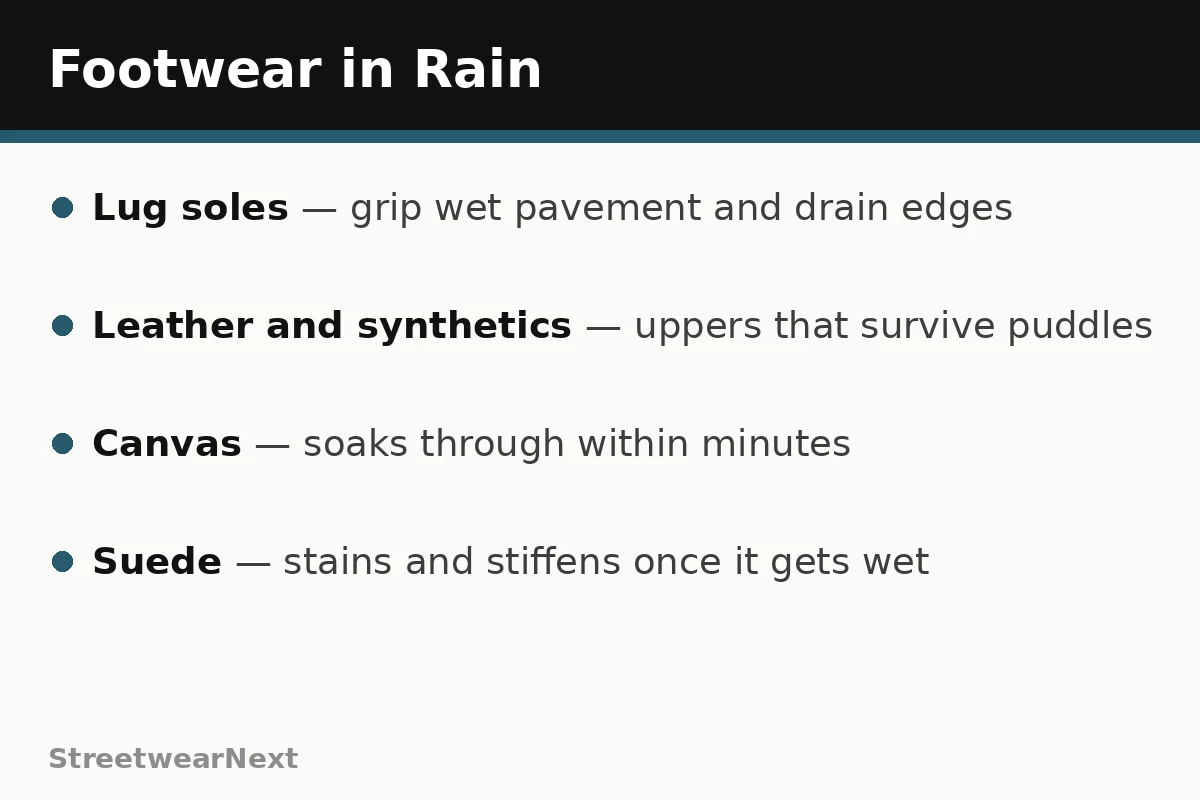
- Footwear decides most rainy outfits, and lug soles with leather or synthetic uppers survive puddles while canvas and suede suffer badly.
- Wet denim gets heavy and dries slowly, untreated cotton soaks through, and suede stains and stiffens, so all three sit out a downpour.
- Keep hems off wet ground with a cropped, cuffed or tucked leg, because a dragging hem wicks water up the whole trouser.
- Choose a waterproof bag and a brim or hood you can rely on, and keep phones and leather goods inside the shell line, not outside it.
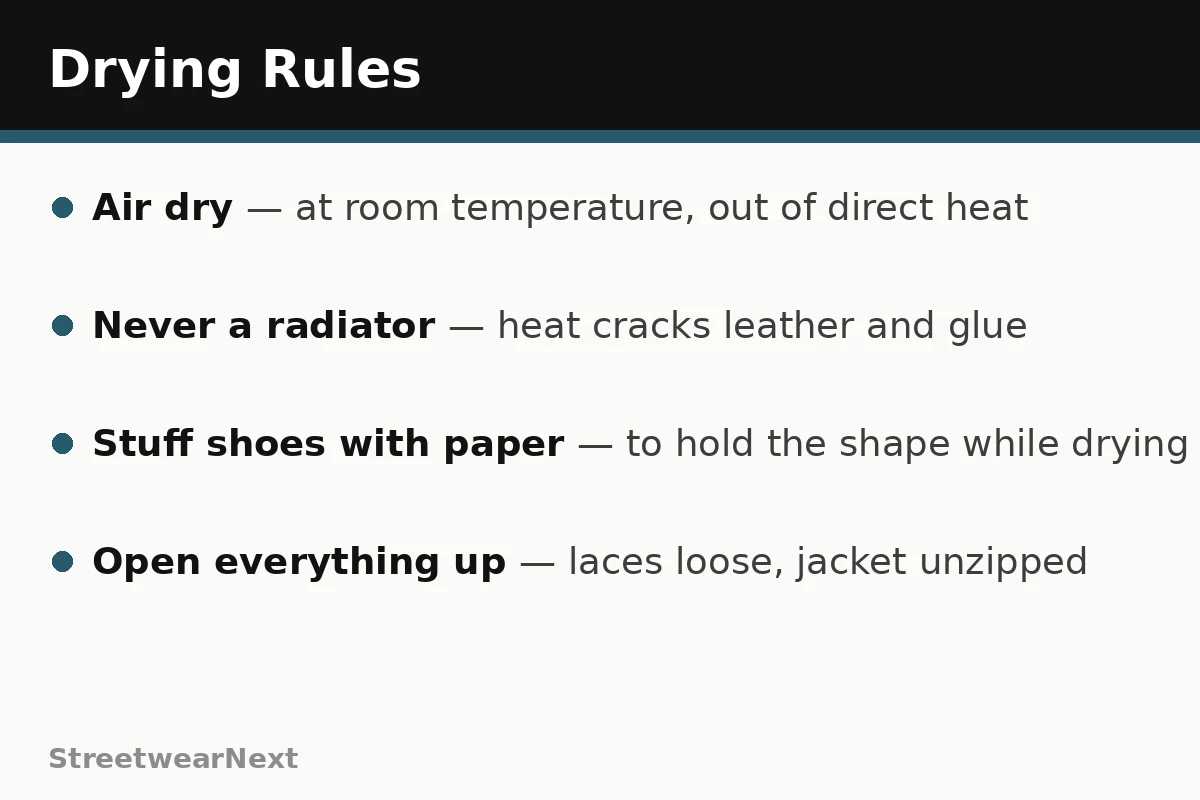
- After the rain, air dry everything at room temperature, never on direct radiator heat, and stuff wet shoes with paper to hold their shape.
Contents
- Shells: Waterproof Is a Construction, Not a Label
- Footwear That Survives Puddles
- Fabrics to Keep Out of the Rain
- Hems Off Wet Ground
- Bags, Hats and Keeping the Rest Dry
- Moving Through a Downpour
- Drying and Care After the Rain
- Our View
- Frequently Asked Questions
- Sources
- Recommended
Shells: Waterproof Is a Construction, Not a Label
The single most useful rain skill is reading a jacket honestly, because waterproof and water-resistant describe two different levels of protection and only one of them survives a downpour. A water-resistant garment carries a surface finish that makes light rain bead and roll off for a while. It is a treatment on the outside of ordinary fabric, and it wears down with washing, abrasion and time. In a shower it buys you ten or twenty comfortable minutes. In sustained, driving rain the fabric underneath eventually wets through, first at the shoulders where rain lands hardest and at the seams where stitching has punched holes through the cloth. A waterproof garment is built differently from the inside out. It carries a membrane or a solid coating that water cannot pass through at all, and, just as importantly, its seams are taped or sealed so the stitch holes cannot act as a row of tiny leaks. The distinction behind durable water repellent finishes is exactly this: the repellent finish is what makes water bead on the surface and keeps the outer fabric from soaking and feeling clammy, but the finish alone is not the waterproofing. The membrane underneath does that job, and a jacket with only the finish and no membrane is a resistant jacket, whatever the marketing calls it.
The membrane itself is worth understanding at the level a buyer actually needs. The best-known version, explained in the background on Gore-Tex membrane technology, is a thin layer full of pores too small for liquid water droplets to enter but large enough for water vapour from your own sweat to escape, which is why a good shell keeps rain out without turning into a plastic bag you steam inside. Cheaper waterproof coatings work on the same principle with less breathability, and for a city commute, a bus wait and a walk between stations, that trade is usually acceptable. What is not acceptable, at any price, is an unsealed seam. Run a finger along the inside of the shoulder and hood seams before you buy or before you rely on a jacket you already own. If you can feel and see the stitching with no tape covering it, rain will find those holes. Pit zips, a proper storm placket over the front zip and a hood that cinches down are the other functional details that separate a shell from a fashion jacket with a technical name, because wind-driven rain enters at openings long before it defeats a membrane.
| Fabric or material | Behaviour when wet | Drying time | Rain verdict |
|---|---|---|---|
| Waterproof membrane shell | Sheds rain at the surface, seams sealed against leaks | Fast, outer face dries in hours | Wear it, this is the outer layer |
| Water-resistant treated nylon | Beads light rain, wets through in sustained rain | Fast | Showers only, not a downpour |
| Denim | Absorbs water, gets heavy, chafes when soaked | Slow, often overnight or longer | Avoid in real rain |
| Untreated cotton hoodie or tee | Soaks through quickly and stays cold against skin | Slow | Only under a waterproof shell |
| Suede | Absorbs water, stains, stiffens as it dries | Slow, and damage can be permanent | Keep out of the rain entirely |
| Canvas sneakers | Drink puddles in one step, stay squelchy for hours | Slow | Swap for leather or synthetics |
| Leather boots, lug sole | Shed puddle water, grip wet pavement | Moderate, air dry with paper inside | The default rainy footwear |
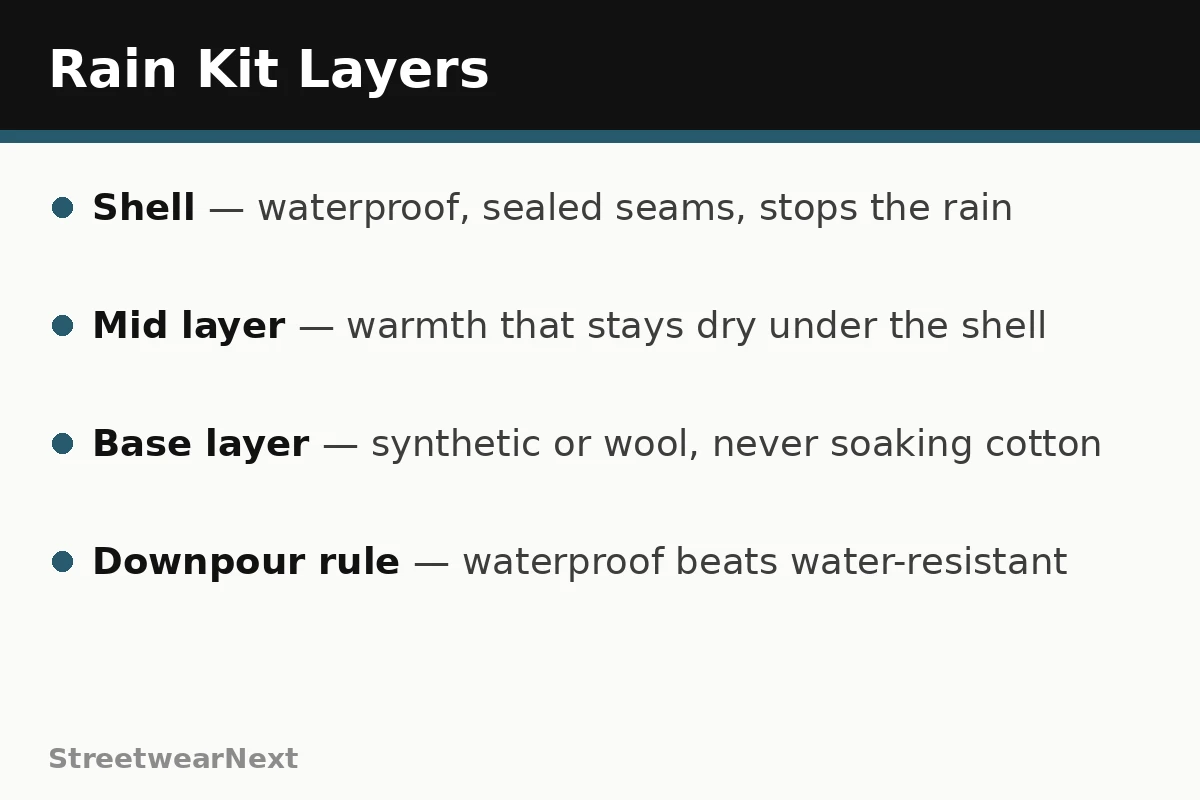
The shell also decides what the rest of the outfit is allowed to be, and this is the point most rainy outfits get backwards. Once a genuinely waterproof shell is on, the layers underneath go back to being chosen for comfort and silhouette rather than survival, because they are never going to meet the rain directly. Our guide to streetwear hoodies covers the mid layer most people will wear here, and a hoodie under a shell is a sound rainy-day build provided the shell hood, not the hoodie hood, is the one doing the weather work, since a cotton hood worn up outside the shell simply collects rain and then sits wet against your neck. Think of the outfit in three jobs. The shell stops the water. The mid layer carries the shape and comfort of the outfit. The base layer sits against the skin and should be something that still feels acceptable if a little rain sneaks in at the collar or cuffs. When each layer has one job, a downpour becomes a problem the outfit has already solved. When one garment is asked to do all three jobs, which is what a thick cotton jacket in heavy rain is being asked to do, it fails at the first one and the failure cascades through everything under it.
Footwear That Survives Puddles
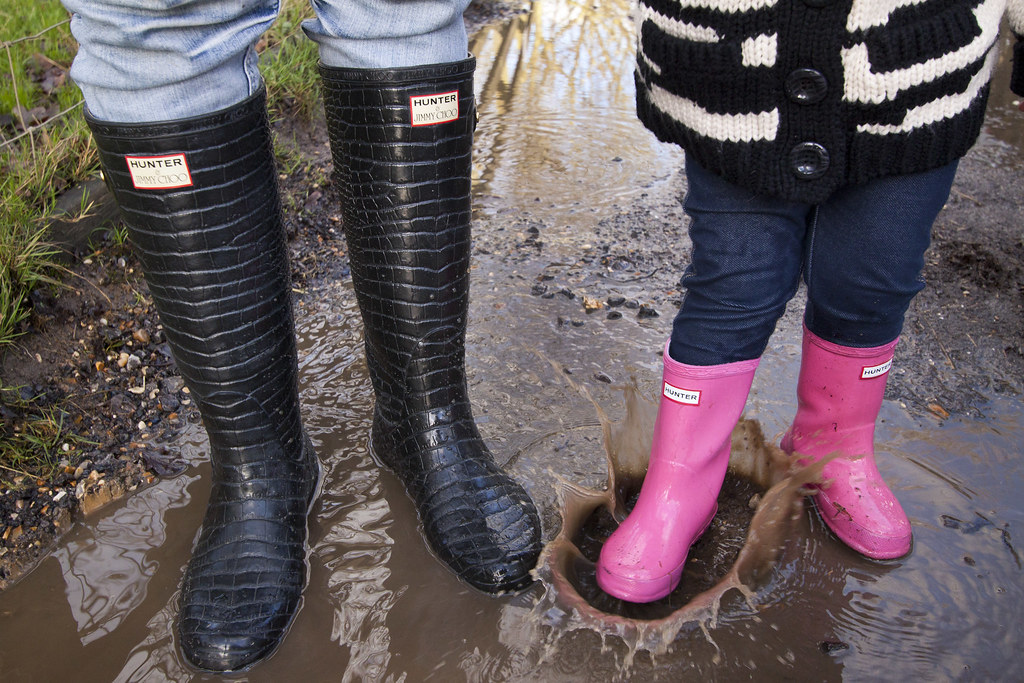
More rainy outfits are ruined from the ankle down than from the shoulders down, because you can dodge rain from above but you cannot dodge the water already standing on the ground. Start with the sole, because grip and height are the two things that decide whether a puddle is an inconvenience or the end of your day. A lug sole, the deep, chunked tread pattern borrowed from hiking and work boots, channels water out from under the shoe and bites into wet pavement, painted lines and metal covers that turn treacherous when soaked. A flat, smooth fashion sole does the opposite, aquaplaning on the same surfaces and offering nothing at kerbs and station steps. Height matters almost as much. A boot or a chunky-soled sneaker lifts the upper and the foot above shallow standing water, so the splash line from your own stride lands on the sole and the welt rather than over the top of the shoe. The footwear built purely for this job makes the logic obvious, since Wellington boots were built as waterproof rubber boots for wet ground long before they were a festival cliché, and their design, a sealed rubber upper, a tall shaft and a treaded sole, is simply the extreme version of what every rainy-day shoe should borrow in part.
The upper material is the second decision, and here the ranking is unforgiving. Leather and synthetic uppers survive puddles. A leather boot or sneaker sheds splash water, tolerates a brief submersion at a flooded kerb, and, dried properly, comes back the next day with nothing worse than a waterline you can condition away. Synthetic and rubberised uppers are even more indifferent to water and are the practical choice when the forecast is for hours of rain rather than a single shower. Canvas is the failure at the other end. A canvas sneaker drinks a puddle in one step, holds the water against your socks, and stays cold and squelchy for the rest of the day, and no thickness of sock fixes a shoe that is itself the sponge. Suede suffers worst of all, because it absorbs water into the nap, stains where the waterline sits and stiffens as it dries, which is why the care background on suede is split leather with a napped surface matters here: that soft nap is exactly what water damages. The older overshoe tradition understood all of this, because galoshes protect shoes directly by covering a good shoe in rubber rather than asking the shoe itself to be waterproof, and a modern pair of waterproof boots is the same idea with the protection built in instead of slipped on.
Socks and rotation complete the footwear picture, and both are cheap insurance people skip. A spare pair of socks in your bag turns a single misjudged puddle from a day-long misery into a two-minute fix, and it weighs nothing. Rotation matters because no shoe should be worn two wet days running. Leather and synthetics both need a full day of air to dry properly between wearings, and forcing a still-damp shoe back into service keeps your feet cold, breeds odour and shortens the life of the shoe itself. If your rotation is small, prioritise one genuinely rain-proof pair, a leather or synthetic boot or sneaker with a lug sole, and protect it with the drying routine covered at the end of this guide. One pair that works in all weathers is worth more on a wet week than three pairs of canvas sneakers that each fail in a slightly different colour. Check the tread on that pair twice a year, too. Lugs worn smooth are a promise the shoe no longer keeps, and wet pavement is where you find out.
Fabrics to Keep Out of the Rain
Some fabrics merely get wet, and some fabrics are actively worse wet than they were dry, and knowing which is which is what lets you leave the risky pieces at home without a second thought. Denim heads the list, and it heads it for mechanical reasons rather than fashion ones. The background on denim is cotton twill explains the structure, a dense cotton weave, and dense cotton is a thirsty material. A pair of jeans in sustained rain absorbs water from the hem upward and from every splash at the calf, and wet denim gets heavy in a way few other trousers match, sagging at the waist, dragging at the hem and chafing at the thigh with every step. It then dries slowly, slower than almost anything else in a normal wardrobe, so a pair soaked on the morning commute is still damp at the evening one. Our guide to streetwear jeans covers fit and styling in full, and none of that guidance changes the wet-weather verdict: jeans are a fair-weather trouser, and on a day of real rain a synthetic or treated trouser, or even a plain cotton twill in a shorter cut that stays clear of the ground, will serve you better than your best denim.
Untreated cotton is the second fabric to manage carefully, and it is everywhere in streetwear, in hoodies, tees, crew necks and caps. Cotton absorbs water readily, holds it against the body and loses what little insulating value it had the moment it is soaked, which is why a wet cotton hoodie feels so much colder than the temperature alone explains. Under a waterproof shell, cotton is fine, because the shell is doing the weather work and the cotton never gets its chance to fail. Worn as the outer layer in rain, cotton is a sponge with sleeves. Suede, already covered from the footwear side, deserves its ban repeated for clothing and accessories: suede jackets, caps and bags all share the same napped surface that water stains and stiffens, and a single downpour can mark a suede piece permanently. The wider science behind keeping water out of fabrics altogether is set out in the overview of waterproofing treatments and construction, and the practical lesson for a wardrobe is simple. Either a garment has been deliberately waterproofed, membrane, coating or sealed construction, or it has not, and if it has not, rain treats it as the raw material it is. Wool is the honourable exception worth naming: a dense wool knit or coat absorbs a surprising amount of moisture before it feels wet and keeps working while damp, which is why wool overshirts and beanies remain a sensible choice in drizzle even though a true downpour still calls for the shell over the top.
Hems Off Wet Ground
A trouser hem in contact with wet ground is a wick, and it will pull water up the leg far beyond the splash line if you give it the chance. This is the quietest failure in rainy dressing and the easiest to prevent. A full-length, wide hem that breaks over the shoe on a dry day sits a fraction lower when the fabric is damp and heavy, and on wet pavement that fraction is the difference between a hem that clears the ground and a hem that trails through every puddle, picking up water, grit and road dirt with each step. The water then climbs. Cotton and cotton-blend trousers are especially prone to it, and by the end of a wet commute the damp can reach the calf even though no rain ever landed above the ankle. The fixes are all length decisions made before you leave. A cropped trouser that ends clear of the ankle removes the problem entirely. A cuff or a pin roll on a longer leg lifts the hem and narrows it in one move, keeping it off the ground and out of the splash zone. A hem tucked into a boot does the same job in heavier rain and is the reason boots pair so naturally with longer trousers in winter street scenes.
Skirts, wide-leg trousers and long coats obey the same physics, and the principle generalises beyond any single garment: the lower a hem hangs and the wider it swings, the more wet ground it meets. A long coat worn open in rain collects water at its swinging front edges, and a maxi length anything on a flooded pavement is a cleaning bill waiting to happen. Raise what you can, belt or button what you cannot, and accept that on the wettest days the cropped and shorter silhouettes are not a compromise but the correct tool. There is a safety dimension here too, and it is not trivial. The National Weather Service flood safety guidance warns against walking through moving or deep standing water at all, and the streetwear translation of that warning is simple: if the water on your route is deep enough to cover the road markings or hide the kerb, no hem adjustment and no boot makes the route sensible, and the right outfit decision is a different route. Ordinary puddles and soaked pavements are a clothing problem. Flooded streets are not, and treating them as one is how people get hurt for the sake of an outfit.
Bags, Hats and Keeping the Rest Dry
The shell protects your torso, the boots protect your feet, and everything you carry or wear on your head needs its own answer, because bags and hats sit outside the shell line by design. Start with the bag, since it usually carries the most expensive objects in the outfit. A crossbody or backpack in a coated synthetic, a waterproof roll-top, or leather that has been conditioned will shed a commute of rain without complaint. An untreated canvas tote or a suede bag will not, and the failure is silent: the outside looks merely damp while the water works through to the notebook, the headphones and the spare layer inside. Our guide to streetwear accessories covers bags and the rest of the finishing kit in full, and the rainy-day edit of that advice is to choose the bag by its material first and its look second, and to keep a thin plastic bag folded inside it as a liner for the truly bad days, an ugly trick that has saved more laptops than any technical fabric. Whatever the bag, the phone belongs in an inside pocket under the shell, not in the bag’s outer slip pocket and not in a trouser pocket below the shell hem, where rain running off the jacket lands directly on it.
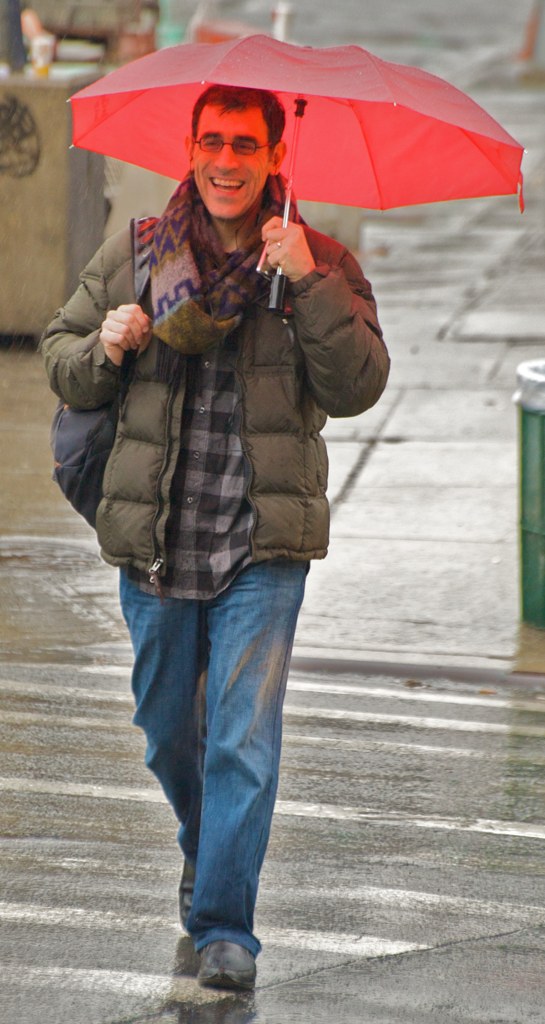
Headwear splits into three honest options. The shell hood is the most reliable, because it moves with you, cannot blow away and protects the neck as well as the head, and it is why a rainy-day shell without a good hood is only half a shell. A cap with a brim is the second option and the one most streetwear outfits already own: the brim keeps rain off your face and glasses, and a synthetic or treated cotton cap shrugs off a shower, though the fuller background in our guide to streetwear hats is worth reading before you trust a favourite suede or untreated cotton cap to a storm, since those are precisely the materials rain ruins. A wool beanie is the third option, warm and tolerant of drizzle, but it saturates in heavy rain and then sits cold. The umbrella remains the oldest answer of all, and the history of the umbrella as portable shelter is really the history of keeping a whole outfit, not just a head, out of the rain. It still earns its place for short, calm-weather trips between nearby stops. In wind it inverts, occupies a hand you need for doors, rails and bags, and sheds its water onto everyone beside you, which is why the shell, hood and boots combination remains the working default and the umbrella the supplement rather than the system.
Moving Through a Downpour
A rain outfit is tested in motion, on the walk to the station, the wait on the platform and the last flooded street before home, and small habits decide whether the gear you chose gets to do its job. Slow down at the obvious traps. Painted road markings, metal drain covers, marble and polished stone in station entrances and wet leaves on pavement are all low-grip surfaces where a lug sole helps but does not make you invulnerable, and a fall in wet clothes onto wet ground doubles the soaking in one second. Cross standing water at its shallowest edge rather than striding through the middle, and step over, not into, the streams that run along kerbs at crossings, because that moving kerbside water is deeper than it looks and it is aimed exactly at ankle height. Keep the shell closed while you move. An open shell worn for the look funnels rain onto the mid layer at every step, and the two minutes it takes to zip up and settle the hood is the cheapest protection in this entire guide. The heritage of the dedicated rain garment is a useful reminder here, since the raincoat as dedicated outerwear exists precisely because ordinary coats, worn ordinarily, failed in ordinary rain for centuries before anyone thought to build a garment whose whole job was the weather.
Public transport and indoor stops create the second test, the drip problem. A soaked shell taken straight onto a crowded train sheds water onto your own bag, your own trousers and everyone standing near you, so shake the shell off at the door where the ground is already wet, carry it by the loop rather than draped over your other clothes, and, if you will be somewhere for a while, hang it where it can drip freely instead of balling it into a locker or under a desk, where it will stay wet for hours and smell of it by evening. Leather goods need the same moment of thought, because the material science behind leather is treated hide explains both its strength and its one weakness: leather tolerates getting wet, but it hates drying badly, soaked through and then forced, which is the subject of the final section. In motion, the rule is simply to keep leather bags and boots out of direct, sustained soaking where you can, wipe them down when you arrive, and never leave them sitting in a puddle of their own drips on a hallway floor while you deal with everything else first.
Drying and Care After the Rain
What you do in the first hour after getting home decides whether a rainy day costs you nothing or quietly shortens the life of your best shoes and jacket, and the rules are few, firm and easy. Air dry everything at room temperature. Hang the shell and any wet layers where air can move around them, on a hanger or a rail, not over the back of a chair in a heap, and give boots and shoes the same moving air in the open room. Never use direct radiator heat, and never park wet shoes on or against a heater, under a hairdryer on hot or in front of a fire. Direct heat dries the outside faster than the inside, cracks leather, warps soles and glues, cooks the membranes and coatings that made your shell waterproof in the first place and can leave a garment stiff and damaged in ways no later care reverses. Slow air at ordinary room temperature feels like doing nothing, and it is in fact the entire professional method. Stuff wet shoes with paper as soon as you take them off. Newspaper or plain packing paper pushed firmly into the toe and through the body of the shoe draws moisture out of the lining, holds the shoe’s shape while it dries and stops the toe collapsing into the creases that become permanent once a soaked shoe dries empty and bent. Replace the paper after a few hours if the shoes were truly soaked, and leave the second stuffing in overnight.
Leather gets one extra step once it is dry, not while it is wet. A conditioner worked into boots or a bag after a full air dry replaces the oils the rain and the drying together drew out, and it is what keeps repeatedly soaked leather supple instead of boardy and cracked. Do not condition a still-damp shoe, because you seal the moisture in rather than feeding the leather. Shells need their own occasional care: the repellent finish that makes water bead fades with wear and washing, and most finishes revive with a clean wash and gentle tumble or a re-proofing treatment, so a shell that has started wetting out, darkening as it absorbs water instead of shedding it, is usually asking for maintenance rather than replacement. Suede and canvas, if they did get caught despite everything, follow the same air-dry rule, with suede brushed once fully dry to lift the nap and canvas left unstuffed but open, laces loosened, until it is dry all the way through. Finally, store nothing wet. A shell hung in a closed wardrobe while still damp, or shoes returned to a box before they are dry, will smell within days and can mildew within a week, turning one rainy afternoon into a permanent loss. Dry first, store second, and the same kit walks out ready the next time the sky turns.
Our View
Our view is that rainy-day dressing is a solved problem that most people lose on one or two unexamined defaults: the canvas sneaker worn out of habit, the jacket trusted because its product page used the word waterproof loosely, the jeans chosen because they were already on. None of those defaults survive contact with a real downpour, and none of them are hard to replace. One honest shell, one pair of lug-soled boots in leather or synthetic, hems kept off the ground and a patient drying routine afterwards will carry a streetwear wardrobe through years of wet weather with no drama at all.
Rain is not a style problem. It is a materials problem. Wear the materials that shed it, keep the hems out of it, and dry everything slowly when you get home.
— Brian Ka
Frequently Asked Questions
What is the difference between waterproof and water-resistant?
Water-resistant means a surface finish that beads light rain for a short time before the fabric wets through. Waterproof means a membrane or coating water cannot pass, plus taped or sealed seams so the stitch holes cannot leak. Only the waterproof construction survives a sustained downpour.
What shoes are best for streetwear in the rain?
Boots or chunky sneakers with lug soles and leather or synthetic uppers. The lugs grip wet pavement and channel water away, the raised sole keeps the upper above shallow puddles, and leather or synthetic materials shed water instead of absorbing it. Avoid canvas, which soaks instantly, and suede, which stains and stiffens.
Why should I avoid wearing denim in heavy rain?
Denim is dense cotton, and it absorbs a large amount of water. Wet denim gets heavy, sags, chafes and then dries very slowly, often staying damp for the rest of the day. A synthetic or shorter-cut trouser that stays clear of wet ground is a better choice when real rain is forecast.
How do I stop trouser hems getting soaked?
Keep the hem off wet ground. Choose a cropped leg, cuff or pin roll a longer trouser, or tuck the hem into a boot in heavier rain. A hem trailing on wet pavement acts as a wick and pulls water up the leg well above the splash line.
What is the right way to dry wet shoes and jackets?
Air dry at room temperature with air moving around the garment, and stuff shoes with paper to draw out moisture and hold their shape. Never use direct radiator heat or a heater, which cracks leather, warps soles and damages waterproof membranes. Condition leather only once it is completely dry.
Questions About Building Your Wardrobe?
Not sure whether your current jacket is genuinely waterproof, or which of your shoes can be trusted in a downpour? Send us your questions and we will point you in the right direction.
Sources
- Wikipedia — Gore-Tex
- Wikipedia — Raincoat
- Wikipedia — Wellington Boot
- Wikipedia — Suede
- Wikipedia — Denim
- Wikipedia — Umbrella
- Wikipedia — Waterproofing
- Wikipedia — Durable Water Repellent
- Wikipedia — Galoshes
- National Weather Service — Flood Safety
- Wikipedia — Leather