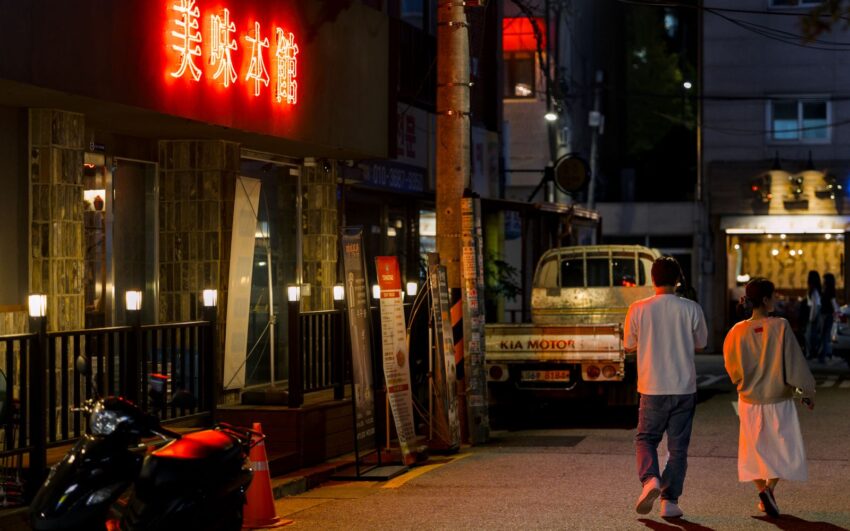
A Seoul outfit that works at noon can fail at eight in the evening, and the failure is rarely about the clothes themselves. Date night changes the conditions. The light drops and warms, the distance across a table shrinks to an arm’s length, and an outfit is judged sitting down as much as standing up, then judged again on the walk between the restaurant and the bar. Korean streetwear is built for exactly this kind of scrutiny when it is edited for the evening, because its strengths are proportion, restraint and a silhouette that holds its shape in low light. Worn unedited, the daytime version reads relaxed to the point of careless. Edited for after dark, the same oversized blazer, wide trouser and quiet palette become something rarer, an outfit that looks romantic at close range and still reads unmistakably street on the pavement outside. This guide makes that edit, stage by stage, from the restaurant door to the last walk home.
Start Here
For the general men’s version of the silhouette this guide edits for the evening, start with Korean streetwear for men and the outfit formulas in Korean street style for women. The wider aesthetic behind both is set out in Korean streetwear style, where the proportion rules used below come from.
Key Takeaways
- Evening dressing is judged at close range and in warm light, so texture and finish matter more than logos or colour.
- Keep the Seoul silhouette, wide trouser, relaxed blazer, quiet palette, and polish the edges rather than dressing up.
- Test every outfit sitting down, because the table view is the one your date actually gets for most of the night.
- Build the outfit for the whole route, restaurant, walk, then bar or cafe, not for the doorway photograph.
- Loafers and clean minimal shoes survive the evening walk, statement sneakers and gym shoes do not survive the table.
- Romantic at close range means a clean neckline, pressed cloth, one shine point and a scent kept deliberately quiet.
Contents
- After Dark Changes the Rules: Light, Distance and the Table
- The Evening Silhouette: Volume That Stays Clean at Close Range
- Sitting vs Standing: Proportions Across the Table
- Four Evening Formulas, for Him and for Her
- Colour and Texture After Dark: The Quiet Palette at Night
- Shoes, Scent and Finishing: The Close-Range Details
- Dinner to Street: Transitions and What Reads Sloppy
- Our View
- Frequently Asked Questions
- Sources
- Recommended
After Dark Changes the Rules: Light, Distance and the Table
A date night outfit is examined under conditions no daytime outfit ever faces, and the first job is to understand those conditions before choosing a single piece. Fashion in South Korea is often photographed in bright daylight on wide streets, where volume reads clearly and colour stays honest. Evening removes both advantages. Restaurant lighting is warm, low and directional, so it flattens pale colours, deepens dark ones and throws every crease and shine into relief. Distance collapses too. Across a table, your date sees your neckline, your shoulders, your hands and the top third of your outfit for an hour or more, at a range where a rumpled collar or a shiny forehead of fabric cannot hide. The outfit that survives the evening is the one designed for that table first and the street second.
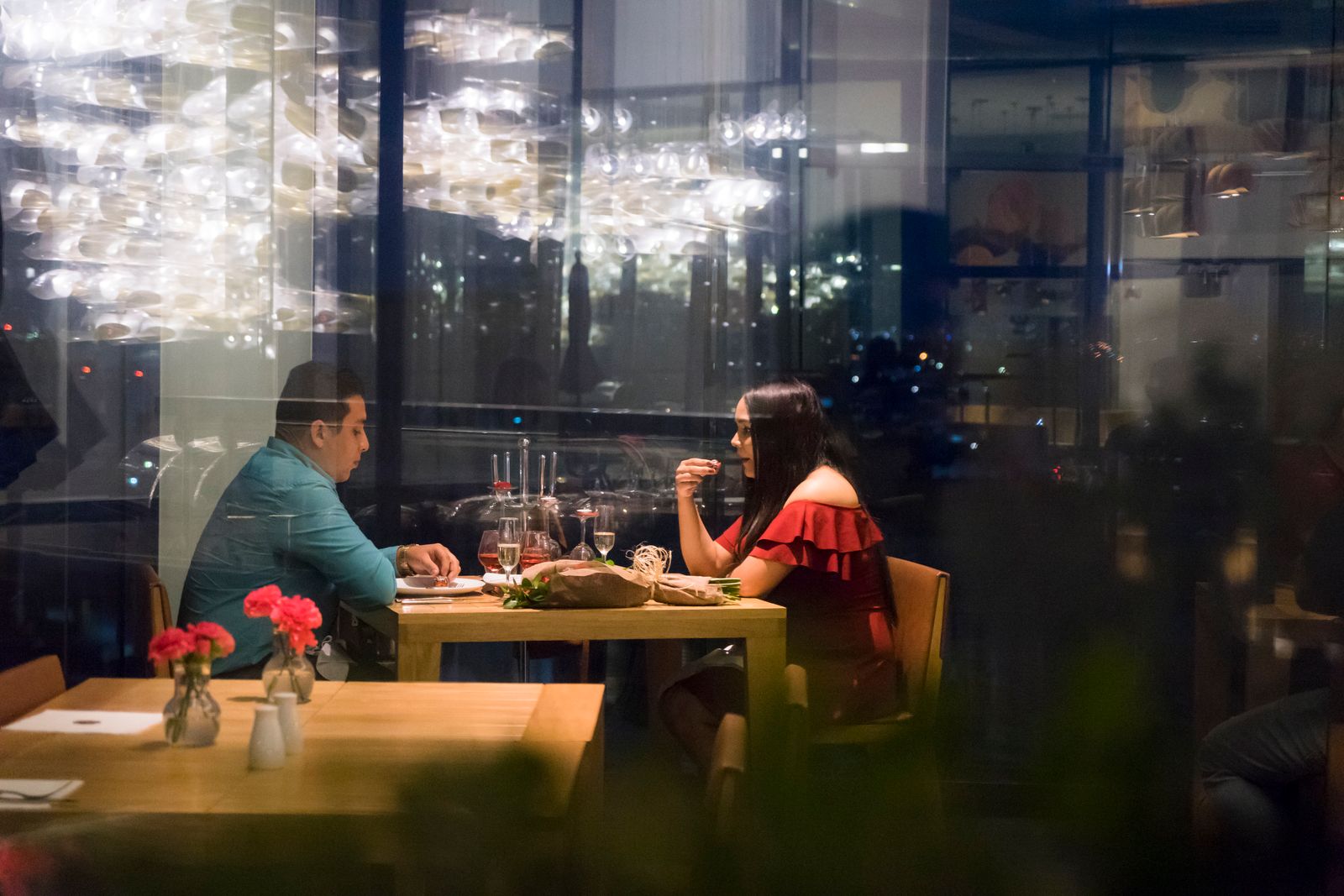
The second condition is colour behaviour, because evening light rewrites the palette you thought you were wearing. Basic colour theory explains why warm light pushes neutrals toward amber and drains cool blues toward grey, and any Seoul dresser who has watched a stone blazer turn beige under restaurant bulbs has seen the principle at work. Black stays black, which is one reason Seoul evening dressing leans on it so heavily. Charcoal warms into something softer and often more flattering. White can glare under a downlight, so cream and off white are the safer light notes after dark. Saturated colour is the risk, because a bright tone that looked playful at noon can look loud across a small table, and loud is the opposite of the register a date rewards. The table below translates each stage of the evening into what it demands from the outfit.
| Evening stage | What changes | What the outfit needs |
|---|---|---|
| Restaurant | Warm low light, close range, mostly seated | Texture over logos, clean neckline, pressed cloth |
| The walk | Cooler street light, full length on view | Hems that clear the pavement, shoes you can stroll in |
| Bar or cafe | Standing, brighter and more social | One layer that opens or comes off cleanly |
| Close range | Conversation distance for hours | Quiet scent, tidy grooming, one shine point only |
Read the evening as a route, not a moment, and the outfit choices start making themselves. Most date outfits are chosen in a mirror at home, standing, in white light, which is the one combination of conditions the night will never reproduce. The Seoul districts make the same point geographically. The contrast in our guide to Hongdae vs Gangnam style is useful here, because Gangnam polish is the restaurant end of Korean evening dressing and Hongdae volume is the street end, and a good date outfit borrows Gangnam finish for the table and Hongdae proportion for the walk between venues. Neither district dresses for a single photograph. Both dress for a whole night out, and that is the standard this guide holds every formula below to.
The Evening Silhouette: Volume That Stays Clean at Close Range
The Seoul silhouette survives the evening because its volume is architectural rather than soft, and architecture is what close range rewards. At its root streetwear blends casual codes from sport, skate and workwear, and the daytime versions of those codes, the hoodie, the cargo, the oversized tee, are exactly the pieces that collapse at a table. The evening translation keeps the proportions and changes the garments carrying them. Width moves into tailored pieces, a blazer with room in the body, a trouser that falls wide and full length. Softness moves into fine surfaces, a smooth knit, a matte shirt. The outline stays unmistakably Korean, but every edge the eye lands on at close range is a finished edge, a lapel, a cuff, a clean hem.
The blazer does most of this work, for both men and women, because it frames the part of the outfit the table actually sees. A blazer is a tailored jacket, and its lapel and shoulder line signal intent before its proportions register at all. The Korean evening cut adds room through the body and drops the shoulder slightly, and both moves need a close-range check. The shoulder should still sit in a clean line rather than sliding toward the elbow, because a sliding shoulder reads as borrowed clothing at conversation distance. The body can be generous, but the front should hang straight when open and close without pulling when you sit. Length should cover the seat or stop cleanly at it, never hover between the two, because a hovering hem is the first thing a seated view exposes.
Fabric is the difference between volume that reads as polish and volume that reads as sloppiness. Choose cloth with body, a wool blend, a firm twill, a structured knit that holds a lapel shape through dinner and a walk. Soft collapsing fabrics lose the shoulder by the second hour, and once the shoulder goes, the whole outfit follows it down, because the blazer is the structure every other piece borrows. Underneath, the rule is a finished neckline. A fine knit, a dark turtleneck, a shirt with a neat collar, something that looks complete when the blazer opens or comes off at a warm table. A graphic tee under an evening blazer is two registers arguing with each other, and at close range the argument is all your date can see.
One proportion note matters more after dark than at any other time. Evening outfits are read in fragments, the top third across the table, the full length on the walk, the shoes at the kerb. Each fragment has to work on its own. The top third works when the neckline is clean and the shoulder sits. The full length works when the wide trouser falls unbroken to the shoe and the blazer length agrees with it. The ground fragment works when the shoe is polished enough for the pavement light to catch it slightly. Dressers who check all three fragments before leaving rarely get caught out by the night, because they have already seen the outfit the way the evening will present it, in pieces, under changing light.
Sitting vs Standing: Proportions Across the Table
Most of a date is spent seated, so the seated version of the outfit is the real outfit, and it obeys different proportion rules than the standing one. Standing, a wide trouser falls from the hip and the eye reads the full Seoul line at once. The category is broad, since trousers cover many cuts, but seated, the leg folds at the knee, the hem rides up, and the waistband and rise do the visual work instead. A high or mid rise keeps the line unbroken when you sit, and it keeps a tucked shirt tucked through a long dinner. A low rise gaps, bunches and forces the small constant adjustments that read, across a table, as discomfort. Comfort is not a side benefit here. An outfit you keep adjusting is an outfit that stops looking deliberate, and deliberate is the whole effect.
The shirt faces the same seated test. A button-down shirt keeps a collar standing through an evening, which is why it remains the safest top half under an evening blazer. Worn the Korean way, tucked into the high rise of the trouser with the top button open, it gives the table view a clean frame, collar, open neck, lapel either side. Untucked, the shirt tail breaks the waist line the moment you sit and turns a tailored outfit into a layered one. Sleeves matter at this range too. A cuff that ends at the wrist with a sliver of shirt showing reads as chosen. A sleeve that covers the hand reads as a size mistake, and date night is the worst possible setting for a size mistake, because it suggests the outfit was assembled in a hurry.
For women, the seated checks run parallel. A skirt or dress length that is elegant standing can ride into awkwardness on a restaurant chair, so the evening test is to sit in the outfit at home, cross your legs, and see where the hem settles. Wide-leg trousers sidestep the problem entirely and carry the Seoul proportion into the bargain, which is one reason they anchor so many of the formulas below. A long blazer over a shorter dress behaves the same way, giving coverage seated and drama standing. The principle is identical for everyone at the table. If a piece only works in one posture, it does not work for an evening that constantly alternates between the two.
There is also the question of what the table hides and what it reveals. Below the table line, almost nothing is visible during dinner, which tempts people to spend all their effort on the top half. Then the walk comes, the full outfit is on show under street light, and the neglected trouser and shoe carry the verdict. The better allocation is the reverse of instinct. Get the top third clean and simple, because simple survives two hours of close viewing, and spend the real care on length, hem and shoe, because those are judged in motion, where flaws cannot be posed away. An outfit that stands up, walks and sits back down without a single adjustment has passed the evening’s hardest test before the food arrives.
Four Evening Formulas, for Him and for Her
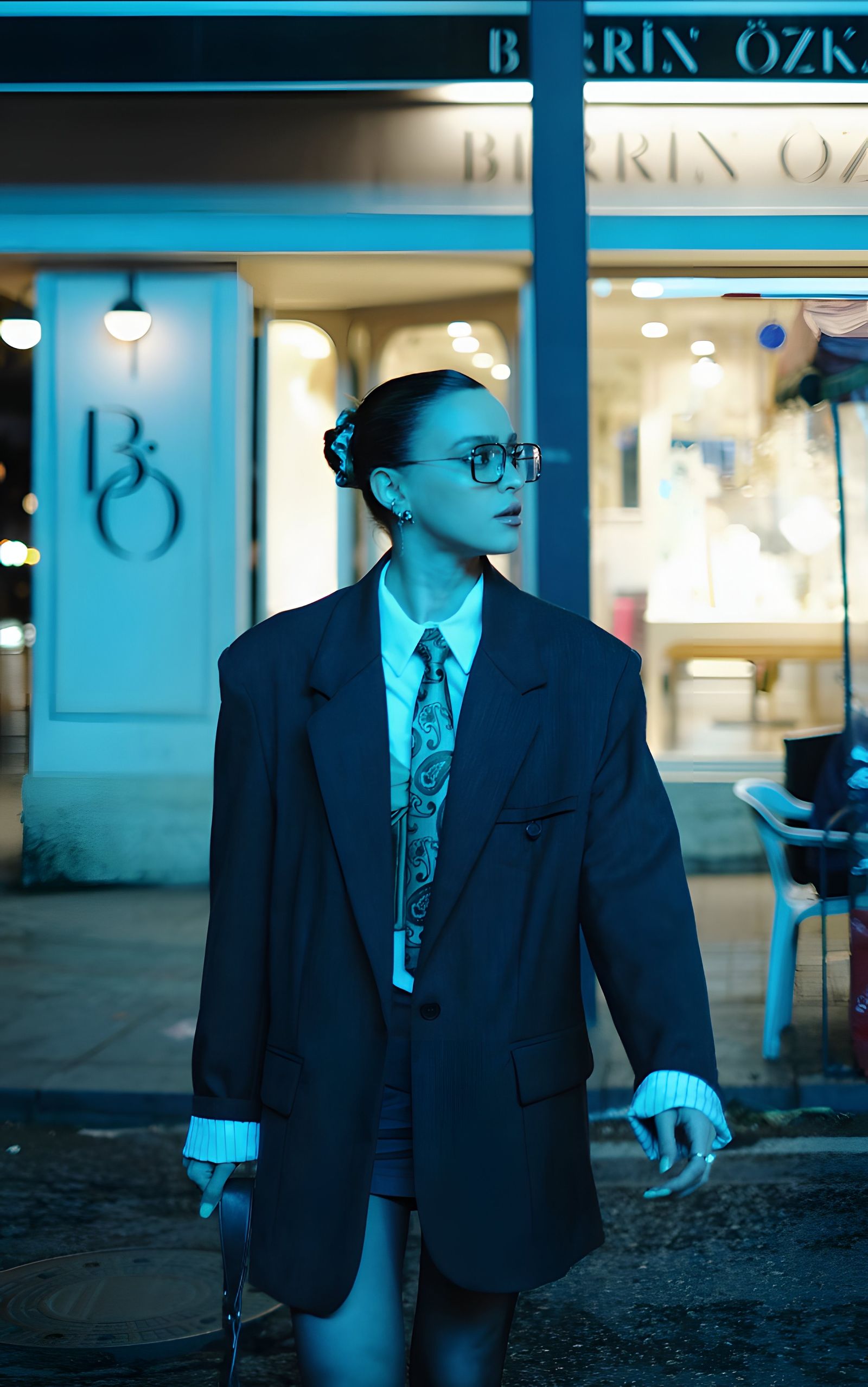
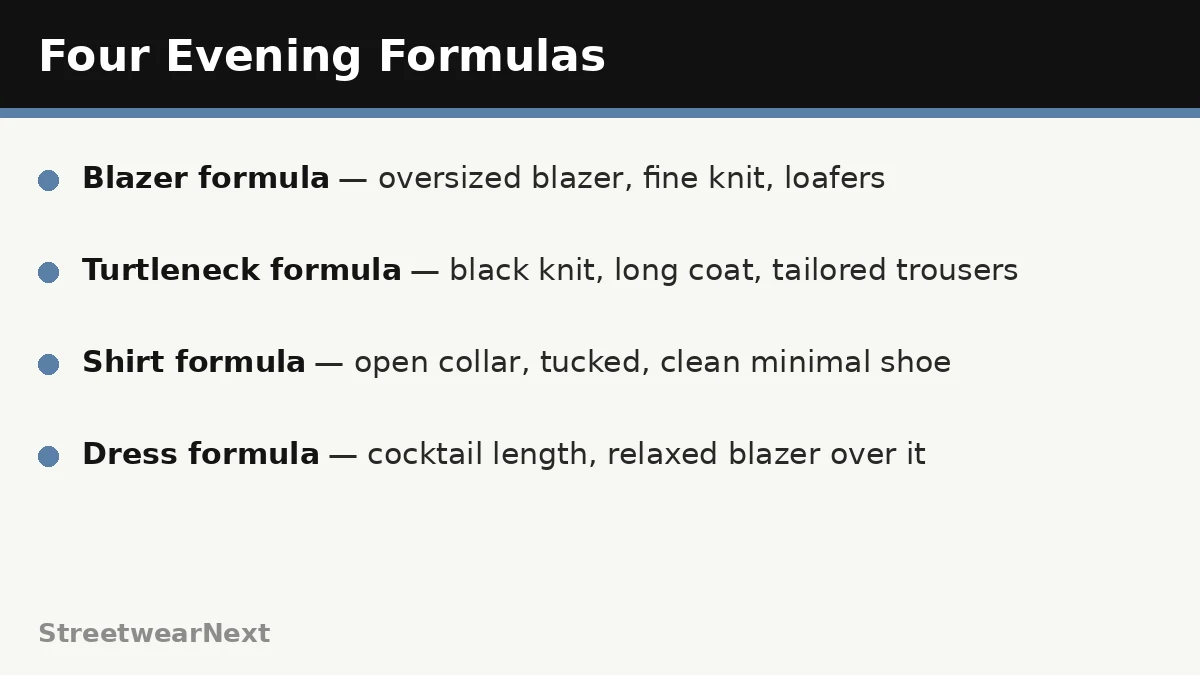
Four formulas cover nearly every Seoul date night, and each one keeps the street silhouette while changing the register for the evening. The first is the blazer formula, an oversized blazer over a fine knit, wide-leg tailored trousers below and loafers to finish, the direct evening descendant of the daytime Seoul uniform. The second is the turtleneck formula. A turtleneck gives a clean neckline with no collar to manage, and in black under a long coat or worn alone with tailored trousers it is the most forgiving evening top there is, because it photographs well, sits well and never wrinkles into untidiness across a table. Both formulas work for men and women with almost no adjustment beyond fit.
The third formula is the shirt formula, built for warmer evenings and lighter restaurants. An open-collar shirt, tucked, sleeves neat, over wide trousers and a clean minimal shoe. Its polish lives entirely in the details, a pressed front, a collar that sits flat, one button more open than the office version and no more. The fourth is the dress formula. A cocktail dress is evening length by design, shorter than formal wear and made for exactly this kind of night, and the Seoul move is to wear a relaxed oversized blazer over it, so the dress provides the occasion and the blazer keeps the street register alive. The contrast between the two pieces is the outfit, and it only works when the blazer is genuinely oversized and the dress is genuinely simple.
Knitwear stitches the four formulas together across the seasons. Knitwear covers knitted garments from fine crew necks to cardigans, and the evening versions are the fine-gauge ones, smooth enough to sit under a blazer and soft enough to read as warmth rather than uniform at close range. A fine black or charcoal knit is the single hardest working piece in this guide. It carries the blazer formula in winter, replaces the shirt in the shirt formula when the night turns cold, and layers under a coat for the walk home. What knitwear must never be after dark is the chunky daytime hoodie or the logo sweatshirt. Their textures belong to daylight, and under restaurant light they read as the clothes you wore earlier, not the clothes you chose for the evening.
Coordination between two people deserves one honest paragraph, because Seoul date dressing has a quiet tradition of it. Matching exactly is a daytime, photograph-first gesture. The evening version is tonal coordination, both of you inside the same quiet palette, one in charcoal and black, the other in black and cream, so you read as a pair across a restaurant without wearing a uniform. Our guide to all-black streetwear for men shows how much range a single colour family holds, and that range is what makes coordination possible without sameness. Pick the palette together, then dress independently inside it. The result looks intentional in every fragment of the night, and intention, again, is what close range rewards.
Colour and Texture After Dark: The Quiet Palette at Night
The muted Seoul palette is not a compromise after dark, it is an advantage, because evening light punishes bright colour and rewards depth. Black, charcoal, navy, stone and cream behave predictably under warm bulbs and cool street light alike, shifting slightly in tone while keeping their relationships intact. A tonal outfit, shades of one family worn together, is the signature evening arrangement for the same reason it is the signature Seoul one. It lengthens the body on the walk, removes every colour decision from close range, and lets texture carry the interest that colour would otherwise have to provide. Across a candlelit table, a matte wool blazer over a smooth knit over a flat twill trouser reads as rich. The same pieces in three competing colours read as busy, and busy is a daytime quality.
Readers who follow Gangnam USA’s Korean fashion coverage will recognise this as the district’s evening register, quiet colours and considered cuts in the restaurants and bars where Seoul actually goes on dates. That register travels well because it is built on behaviour rather than branding. Nothing in a tonal evening outfit announces its price or its label, so the attention stays on the person, which is rather the point of the exercise. One controlled break in the palette is allowed and often welcome, a cream knit inside an all black outfit, a stone trouser under a navy blazer. Two breaks and the outfit starts negotiating with itself, and the negotiation is visible at exactly the range a date is viewed from.
Texture is where the evening outfit earns its close-range marks, so choose surfaces the light can work on. A slight rib in a knit, a brushed wool, a satin facing on a dress or a smooth leather shoe each catch low light differently, and those small differences are what a person across a table actually perceives as quality. Shine follows a strict budget. One shine point per outfit, a polished shoe, a small piece of silver jewellery, a satin edge. Two shine points compete, and anything beyond that reads as evening wear in the costume sense, which breaks the street register the whole guide is protecting. Pattern, if it appears at all, stays tonal and small, a fine check or stripe that reads at arm’s length as texture. Graphics and slogans have no tonal version. They speak at full volume in a setting that rewards a lower voice.
Shoes, Scent and Finishing: The Close-Range Details
Shoes carry a double duty on date night that no other piece faces, because they are judged at the table’s edge, on the walk and at every kerb in between. The loafer is the natural Seoul evening shoe for the same reason it anchors the polished end of the style generally. A loafer is a slip-on shoe with a low profile and no laces, and in black or dark brown leather it sits precisely between sneaker ease and formal structure, which is the ground this entire way of dressing occupies. It takes a wide hem cleanly, it walks three blocks without complaint, and its slight shine under street light supplies the outfit’s one shine point without any help. Keep the sole slim after dark. A chunky platform loafer is a daytime statement, and at night it reads heavier than the outfit around it.
Minimal sneakers are the conditional alternative, and the conditions tighten after dark. They must be clean to the point of looking new, low, plain and dark or white with no visible branding, because restaurant light is unforgiving about worn leather and greyed soles. Our guide to Korean streetwear shoes covers the full range, and the evening rule when using it is to choose from the quiet end only. Boots earn a place in winter, a clean Chelsea or plain lace-up with the volume kept moderate. What never survives the evening is the shoe that belongs to another part of your day, the running shoe, the skate shoe, the trainer you commuted in. Each one tells the table that the outfit stopped being a decision somewhere around the ankles.
Scent is the finishing detail nobody sees and everybody registers. Perfume is a personal scent designed to be noticed at the distance of a conversation, not across a room, and date night is the setting that definition was written for. One or two applications, on skin rather than cloth, well before you arrive, so the first impression at the table is a settled scent rather than a fresh cloud. A loud fragrance undoes a quiet outfit in seconds, because it is the one element your date cannot politely look away from. The same discipline governs the smaller finishes in our guide to Korean streetwear accessories, a plain watch, small silver jewellery, a neat structured bag, each translated to its quietest version. Caps, beanies and visible chains stay in the daytime wardrobe, and grooming, neat hair, clean nails, a pressed garment, closes the outfit the way it closes every Seoul look worth wearing.
Dinner to Street: Transitions and What Reads Sloppy
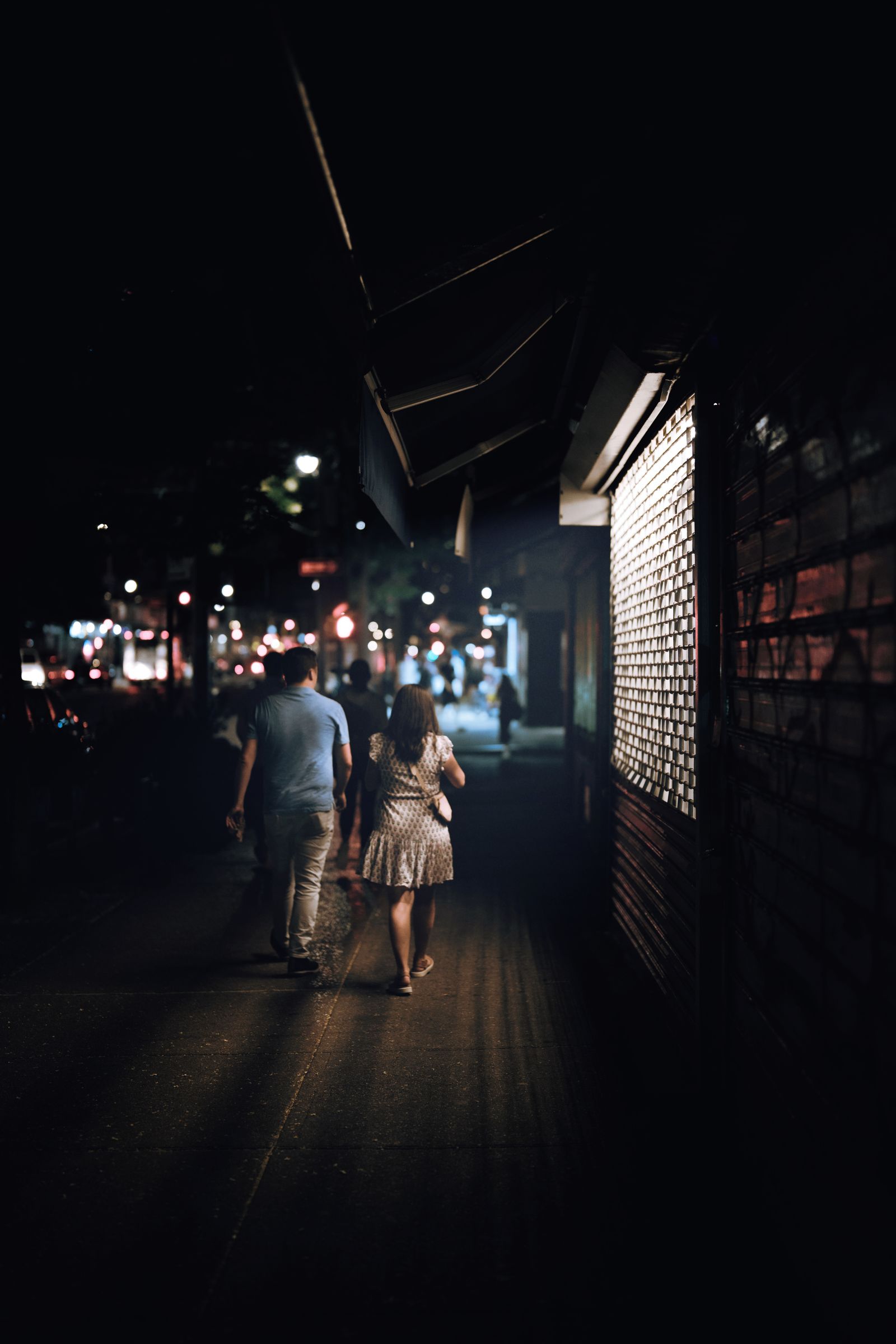
The transition is where date outfits are won and lost, because the night moves through at least three settings and each one re-reads the outfit from the beginning. Restaurant to pavement is the first test. The blazer that framed you at the table now has to work in motion, over the full length of the trouser, in cooler and brighter light. This is where the hem earns its keep. A hem that meets the shoe with one light break walks cleanly and stays clean. A pooling hem drags, darkens at the edge and announces itself in every puddle of light between venues. The second test is the layer change. A good evening outfit has one planned move, the blazer opens, the coat comes off at the bar, the knit stands alone at a warm cafe table. An outfit with no planned move forces improvisation, and improvised layers, a hoodie produced from a bag, a shirt tied at the waist, break the register instantly.
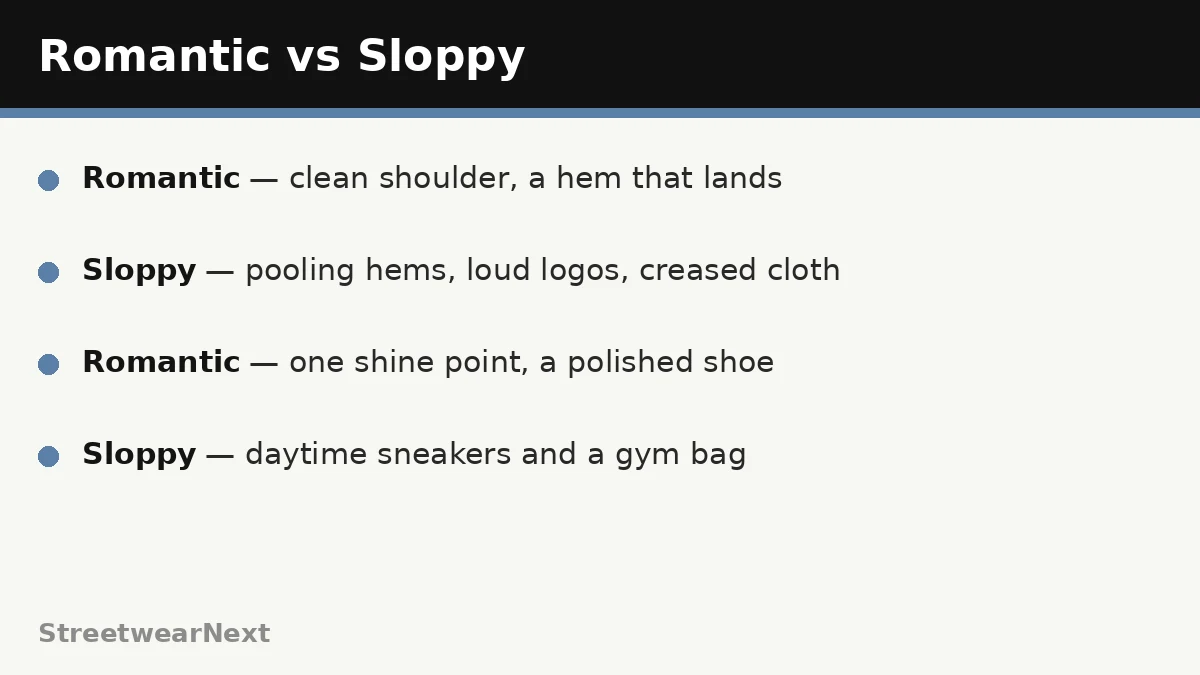
The failures list is short because it is consistent. Pooling hems and cropped lengths that strand the ankle in no man’s land. Loud logos and graphics that shout across a quiet table. Soft, creased cloth that lost its shape by the second hour. Daytime sneakers and a gym bag carried into the evening as if the night were an errand. A scent applied in the doorway. Each failure has the same shape, a piece or a habit carried over from the daytime without its register changed, which is the exact mistake this guide exists to prevent. The work translation of the same silhouette makes the point from the other direction, and our guide to Korean streetwear for work shows how the blazer and wide trouser change register for an office. Evening is simply the third register of the same clothes, and it is learned the same way, piece by piece.
The habit that keeps all of it working is a sixty-second check before leaving, run in the order the night will judge you. Neckline clean and finished. Shoulder sitting where it should. Waist tucked or deliberately closed. Hem meeting the shoe, shoe polished and walkable. One shine point, scent quiet, one layer ready to open or come off. That check is the whole method in miniature. Korean streetwear after dark was never about dressing up in someone else’s clothes. It is about taking the proportions Seoul dressing does better than anyone and presenting them at the distance, in the light and across the route a date actually involves, so the outfit reads the way it was meant to, considered, comfortable and quietly romantic, with the street still visible in every line of it.
Our View
Our view is that date night is the test Korean streetwear was quietly built to pass. Seoul dressing already values a clean shoulder, a full-length trouser, a quiet palette and an outfit that holds together in fragments, across a table, on a walk, at close range. Edit the daytime pieces for the evening conditions, polish the edges instead of replacing the silhouette, plan the one layer move, and you are not dressing up as someone else for the night. You are wearing your own style at its most considered, and that is what reads as romantic.
Do not ask whether a Seoul outfit is dressed up enough for date night. Ask whether its neckline, its hem and its shoes survive the table, the walk and the last hour, because those three answers are the evening.
— Brian Ka
Frequently Asked Questions
Can Korean streetwear really work for a date night?
Yes, in its evening translation. Keep the wide trouser, the relaxed blazer and the quiet palette, then polish the edges, a clean neckline, a pressed cloth, a hem that lands on the shoe and loafers or equally clean minimal shoes. The silhouette stays street, the finish becomes evening.
What is the safest first date outfit in this style?
The blazer formula. An oversized blazer over a fine dark knit, wide-leg tailored trousers and black loafers. It sits well, walks well, works for men and women, and its top third, the part seen across the table, is the most forgiving combination in this guide.
Are sneakers acceptable on a Seoul-style date night?
Only the quiet kind. Clean, low, plain leather sneakers with no visible branding can work, especially for a cafe or a casual restaurant. Worn, chunky or statement sneakers read as daytime carryover and undo the evening register, so loafers remain the default.
How should couples coordinate without matching outfits?
Coordinate tonally, not identically. Agree on one quiet palette, black and charcoal, navy and stone, black and cream, then each dress independently inside it. You will read as a pair in every light the night offers, without wearing a uniform.
What makes a streetwear outfit read sloppy instead of romantic?
Carryover. Pooling hems, creased soft cloth, loud logos, daytime shoes and a scent applied at full strength all signal that the outfit was not rethought for the evening. Romantic is the same silhouette with every edge checked, romantic is a decision, sloppy is a default.
Questions About Korean Streetwear for Date Night?
Not sure whether a Seoul piece will survive the table, or how to translate an outfit you already own for an evening out? Send us your questions and we will point you in the right direction.
Sources
- Wikipedia — Fashion in South Korea
- Wikipedia — Color Theory
- Wikipedia — Streetwear
- Wikipedia — Blazer
- Wikipedia — Trousers
- Wikipedia — Button-Down Shirt
- Wikipedia — Turtleneck
- Wikipedia — Knitwear
- Wikipedia — Cocktail Dress
- Wikipedia — Loafer
- Wikipedia — Perfume