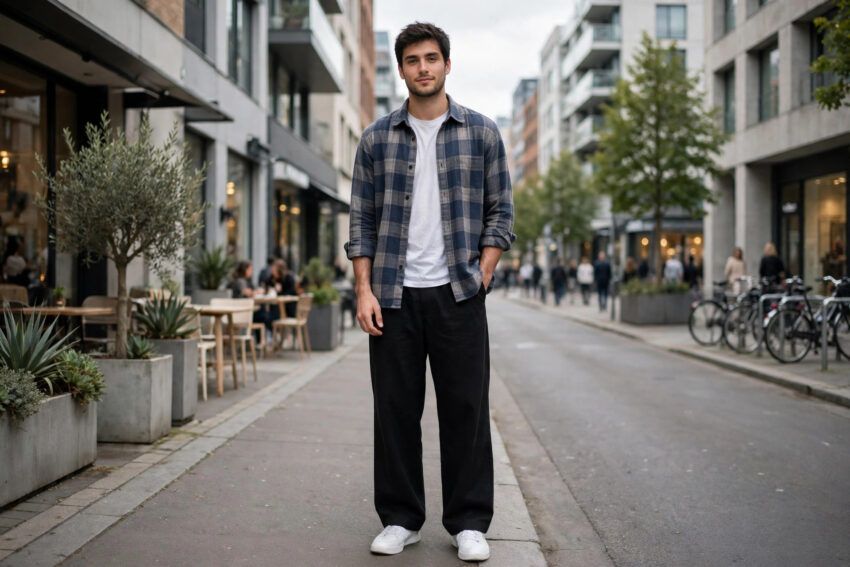
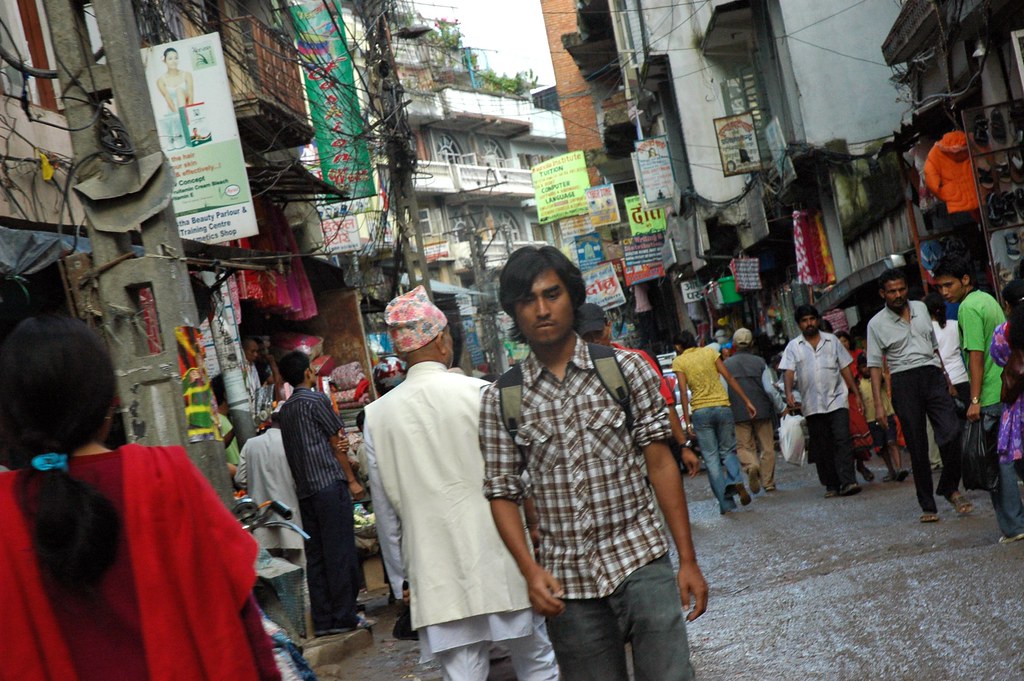
A flannel shirt tips into lumberjack costume at predictable points, and none of them is the shirt itself. It happens when a large red and black check is worn buttoned to the neck, untucked over faded blue jeans, with work boots below and nothing in the outfit that belongs to a city. Every element is quoting the same workwear story at the same time, so the eye reads the story instead of the clothes. Change any two of those elements and the same shirt reads as streetwear. This guide is about the flannel shirt only: how plaid scale and colour set the volume, why fit decides whether it reads as a work shirt or a styled layer, the four ways to wear it, and the bottoms, shoes and layers that keep plaid on the street side of the line.
Start Here
Check your rotation against the streetwear essentials every wardrobe needs, browse complete looks in the streetwear inspo gallery, and for transitional weather formulas that pair well with a flannel layer, see our guide to Korean street style in spring and fall.
Key Takeaways
- Flannel is a fabric and plaid is a pattern. The lumberjack look comes from the whole outfit quoting workwear at once, not from either one alone.
- Plaid scale sets the volume: small checks read almost solid, medium tartan is the versatile middle, and large buffalo check is the boldest and needs plain pieces around it.
- Fit does the separating work. A flannel that skims the body, with sleeves rolled to the forearm, reads styled; a boxy work cut worn closed reads as uniform.
- Wear it four ways: open over a tee, half buttoned, buttoned and tucked, or tied at the waist as a colour block.
- Bottoms and shoes change the story fastest. Black or wide-leg trousers and clean sneakers pull plaid into the city; faded jeans and work boots push it back out.
- One workwear piece per outfit. Flannel plus a denim jacket, work boots and a beanie is a costume; flannel plus anything else is a look.
Contents
- Plaid Scale and Colour: Where the Lumberjack Look Starts
- Flannel Is a Fabric, Plaid Is a Pattern
- Fit: The Difference Between Work Shirt and Streetwear
- Four Ways to Wear It
- Bottoms and Shoes That Change the Story
- Layering Flannel Without Doubling the Workwear
- Buying and Care: Weight, Shrinkage and Fading
- Our View
- Frequently Asked Questions
- Sources
- Recommended
Plaid Scale and Colour: Where the Lumberjack Look Starts
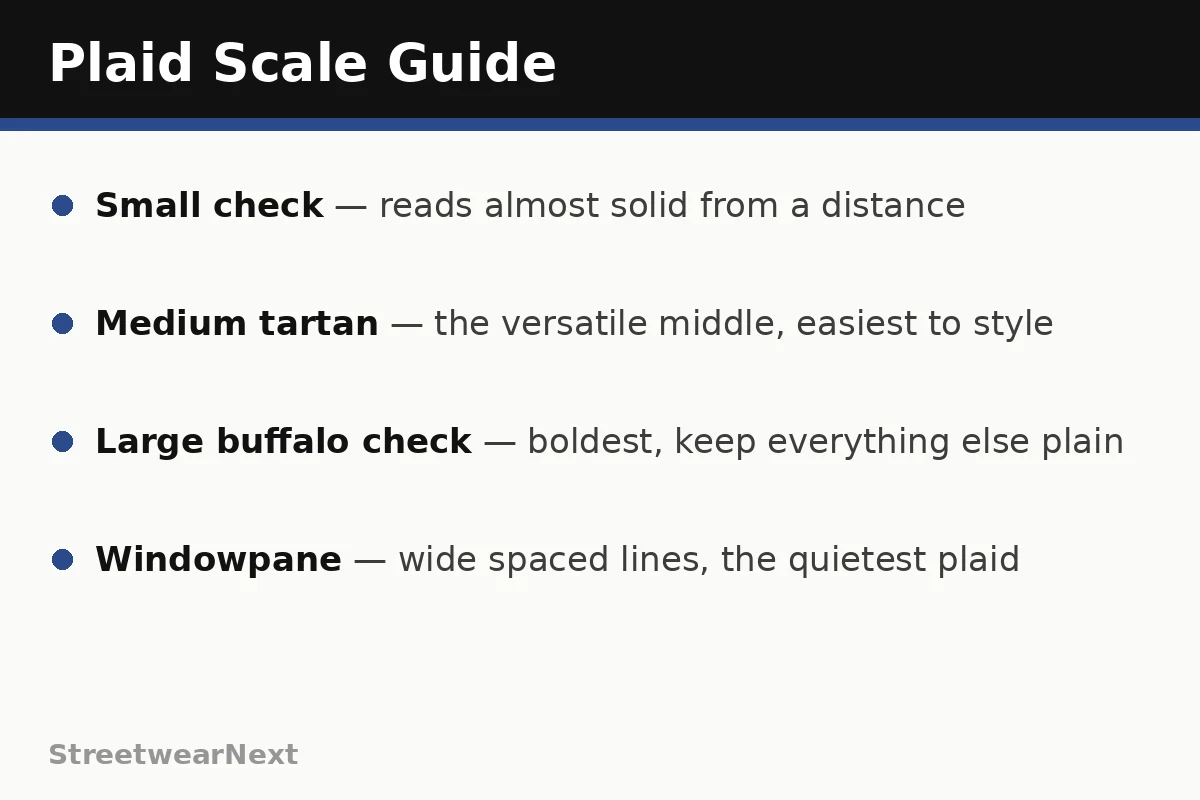
The lumberjack look starts with scale and colour before it starts with anything you pair the shirt with, because one specific combination, a large check in red and black, carries the whole stereotype on its own. Plaid is not one pattern but a family of them, built from bands of colour crossing at right angles so the intersections mix into new shades. The background on how plaid is a pattern of crossed horizontal and vertical bands explains why the same shirt shape can look completely different from one check to the next: change the width of the bands and the spacing between them and you change how loud the garment is from across a street. A small, tight check blurs at distance and reads almost like a solid colour with texture, which makes it the easiest plaid to wear and the hardest to get wrong. A medium check stays readable as a pattern without shouting, and it is where most versatile flannels live. A large check is a statement at twenty paces, and it has to be styled like one, with everything around it kept quiet.
Colour does the same work as scale, and the two multiply each other. The traditional end of the family is tartan, and the history behind tartan patterns carry setts, repeated sequences of coloured bands that were tied to particular weavers and regions, which is why classic tartans feel grounded and slightly formal even on a soft shirt. Their colours are usually deep and mixed, greens, navies and burgundies with thin lines of yellow or white running through, and that complexity is exactly what makes them read as considered rather than costume. At the other extreme sits the two-colour check, and buffalo check is the boldest member of the family: large, equal blocks of red and black with nothing in between to soften it. That single pattern, at that scale, in those colours, is the lumberjack shorthand all by itself. Wear it if you like it, but know that it starts the outfit one step from the costume line, and every other choice has to pull in the opposite direction. Muted and mixed-colour plaids start from the opposite place, with room to spare.
| Plaid scale | What it looks like | Volume | Styling rule |
|---|---|---|---|
| Small check | Tight bands that blur into near-solid at distance | Low | Wear it like a plain shirt, pairs with almost anything |
| Medium tartan | Readable pattern, mixed colours, thin accent lines | Medium | The versatile middle, keep one other piece simple |
| Large buffalo check | Big equal blocks, usually red and black | High | Everything else plain, dark and pattern free |
| Windowpane | Wide spaced thin lines over a solid ground | Low to medium | The quietest plaid, works tucked and dressed up |
| Madras style check | Bright, uneven bands, usually a lighter summer cloth | Medium to high | Warm weather only, pair with plain shorts or chinos |
The practical rule that falls out of the table is simple. The louder the plaid, the quieter everything else in the outfit has to be, and the quieter the plaid, the more freedom you have everywhere else. A small check flannel can sit over a graphic tee and beside patterned sneakers without the outfit arguing with itself. A buffalo check needs a plain tee, plain dark trousers and plain shoes, and even then it is the whole personality of the look. Most people who feel that flannel does not work for them own exactly one shirt, and it is usually the loudest version, bought because it looked the most like flannel on the rail. Start at the medium or quiet end of the scale and the shirt becomes one of the easiest pieces in the wardrobe instead of a costume you talk yourself into twice a year.
Flannel Is a Fabric, Plaid Is a Pattern
Half the confusion around this shirt dissolves once the two words are separated, because flannel names a cloth and plaid names a design, and a shirt can carry either one without the other. The definition behind flannel is brushed fabric is a soft woven cloth, traditionally wool or cotton, whose surface is raised or brushed so the fibres stand slightly and trap warmth against the skin. That brushed surface is why flannel feels warm the moment you put it on and why it drapes softly instead of crisply. Plaid, by contrast, can be printed or woven onto anything, including thin summer cotton with no warmth in it at all. A solid navy flannel shirt exists and is one of the most useful cold weather shirts you can own. A plaid shirt in unbrushed poplin exists too, and it behaves like a summer shirt that happens to wear a winter pattern. When you shop, you are choosing two things, not one: the cloth, which decides warmth, weight and drape, and the pattern, which decides volume and styling difficulty.
The fibre underneath the brushing decides how the shirt behaves across a season. The everyday version is cotton, and the way cotton flannel softens with washing is part of its appeal: cotton fibre takes the brushed finish well, breathes reasonably, and gets more comfortable the longer you own it, at the price of shrinking a little early on and fading slowly at the folds. Wool is the older and warmer option, and a wool flannel drapes heavier and holds its shape better than cotton at the same weight, because wool fibres are naturally elastic and resist creasing, which is why wool flannels tend to look sharper for longer and cost more. Blends sit between the two and are what most high street flannels actually are. Weight is the number that matters most in practice. A light flannel wears like a shirt and layers under a jacket. A heavy flannel wears like a light jacket itself, holds an open shape over a tee, and is the version streetwear reaches for most, because it keeps its structure instead of clinging. If a flannel feels thin and limp on the hanger, it will look thin and limp worn open, whatever the pattern promises.
Construction details finish the fabric picture, and two of them are worth checking before you buy. The first is whether the pattern is woven in or printed on. A woven plaid shows the same pattern, slightly softer, on the inside of the cloth, because the coloured yarns run through the whole fabric. A printed plaid sits on the surface, looks flat white or pale inside, and fades unevenly as the print wears. Woven costs more and ages far better. The second detail is pattern matching at the seams and pockets. On a well made shirt the check lines up across the pocket flaps and continues unbroken across the front placket. On a cheap one the pattern jumps at every seam, and that jumpiness is a large part of why some flannels look thrown together even in a good outfit. Neither detail appears in a product title, and both are visible in ten seconds in a shop or in a clear product photo, which makes them the fastest quality check this category offers.
Fit: The Difference Between Work Shirt and Streetwear
Fit is where the work shirt and the streetwear shirt part company, because the work cut is built to move in, with room everywhere and length to stay tucked during physical work, and worn as it comes it carries that job with it. The classic work flannel is generous through the chest and waist, long in the body, and full in the sleeve, and every one of those choices makes sense for a garment designed to be worn over other clothes while someone lifts, reaches and bends. Transferred unchanged to a city outfit, the same generosity reads as shapelessness, and shapeless plaid over straight jeans is most of the lumberjack effect on its own. The streetwear version keeps the comfort and removes the excess. It skims the body rather than hanging from it, the shoulder seam sits on the shoulder instead of past it, and the hem ends around the hip bone rather than below it, so the shirt can be worn untucked without looking borrowed. The wider story of how work and skate clothing became streetwear as a category is a story of exactly this editing, keeping the durable cloth and changing the cut and the company it keeps.
Oversized is the deliberate exception, and it only works when it is clearly deliberate. An oversized flannel worn open over a fitted tee and a clean, structured bottom reads as a chosen silhouette, because the contrast between the big layer and the controlled pieces under it shows intention. The same oversized shirt worn closed, over a loose tee and baggy jeans, has no contrast anywhere, and the eye defaults to the workwear reading. The difference is not the shirt, it is whether anything in the outfit is fitted. Keep one anchor of structure, a tucked tee, a clean trouser line, a shoe with a defined shape, and the big flannel reads as the relaxed piece in a planned outfit. Sleeves carry more of this signal than people expect. A sleeve worn down and buttoned at the wrist, on a soft brushed shirt, reads uniform. The same sleeve rolled twice to show forearm reads styled, because rolled sleeves are a choice nobody makes by accident, and the outfit gets credit for every visible choice in it.
Length and the tuck follow the same logic. A flannel hem that ends mid hip can be worn untucked cleanly. A longer hem worn untucked flaps and reads as a work shirt escaping, so longer cuts should be tucked, half tucked at the front, or worn open as an overshirt where the length becomes the point. The half tuck deserves its reputation here: front tucked, back loose, it shows the waistband and the belt line, breaks the shirt into a top and a layer at the same time, and it is the quickest single adjustment that moves a flannel from work to street. Collar behaviour matters at the small end too. A soft collar worn open with the top two buttons undone reads relaxed. The same collar buttoned to the top with nothing at the neck reads severe on a plaid shirt in a way it does not on a plain one, because the pattern gives the severity something to frame. Fit, in short, is not about tightness. It is about which decisions are visible.
Four Ways to Wear It
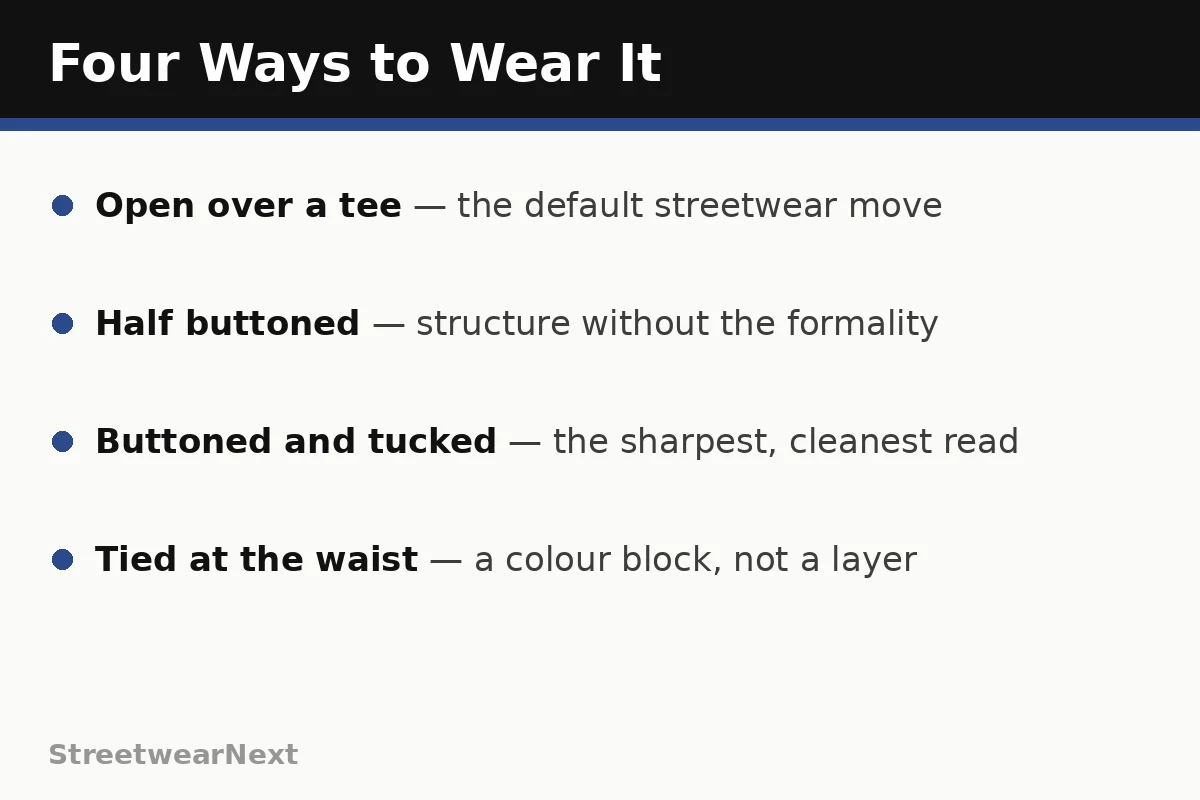
One flannel shirt worn four ways is four different outfits, and the way you fasten it changes its meaning as much as anything you pair it with. The default streetwear move is open over a tee. The shirt becomes a light layer and a frame, the tee carries the front of the outfit, and the plaid shows at the edges and the sleeves where it adds colour without covering the whole torso. This is the version with the longest pedigree in the culture, since grunge made flannel famous in exactly this configuration, worn open or tied, over band tees and ripped denim, and the reason it still works is structural: an open shirt is a layer, and layers read as styling, while a closed work shirt reads as a uniform. Keep the tee plain or with a single graphic, keep it fitted enough to hold the front line, and let the flannel be the pattern. Half buttoned is the second way: fasten the middle buttons, leave the top open and the bottom loose, and the shirt gains structure while keeping the layered read. It is the version that works best with the shirt as the main top rather than as a jacket substitute.
Buttoned and tucked is the third way and the sharpest. Fully fastened, tucked into a clean trouser with the sleeves rolled once, a medium or small check flannel reads closer to a dressed shirt than to workwear, and it is the version to reach for when the rest of the day is smarter than a tee allows. The tuck is doing the work, because tucking is a deliberate, visible decision that workwear styling almost never makes with this shirt. The fourth way removes the shirt from the torso entirely: tied at the waist, sleeves knotted at the front, it becomes a colour block and a hem breaker over plain trousers or shorts, a styling device the wider story of hip hop fashion styling used heavily in the nineties and that streetwear has kept ever since. Worn this way the plaid works at hip level, it breaks a long plain outfit into sections, and it keeps a layer within reach for the evening. It fails only when the rest of the outfit is also busy, because a tied shirt is a strong horizontal event and it needs quiet clothes around it.
Bottoms and Shoes That Change the Story
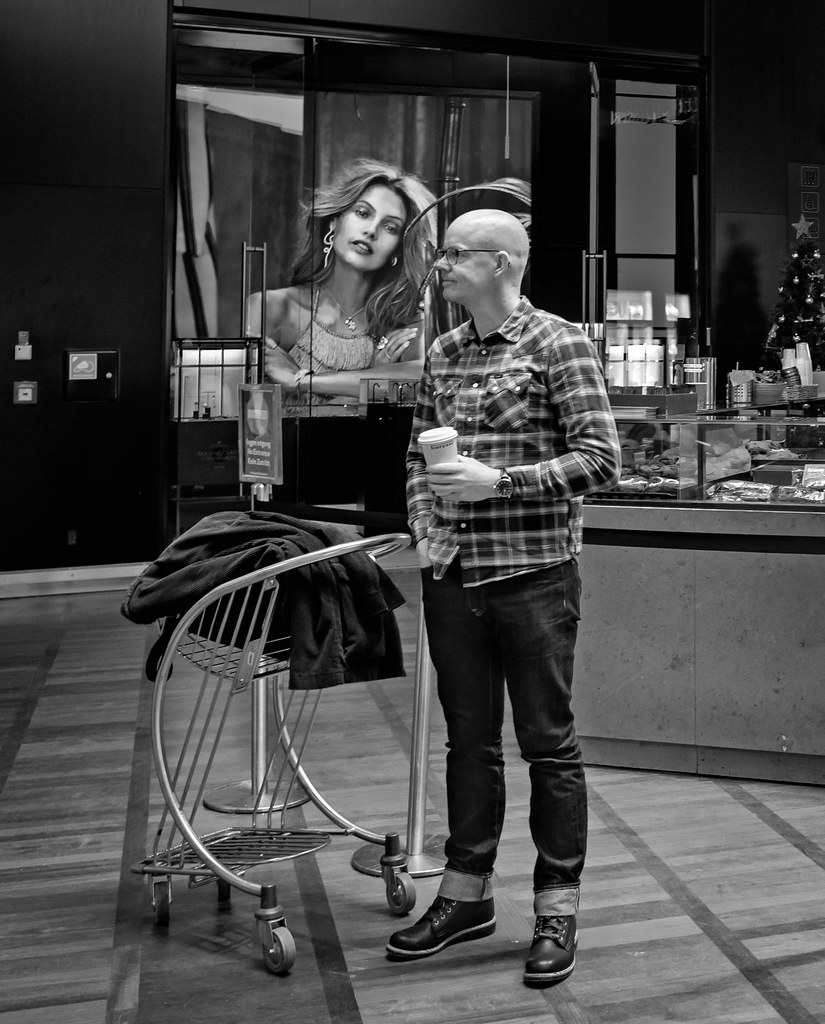
If fit is the slow lever, bottoms and shoes are the fast one, because the trousers and footwear under a flannel decide which world the outfit belongs to before the shirt gets a say. The lumberjack combination is specific: faded blue straight jeans and a work boot. Both pieces come from the same workwear wardrobe as the shirt, so the three of them together form a complete period costume, and the cultural weight of the lumberjack stereotype, the plaid shirt as the uniform of the North American woods worker, is what the combination summons whether you intend it or not. Break either piece and the costume breaks. Black jeans are the simplest break available, because black moves the outfit’s centre of gravity from country to city in one change, and black denim under any plaid, including the red and black check, reads as a styled contrast rather than a matched set. Our guide to streetwear jeans covers the cuts in full, and for flannel the useful ones are the black skinny or straight leg for the buttoned version, and the wider leg for the open overshirt version, where the volume below balances the layer above.
Beyond denim, the strongest partners are the trousers that share nothing with workwear at all. A wide leg tailored trouser in black, charcoal or cream turns a flannel into the casual piece in a deliberate contrast, soft pattern against a clean formal line, and it is the combination that most reliably surprises people who think plaid cannot dress up. Cargo trousers work too, but they sit closer to the line, since pockets and utility detailing are workwear language; our guide to cargo pants streetwear outfits shows the styling in full, and with flannel the rule is to keep the cargo plain, fitted at the waist and worn with sneakers rather than boots, so only one of the two pieces is speaking workwear at a time. Shorts belong to the lighter flannels and the tied at the waist version in warm weather, plain and above the knee, with the shirt carried as the layer for later. In every case the test is the same: count the workwear references in the bottom half. Jeans in a work cut plus boots is two, and two is too many under a plaid shirt. One reference, or none, and the shirt is free to be a pattern instead of a uniform.
Shoes finish the argument. Clean sneakers are the default answer and the safest, because a white or black low top belongs entirely to the street side of the wardrobe and it pulls any flannel outfit with it. Chunky sneakers work with the oversized open version, where their volume matches the layer. Loafers and clean minimal boots work with the tucked version and push it smarter. What does not work, under any version, is the classic work boot with the lugged sole and the padded collar, worn with jeans, because that pairing is the costume’s foundation and no shirt styling survives it. A Chelsea or a plain leather boot in black is a different object from a work boot in tan, and the difference is the whole game: same category of footwear, opposite story. Choose the shoe that belongs to the place you are actually going, and the flannel follows it there.

Layering Flannel Without Doubling the Workwear
Flannel layers in two directions, under a jacket and over a base, and both directions fail the same way, by stacking a second workwear story on top of the first. Understand where the shirt comes from and the rule writes itself, because workwear is flannel’s origin: clothing built for manual labour, valued for durability and warmth, and adopted by fashion precisely for that honesty. The adoption works when the outfit borrows one honest piece and surrounds it with the city. It fails when it borrows the whole wardrobe. A denim jacket over a flannel shirt is two workwear icons competing, and the outfit reads as a theme. A flannel over a hoodie, by contrast, is one workwear piece over a streetwear staple, and it works so well that it is a standard cold weather formula: hood up over the collar or settled under it, the soft grey or black of the hoodie calming the plaid at the front. Our guide to streetwear hoodies covers the layer itself, and with flannel the hoodie should be plain, fitted enough to sit under the shirt without bunching, and in a colour drawn from the plaid’s quietest band.
Over the top, the safe jackets are the ones with no workwear history of their own. A black puffer over an open flannel keeps the plaid visible at the chest and sleeves while the silhouette goes fully urban. A plain overcoat does the same job smarter, and the contrast between a tailored coat and a soft plaid layer is one of the most reliable dressed streetwear combinations there is. A leather jacket works for the same reason: its story is the motorcycle and the city, not the worksite, so the two pieces argue productively instead of agreeing into costume. Headwear follows the same count. A plain cap or a beanie in a solid colour drawn from the outfit is fine, and our guide to streetwear hats covers the shapes, but a beanie plus flannel plus boots is three workwear references, and the count, not any single piece, is what tips the outfit. Keep the total at one, two at the very most, and count honestly: the shirt is always one of them.
Buying and Care: Weight, Shrinkage and Fading
A flannel shirt is a long term piece that fails slowly and predictably, and the buying and care decisions that matter are the ones that manage weight, shrinkage and fading before they manage you. Buy by weight first. Pick the shirt up, or check the fabric description: a heavy flannel holds an open shape over a tee and survives years of washing, a light one is a shirt only and should be bought and worn as one. Expect cotton flannel to shrink a small amount in its first washes, mostly in length, so a shirt that fits exactly on the rail with no room anywhere is a shirt that will fit badly by its third wash; a little ease at purchase is the correct fit, not a compromise. Buy the pattern woven, not printed, for the reasons covered earlier, and check that the check matches across the front and the pockets. None of this requires a large budget. It requires two minutes of looking at the specific shirt instead of the idea of the shirt, and it is the difference between the flannel people live in and the one that migrates to the back of the wardrobe.
Care is mostly a matter of not undoing the brushing. Wash flannel cool or warm rather than hot, because heat accelerates both shrinkage and the flattening of the raised surface that makes the cloth feel like flannel at all. Wash it with similar colours, since the deep dyes in a strong plaid will share themselves with pale laundry in the early washes. Dry it on a line or a hanger where you can, and if you use a dryer, use it low and take the shirt out still slightly damp, because high heat is what turns a soft brushed shirt into a thin tired one over a season. Fading, when it comes, arrives first at the collar, the cuffs and the folds, and on a plaid it softens the pattern rather than ruining it, which is why an old flannel often looks better worn open and casual than it did new and buttoned. Store it hung or loosely folded rather than compressed, brush surface lint off occasionally, and the shirt will outlast most of the trend pieces bought beside it. That durability is the original workwear promise, and it is the one part of the heritage worth keeping in full.
Our View
Our view is that the flannel shirt has an image problem it never earned. The shirt is warm, durable, comfortable and patterned in a way that adds colour to outfits that are otherwise built from black, grey and denim. What people are actually avoiding is not the shirt but a specific combination, the big red check, the work cut, the faded jeans and the boots, worn all at once. Separate the pieces, choose the plaid scale deliberately, fit the shirt like you mean it, and let the bottom half belong to the city, and flannel becomes what it should always have been in a streetwear wardrobe: the easiest pattern a plain outfit can borrow.
Plaid is not the costume. The costume is everything around the plaid agreeing with it. Change the company the shirt keeps and the shirt was never the problem.
— Brian Ka
Frequently Asked Questions
How do you wear a flannel shirt without looking like a lumberjack?
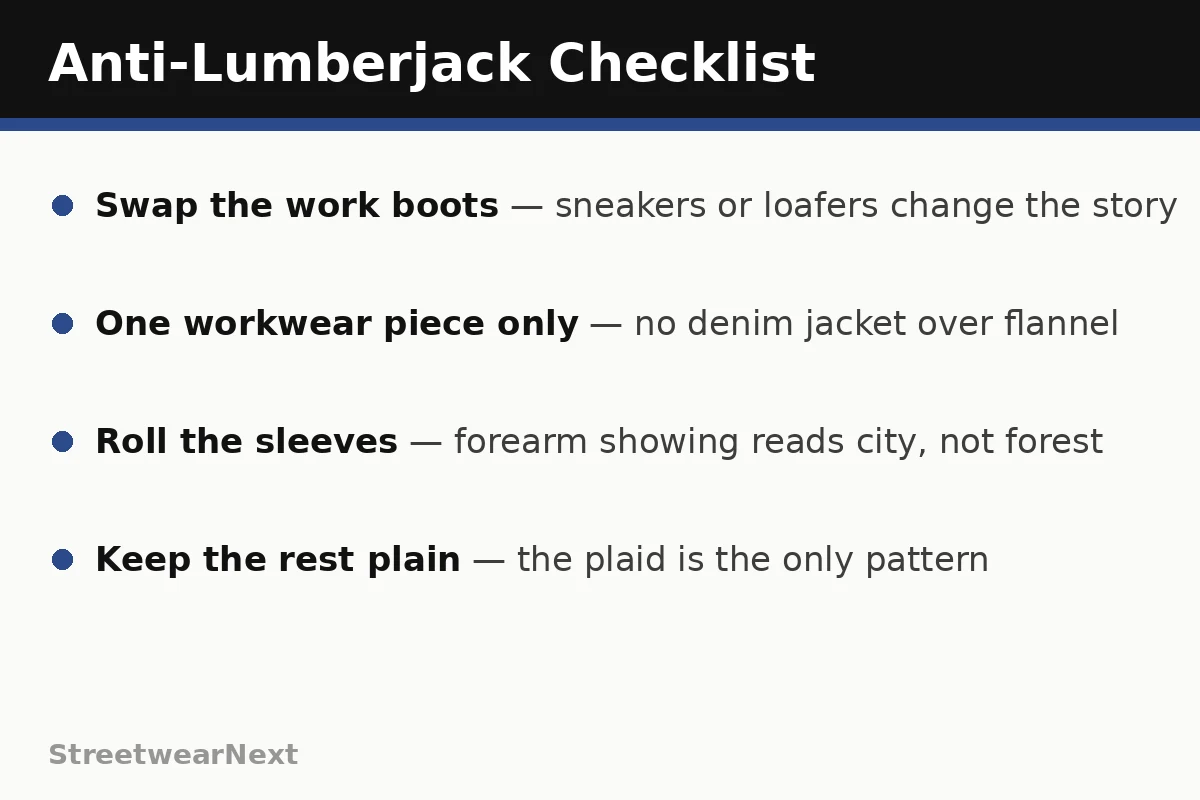
Break the workwear combination. Choose a medium or small check instead of large red and black buffalo check, fit the shirt so it skims the body, roll the sleeves, and pair it with black or wide leg trousers and clean sneakers instead of faded jeans and work boots. One workwear reference per outfit is the rule, and the shirt is that one.
What is the difference between flannel and plaid?
Flannel is a fabric, a soft woven cloth with a brushed surface that traps warmth. Plaid is a pattern, bands of colour crossing at right angles. A shirt can be either without the other: solid flannel shirts exist, and plaid patterns appear on thin summer cloth with no flannel in it at all.
Should a flannel shirt be worn open or buttoned?
Both work, and they read differently. Open over a plain tee is the relaxed streetwear default and frames the outfit. Half buttoned adds structure. Fully buttoned and tucked is the sharpest version and suits a medium or small check with clean trousers. The version to avoid is fully buttoned and untucked over faded jeans, which is the work uniform read.
What pants go best with a flannel shirt for streetwear?
Black jeans, wide leg trousers in black, charcoal or cream, and plain cargo trousers worn with sneakers. These bottoms belong to the city side of the wardrobe, so the plaid reads as a pattern choice rather than part of a work uniform. Faded blue jeans are the hardest pairing and need a clean shoe and a deliberate fit to work.
Does flannel shrink, and how should it be washed?
Cotton flannel shrinks a little in its first washes, mostly in length, so buy with a small amount of ease. Wash cool or warm rather than hot, with similar colours, and dry on a line or hanger where possible. High heat speeds up shrinkage and flattens the brushed surface that makes flannel soft and warm.
Questions About Building Your Wardrobe?
Not sure which plaid scale suits the rest of your rotation, or whether a flannel you own can be styled out of the workwear look? Send us your questions and we will point you in the right direction.
Sources
- Wikipedia — Flannel
- Wikipedia — Plaid
- Wikipedia — Tartan
- Wikipedia — Buffalo Check
- Wikipedia — Cotton
- Wikipedia — Wool
- Wikipedia — Streetwear
- Wikipedia — Grunge Fashion
- Wikipedia — Lumberjack
- Wikipedia — Workwear
- Wikipedia — Hip Hop Fashion