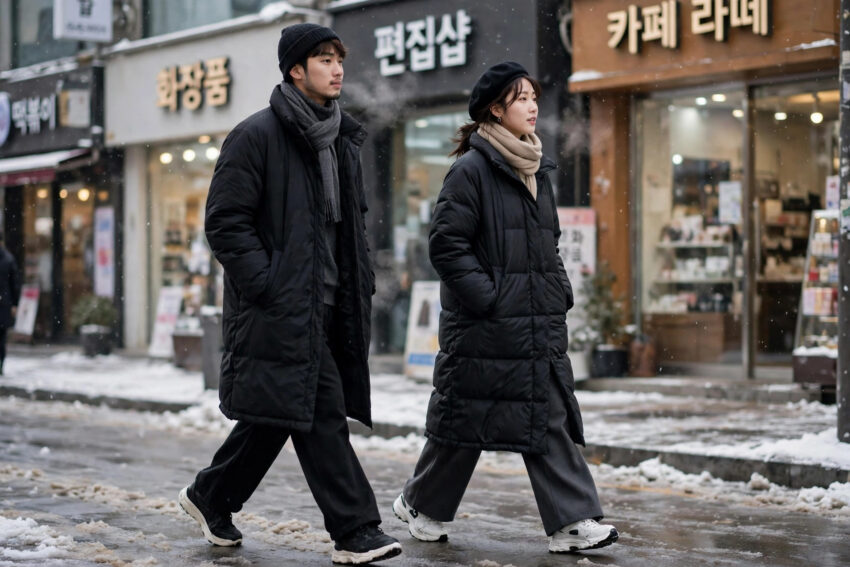
Winter is the season when Korean streetwear makes the most sense, because the Seoul look was never built for a single statement piece worn on its own. It was built for layers that hold a shape in cold air: a long padded coat that falls clean to the calf, a hoodie or knit underneath that adds volume without bulk at the waist, and wide-leg trousers that keep moving when the wind picks up along the Han River. Done well, layering does not hide the silhouette that makes Korean street style recognisable — it creates it. This guide works through the order, weights and proportions that keep that silhouette intact from first frost to deepest cold.
Start Here
Korean Street Style Guide · How to Style a Hoodie in Winter · Streetwear Outfit Ideas for Men in Winter · Korean Street Fashion Over 40 — Gangnam USA
Key Takeaways
- Build winter outfits from the skin out in a fixed order — base, mid, insulation, shell — and decide the silhouette before you decide the warmth.
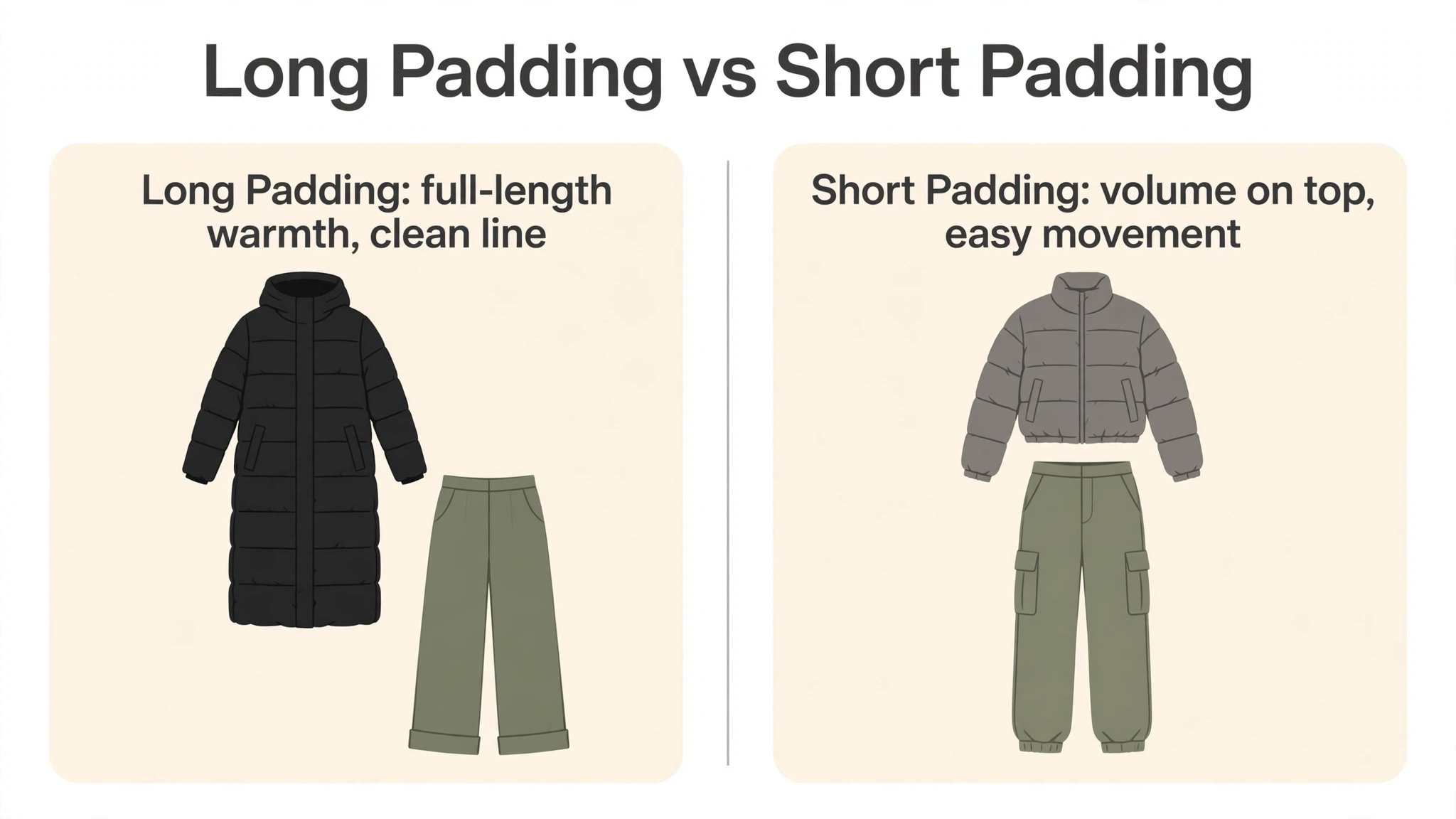
- Long padded coats, known in Korea as long padding, work because they create one clean vertical line; keep what sits underneath slimmer at the waist so the line is not broken.
- Wide-leg trousers stay wearable in winter with heavier fabrics, a hem that clears the boot, and footwear with enough volume to balance the leg.
- A muted palette of black, charcoal, grey, navy, cream and olive lets different textures read as one outfit instead of competing pieces.
- One visible hood, one visible collar and one long outer line is enough — remove a layer at the neck or ankle before adding another.
Contents
- The Layering Order That Protects the Silhouette
- Long Padding: The Coat That Defines the Season
- Hoodies, Knits and the Middle Layers
- Wide-Leg Trousers in Cold Weather
- The Muted Winter Palette and Texture
- Footwear and the Finishing Details
- Putting It Together: Three Winter Formulas
- Our View
- Frequently Asked Questions
- Sources
- Recommended
The Layering Order That Protects the Silhouette
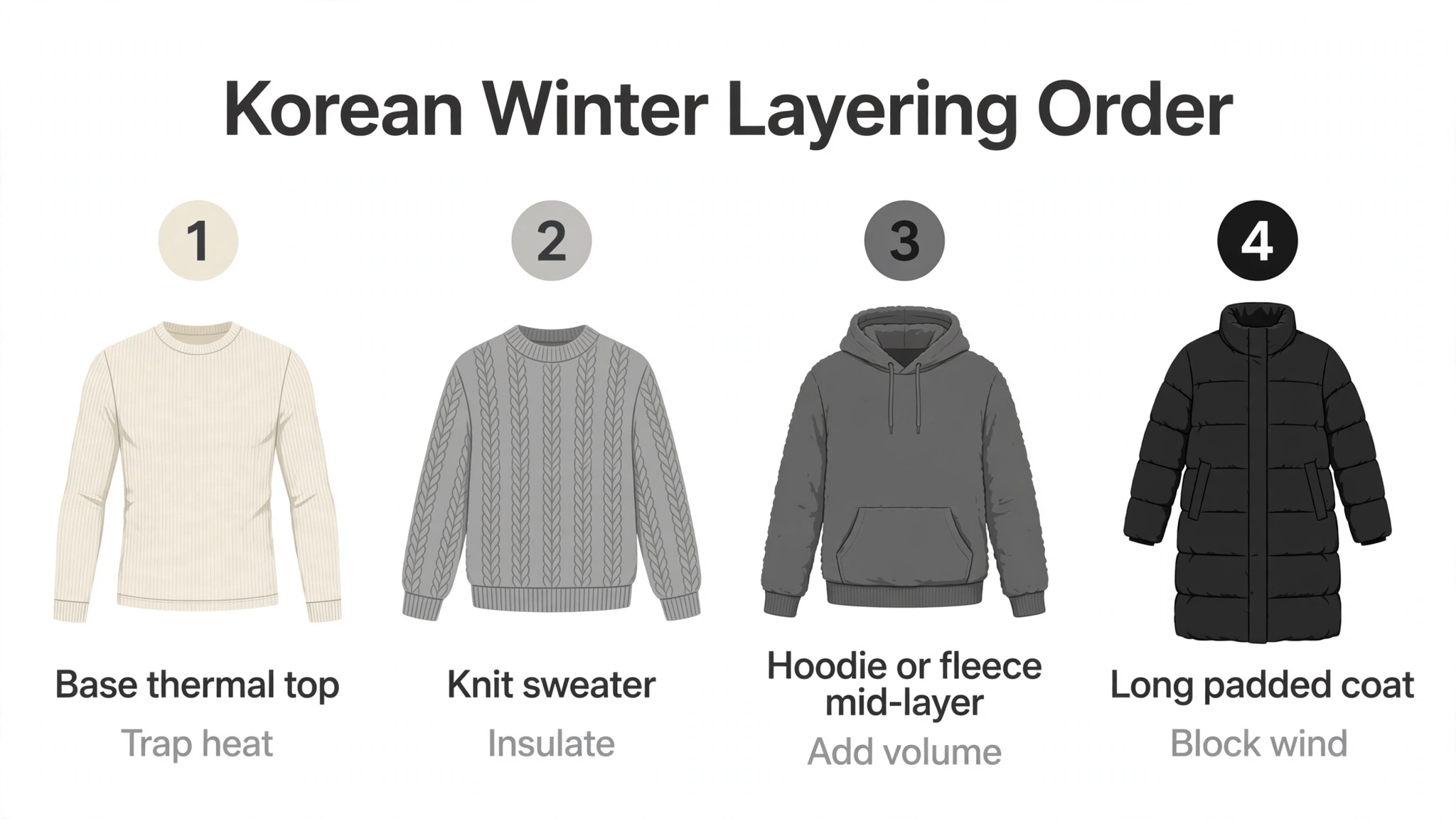
Order comes before warmth. Most winter outfits fail not because they are too cold but because the layers were added in the wrong sequence, so each new piece fights the one below it. The Seoul approach starts with the final outline in mind — long on top, wide through the leg, clean at the shoe — and then assigns every layer a single job inside that outline. A thin, close base regulates temperature against the skin. A mid layer, usually a hoodie, sweatshirt or knit, provides the visible texture and most of the everyday warmth. An insulating layer, when the day demands it, traps heat without needing to be seen. The outer layer, most often long padding or a heavy coat, sets the length, the shoulder and the overall proportion. When each layer knows its job, you can remove the coat indoors and still be wearing a complete outfit — essential through a Seoul day that moves between heated trains and freezing streets.
That layered logic has deep cultural roots. The global attention now paid to Korean fashion did not appear overnight, and museum exhibitions have traced how music, television, film and fashion reinforced one another, as documented in the V&A Hallyu exhibition. The same story reached American audiences through Hallyu at MFA Boston, where garments were shown alongside the popular culture that carried them around the world. If you are building the foundation first, our guide to streetwear essentials covers the base pieces that make this order work week after week.
| Layer | Best Winter Choice | Weight / Feel | Silhouette Job |
|---|---|---|---|
| Base | Long-sleeve tee or thermal top | Light, close to skin | Smooths the line, adds no bulk |
| Mid | Hoodie, sweatshirt or fine knit | Medium, soft volume | Visible texture at neck and cuff |
| Insulation | Thin padded vest or liner jacket | Medium, hidden | Warmth without changing the outline |
| Outer | Long padded coat or heavy overcoat | Heavy, structured fall | Sets length, shoulder and proportion |
| Leg | Wide-leg wool-blend or brushed trousers | Medium-heavy, draped | Balances the long top half |
Keep the waist quiet. The most common silhouette mistake is stacking volume at the middle: a thick hoodie bunched over a belt line, a liner puffing at the hip and a coat that then has to swing around all of it. Instead, let mid layers finish cleanly at or just below the waistband, tuck or half-tuck where the fabric allows it, and let the coat fall uninterrupted from shoulder to hem. That single uninterrupted fall reads as height and intention, and is forgiving in a way cropped, broken layers are not. Our breakdown of hoodie outfit ideas in Korean style shows how the same mid layer changes character depending on what finishes above and below it.
Long Padding: The Coat That Defines the Season
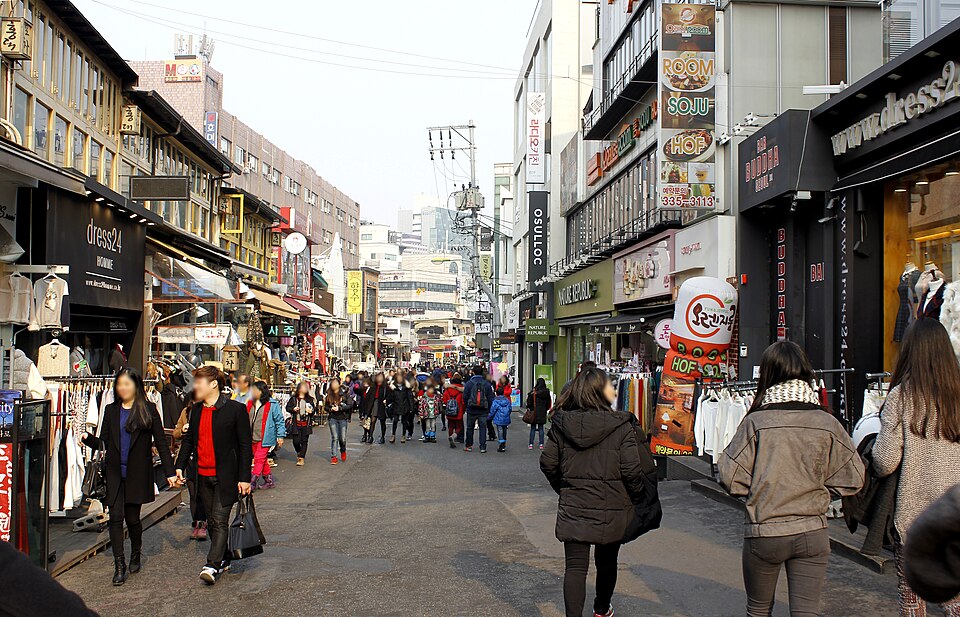
Long padding is practical clothing that became a uniform. In Korea the knee-length or calf-length padded coat moved from sports sidelines and school commutes into everyday winter dress because it solves a real problem: it covers the thigh, blocks wind that a short jacket lets in at the hip, and can be worn over almost anything without changing the outfit underneath. Its popularity is visible in the scale of the domestic market that serves it, a market documented in the Musinsa newsroom release on the platform’s growth and global expansion. When a platform reaches that many young customers, the pieces it sells in volume — long padding every winter among them — stop being trends and become defaults.
Choose length by proportion, not by habit. A coat ending just below the knee lengthens most frames and keeps the wide trouser visible below the hem. Mid-calf lengths work on taller frames but narrow the visible leg and demand a stronger shoe. Shoulder fit matters more than chest room: the coat should sit on your natural shoulder, not slide beyond it. Leave it open on milder days and let the mid layer show in a vertical strip — that strip is where colour or texture contrast belongs. See our guide to streetwear jackets.
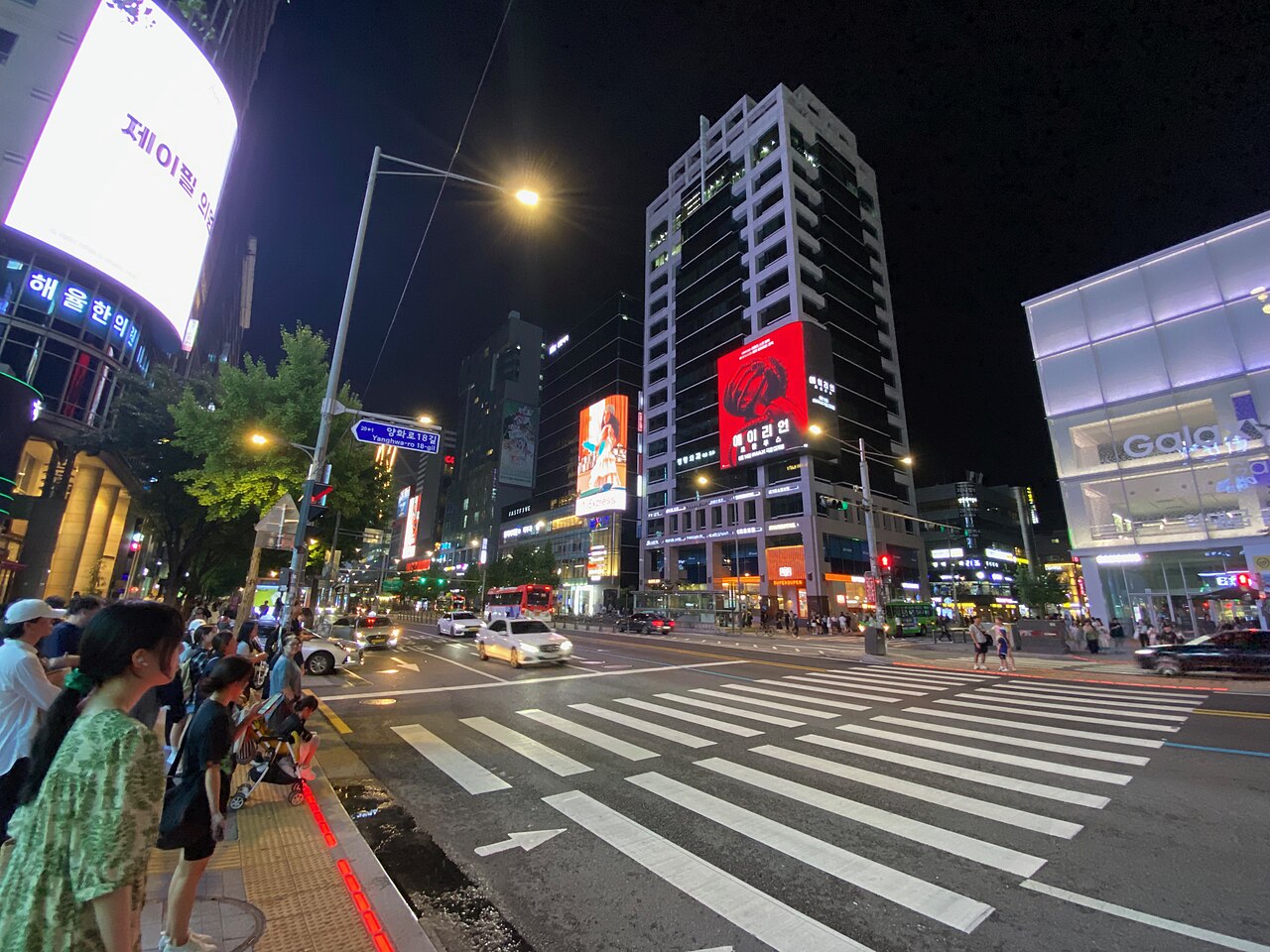
The coat also belongs to the city’s public fashion story. Seoul presents fashion as part of the city itself, most visibly when Seoul Fashion Week connects landmarks including Dongdaemun Design Plaza and Lotte World Tower as runway settings. The point was underlined when Seoul Fashion Week marked 25 years of growth and industry engagement. Long padding will never be a runway centrepiece, and that is the point: runway and street in Seoul feed each other, and designer proportions filter back into how students wear a padded coat with a better trouser and cleaner shoe.
Hoodies, Knits and the Middle Layers
The mid layer is the outfit once the coat comes off. Treat it that way and winter dressing gets much easier. A hoodie under long padding should be substantial enough to hold its own shape — a flimsy hood disappears at the neck and leaves the coat looking unsupported — but not so thick that its body puffs the coat outward. The hood itself is a styling tool: worn over the coat collar it creates the relaxed, unmistakably Korean layered neckline; tucked inside, it gives a cleaner, more minimal finish. Choose one. Two visible hoods, or a hood plus a high scarf plus a raised collar, crowd the face and shorten the whole silhouette. Our dedicated guide on how to style a hoodie in winter works through the hood-up, hood-down and half-zip variations in detail.
Knits give the same warmth with a quieter register. A fine-gauge crew neck or a half-zip knit under a padded coat reads more mature than a hoodie and suits anyone adapting the Seoul look for work or for an older wardrobe — the same territory explored in the Gangnam USA bridge linked in the card above. A chunky knit can replace the hoodie on dry days under an open coat, but watch the sleeve: cuffs that balloon past the coat sleeve spoil the clean exit at the wrist. Korean labels have built international reputations on exactly this kind of considered everyday piece, as surveys of the best Korean brands and overviews of Seoul fashion brands repeatedly show, from minimalist basics labels to more experimental names. The lesson is consistency of cut rather than logos.
Colour in the middle, calm on the outside. Because the coat covers most of the mid layer, the visible parts are the chest strip when the coat is open, the hood, and the cuffs. That makes the mid layer the safest place for the one lighter or warmer tone in the outfit — cream, heather grey or a washed colour under a black coat — without disturbing the muted whole. Graphic-heavy hoodies are a deliberate choice here: a large chest graphic is half-hidden by a closed coat and fully exposed by an open one. If you like the oversized route, our oversized hoodie outfit in Korean style guide covers how to keep extra volume in the hoodie from overwhelming a long coat.
Wide-Leg Trousers in Cold Weather
Wide trousers are a winter asset, not a summer leftover. The extra room through the leg accommodates a thermal layer underneath without changing the outer line, traps a pocket of still air that genuinely helps with warmth, and keeps the balanced, top-and-bottom volume that defines the Seoul silhouette under a long coat. The fabric has to change with the season, though. Light summer cotton that collapses against the leg in wind will undo the shape; look instead for wool blends, brushed cotton, heavy twill or corduroy that hold a crease and fall away from the body. Hold the trouser up by the waistband as a test — if the leg falls in a clean column, it will behave in the street; if it twists and clings, it will do the same on you.
The hem decides whether wide trousers look intentional in winter. In dry weather, a hem that just kisses the top of the shoe keeps the full length of the leg. In wet or snowy conditions, that same hem drags, soaks and darkens within a block. The practical Korean solution is a slightly cropped wide trouser or a single clean turn-up that clears the shoe and any slush, accepting a shorter leg line in exchange for an outfit that survives the day. Avoid stacking excess fabric over winter boots — pooling cloth over a bulky boot reads as an accident from every angle. For colder casual days, fleece joggers offer a tapered alternative that trades the wide column for a cuffed ankle, while black joggers remain the simplest fallback when conditions turn genuinely harsh.
Experimental Korean labels prove how far the trouser can go. Few examples are cited as often as the collective profiled in Hypebae on Ader Error, whose distorted proportions and playful construction showed that a trouser leg, a seam or a hem could be the design idea itself. You do not need avant-garde pieces to borrow the principle: a straight wide leg with a sharp crease already carries the message that proportion is the decoration. That idea travelled globally alongside Korean popular culture, a crossover examined in Dazed on K-pop and fashion, where the styling of idols and the work of Seoul designers are treated as one connected story. Wide trousers under long padding sit squarely in that story — visible, repeatable and easy to adopt without a costume.
The Muted Winter Palette and Texture
Muted does not mean monotonous. The winter palette most associated with Seoul street style — black, charcoal, warm grey, navy, cream, stone and olive — works because it shifts the interest from colour contrast to texture contrast. Matte padding against a soft knit, a smooth wool trouser against a leather shoe, a ribbed beanie against a clean coat shoulder: these are the differences the eye reads at street distance in flat winter light. Build outfits from two or three tones, keep the darkest for the largest piece, and let the lightest appear at the centre, where it lifts the outfit without fragmenting it. A fully black outfit remains the most reliable version, and our guide to the streetwear black jacket shows how much variation is possible inside a single colour.
Texture is also how older and newer Seoul meet. The city’s fashion memory is longer than its current global moment, something a retrospective covered by Korea JoongAng Daily on Seoul fashion history made clear in its look back at styles preserved by the city’s urban life museum. Material held by the Seoul Museum’s Dongdaemun exhibition traces how the Dongdaemun market district shaped the clothes ordinary Seoul residents actually wore. That history matters because Dongdaemun’s culture was always about fabric, cut and speed. Choosing a better cloth in a quiet colour is not a compromise; it is the original Seoul method.
Use one accent, and make it earn its place. A single accent — a beanie in a washed colour, a scarf with a subtle check, a bag strap across the coat — gives a muted outfit a focal point and a personal signature. More than one accent starts an argument the outfit usually loses. Headwear is the easiest accent to change daily, and our roundup of streetwear hats covers beanies, caps and bucket styles that sit correctly with hoods and coat collars. Keep metal and hardware quiet in winter: silver-tone zips and a simple watch suit the palette better than bright, contrasting trims that pull attention to the smallest parts of the outfit.
Footwear and the Finishing Details
Shoes finish the column that the coat starts. Under wide trousers and long padding, footwear needs enough visual weight to hold the bottom of the outfit. Slim, low-profile shoes can disappear under a wide hem and leave the leg floating; chunkier sneakers, padded winter sneakers or a clean leather boot give the column a full stop. This balance is a large part of why sneaker culture and Korean street style developed together, a relationship charted in SNKRDUNK on the Korean takeover of streetwear fashion. The shoe should either continue the trouser tone for length or match the coat; a bright shoe is an accent, so treat it with the one-accent discipline above.
Weatherproofing is a styling decision too. Wet hems, salt-marked suede and soaked canvas undo an otherwise strong outfit faster than any proportion mistake. On wet days choose treated leather or synthetic uppers, a lugged or at least grippy sole for icy pavements, and the slightly shorter trouser hem discussed earlier. Keep a second pair in rotation so shoes recover between wears. A warm, mid-length sock in a tone between trouser and shoe removes the flash of skin that breaks the line when you sit or climb stairs.
Finish at the neck, the wrist and the hand. A beanie worn slightly back, a scarf looped once rather than wound tight, gloves that match the coat or the shoe — these small choices are what separate a layered outfit from a pile of warm clothes. Check the back view before leaving: the coat should fall in one line from shoulder to hem with no mid layer escaping below it. For more complete outfit references across the season, browse our streetwear outfit ideas for men in winter and the wider streetwear inspiration collection, then adapt the proportions rather than copying any single look piece for piece.
Putting It Together: Three Winter Formulas
Formula one: the classic long-padding uniform. Black long padded coat, grey hoodie, charcoal wide-leg wool-blend trousers, chunky black sneakers and a black beanie. This is the reference outfit to master first, because every proportion in it is doing visible work. Vary it by swapping the hoodie for a cream knit, or the sneakers for a leather boot, one change at a time. If your wardrobe is missing the base pieces, start from our Korean street style guide and build outward from the pieces you already own.
Formula two: the softer, lighter-toned version. Stone or light grey long coat, cream knit, navy wide trousers, off-white sneakers and an olive beanie as the single accent. Anchor lighter outfits with the navy trouser and keep the rest within one temperature of colour; this version suits daytime and relaxed offices. Formula three is the harsh-weather fallback: mid-length padding, thermal base, fleece-lined joggers, waterproof boots and a close beanie, accepting a sportier silhouette for full weather protection. Knowing when to switch formulas is part of the style.
Our View
Korean winter streetwear rewards patience more than spending. One long coat that fits your shoulder, one honest mid layer and one wide trouser in a fabric heavy enough to fall properly will carry you further than a wardrobe of statement pieces that cannot be worn together. Learn the order, keep the palette quiet, and let proportion do the talking — that is the Seoul lesson, and it works in any cold city. — Brian Ka
Frequently Asked Questions
How long should a long padded coat be for the Korean streetwear look?
Just below the knee suits most people best. It gives the clean vertical line the style is known for while leaving enough of the wide-leg trouser visible to balance the outfit. Mid-calf lengths work on taller frames but need a shoe with more presence.
Can I wear a hoodie under a long padded coat without looking bulky?
Yes, if the hoodie is substantial but not thick, finishes cleanly at the waistband, and you choose one neckline treatment — hood over the collar or tucked inside — rather than stacking a hood, scarf and raised collar together.
Do wide-leg trousers work in snow and wet weather?
They do with adjustments: choose a slightly cropped length or a single turn-up so the hem clears wet ground, pick heavier fabrics that hold their shape, and wear waterproof footwear with enough volume to balance the leg.
What colours make up the muted Seoul winter palette?
Black, charcoal, warm grey, navy, cream, stone and olive are the core tones. Build an outfit from two or three of them, put the darkest tone on the largest piece, and let texture — matte padding, soft knit, smooth wool — provide the contrast.
What shoes work best with wide trousers and long padding?
Chunky sneakers, padded winter sneakers or clean leather boots. The shoe needs enough visual weight to finish the column the coat starts; very slim shoes tend to disappear under a wide hem.
Questions About Building Your Winter Wardrobe?
Send us your height, your coldest typical day and the pieces you already own, and we will suggest a layering order that fits. Contact StreetwearNext
Sources
- V&A — Hallyu! The Korean Wave exhibition
- Museum of Fine Arts, Boston — Hallyu! The Korean Wave
- Musinsa Newsroom — company and global expansion release, 11 June 2025
- Seoul Metropolitan Government — Seoul Fashion Week to Connect DDP and Lotte World Tower
- Seoul Metropolitan Government — Seoul Fashion Week Marks 25 Years
- Highsnobiety — The Best Korean Brands
- Highsnobiety — Seoul Fashion Brands
- Hypebae — Ader Error, Korean Design Collective
- Dazed — Korea, Catwalk, Runway and K-pop Idol Fashion
- SNKRDUNK Magazine — The Korean Takeover of Streetwear Fashion
- Korea JoongAng Daily — Seoul Urban Life Museum Looks Back at Fashions Gone By
- Seoul Museum — Dongdaemun Fashion Exhibition Board