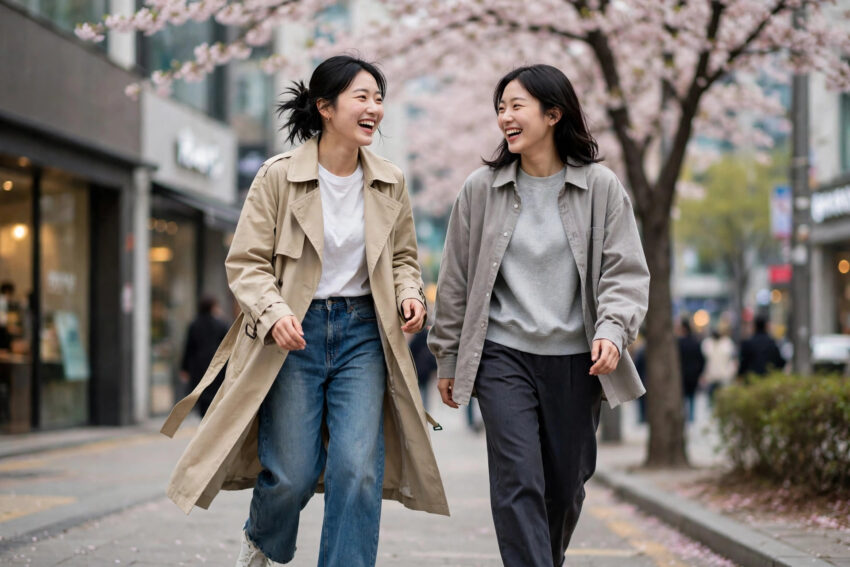
Korean street style faces its hardest test not in the depths of winter or the height of summer, but in the in-between weeks of spring and fall, when a Seoul morning can start near freezing and the same street can feel almost warm by lunch. Transitional weather is a moving target: the temperature swings, the wind changes, the subway runs hot, and the outfit you chose at eight in the morning has to survive all of it without a trip home. Seoul dressers solve this with a discipline that looks effortless from the outside — light, deliberate layers built around a trench coat or a light jacket, with exactly one layer designed to come off and go back on through the day. This guide breaks that system down into formulas you can run in any city where spring and fall refuse to sit still.
Start Here
Key Takeaways
- Transitional dressing is a layering system, not a shopping list: a breathable base, one removable mid layer, and one light outer layer handle almost any spring or fall day.
- Seoul’s in-between months swing hard — April averages lows near 8°C and highs near 18°C, and October is similar in reverse — so the outfit must change through the day, not just survive it.
- The trench coat and the light jacket are the two outer layers that matter; everything else in the outfit is chosen to work with one of them on or off.
- Spring formulas lighten as the day warms: start layered, shed the mid layer by midday. Fall formulas do the opposite: start light, add warmth as the evening cools.
- Every layer must look finished on its own. A layer that only works hidden under another layer is the one that strands you when the temperature moves.
- Proportion still rules: one longer line, one defined point of structure, and shoes with enough presence to hold the outfit together at every stage of the day.
Contents
- Why Transitional Weather Is the Real Dressing Problem
- The Three-Layer System: Base, Mid, Outer
- The Trench and the Light Jacket: Your Two Outer Layers
- Spring Formulas: Warming Up Without Overheating
- Fall Formulas: Cooling Down Without the Bulk
- One Layer On, One Layer Off: Dressing Through the Day
- Building a Small Transitional Wardrobe
- Our View
- Frequently Asked Questions
- Sources
- Recommended
Why Transitional Weather Is the Real Dressing Problem
Winter dressing is a decision you make once; transitional dressing is a decision you remake all day. In deep winter the answer is insulation, and in summer the answer is as little fabric as the day allows. Spring and fall offer no such certainty. The long-term climate record for the capital, set out in the KMA climate normals for the Seoul station, shows why: March averages a high of about 11°C against a low near 2°C, April jumps to highs near 18°C with lows near 8°C, and October runs the same pattern in reverse, with highs around 20°C and lows around 11°C before November drops away. A single outfit in those months has to work across a ten-degree range, in wind, on heated public transport, and often in and out of rain. Dress for the morning and you overheat by noon; dress for noon and the walk home punishes you.
Seoul’s fashion calendar is built around exactly this problem. The city’s two fashion week seasons sit in the transitional months rather than at the extremes, and the Seoul Fashion Week anniversary coverage from the Seoul Metropolitan Government underlines how the event anchors the industry’s spring and fall cycles. What appears on the streets around those shows is rarely a heavy coat or a summer dress. It is layering worn as a skill: long light coats over thin knits, overshirts carried open, sweatshirts that can be tied, carried or worn again by evening. The audience dresses for a full day outdoors between venues, which is precisely the condition transitional formulas are designed for.
History explains why the city got so good at this. A look back through this Seoul fashion history shows a city that has repeatedly absorbed new influences and remade them for local conditions, from the boutique culture of Myeongdong to the hip-hop silhouettes of the 1990s. The wider cultural movement behind the current wave is traced in the V&A Hallyu exhibition, which places fashion alongside music, film and television as exports that travelled together. For the transitional dresser, the practical inheritance is a wardrobe culture built on adaptable everyday pieces rather than occasion dressing — clothes expected to work from a cold platform to a warm café without missing a beat.
| Transitional Month (Seoul) | Typical Swing | Working Formula | The Layer That Moves |
|---|---|---|---|
| Early spring (March) | Lows near 2°C, highs near 11°C | Trench or light jacket over a sweatshirt and long-sleeve base | The sweatshirt comes off indoors and on heated trains |
| Mid spring (April–May) | Lows near 8–14°C, highs near 18–24°C | Trench open over a tee, or an overshirt as the outer layer | The trench is carried or worn open by midday |
| Early fall (September) | Highs near 26°C falling to cooler evenings | Summer base with a light jacket added after dark | The jacket stays in the bag until the evening |
| Mid fall (October) | Lows near 11°C, highs near 20°C | Light jacket or trench over a fine knit, scarf as the finisher | The knit carries the afternoon; the coat returns at night |
The mistake most people make in these months is treating the swing as a coat problem, when it is really a system problem. One heavy layer cannot adapt; three light layers can adapt three times. That is the whole logic behind the Seoul approach, and it is why our broader guide to Korean streetwear style keeps returning to layering as the core skill rather than any single hero garment. Once the system is in place, the individual formulas in this guide become simple variations: change the base, change the outer, and let the mid layer do the adjusting.
The Three-Layer System: Base, Mid, Outer
Every transitional outfit in this guide is built from three layers, and each layer has exactly one job. The base layer sits against the skin and must look complete on its own, because on a warm afternoon it may be the whole outfit: a clean tee, a long-sleeve top, a fine knit or a shirt that holds its shape. The mid layer is the adjustable one — a sweatshirt, a hoodie, a cardigan or an overshirt — chosen because it can be removed, carried, tied or worn open without ruining the silhouette. The outer layer blocks wind and light rain and sets the outfit’s outline: the trench or the light jacket. When each layer can stand alone, the outfit has four working configurations instead of one, and the day’s temperature swing stops being a threat.
This is not a Korean invention so much as a Korean refinement of a classic principle. A detailed breakdown of layering in transitional seasons makes the same case from a menswear angle: temperatures between roughly 7°C and 21°C reward lightweight outerwear, breathable knitwear and pieces that can be combined or separated as conditions change. Seoul street style adds its own signature to that framework — longer lines, relaxed volume kept under control, and a limited palette so that whichever layers remain on the body at any given moment still read as one outfit rather than the leftovers of another one.
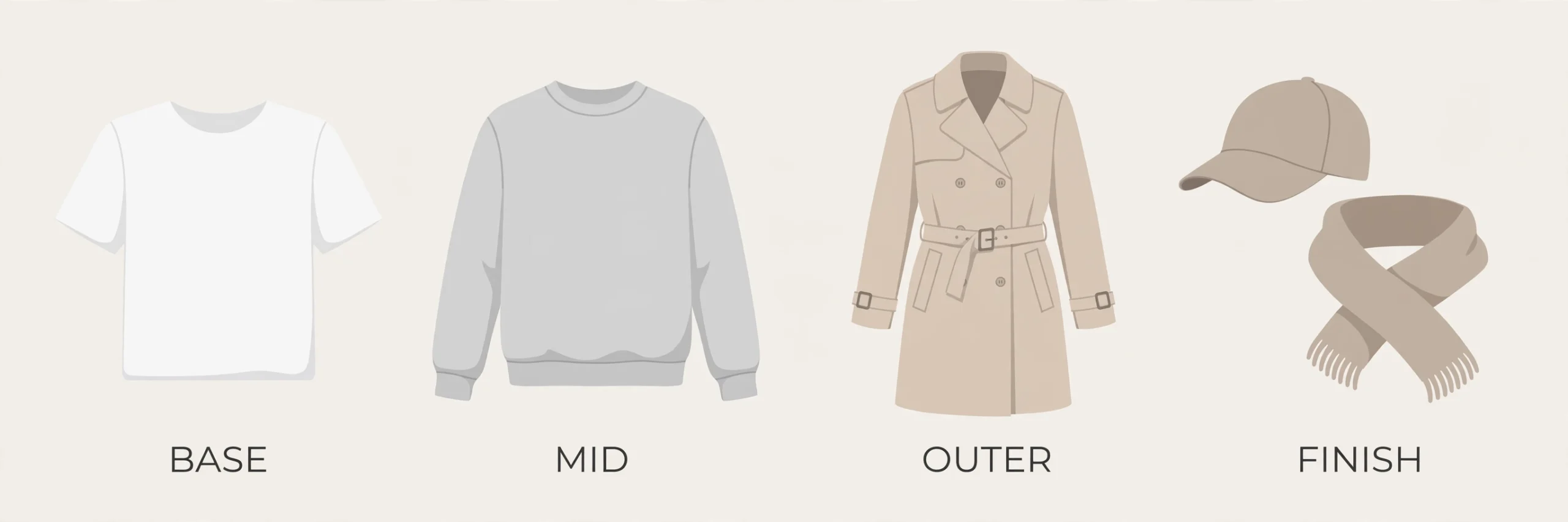
The base layer deserves more thought than it usually gets, because it is the layer the world sees at the warmest point of the day. Choose bases with a finished neckline, a hem that sits correctly untucked, and fabric that does not crease the moment a coat comes off. Plain tees in white, grey and black do most of the work in spring; long-sleeve tops and fine knits take over in fall. If you lean on hoodies as your mid layer, our breakdown of the oversized hoodie outfit in Korean style shows how to keep the volume deliberate, and how to style a hoodie with jeans covers the pairing that carries most casual transitional days.
The mid layer is where discipline matters most, because it is the layer that gets carried. A sweatshirt tied at the waist or shoulders is a styling move in this look, not an accident, but it only works when the garment is light enough to carry without bulk and clean enough to wear again in the evening. Cardigans and zip styles earn their place because they open and close without being removed at all — a cardigan worn open at noon and buttoned at seven in the evening is the transitional day in a single garment. Whatever you choose, test it at home: if the mid layer looks wrong worn alone over the base, it will look wrong at two in the afternoon in public, which is exactly when you will be wearing it that way.
The Trench and the Light Jacket: Your Two Outer Layers
If transitional dressing has a uniform, it is the long light coat worn open over everything else. The trench coat earned that role through engineering, not fashion. The garment’s origin in weatherproof gabardine is documented in the V&A’s Burberry trench guide, which traces how Thomas Burberry’s 1879 invention produced a fabric that was water-resistant yet breathable — the two properties a transitional outer layer still needs today. A trench sheds a spring shower, blocks an autumn wind, and adds almost no insulation of its own, which is the point: the warmth in the system comes from the layers underneath, and those are the layers you can remove.
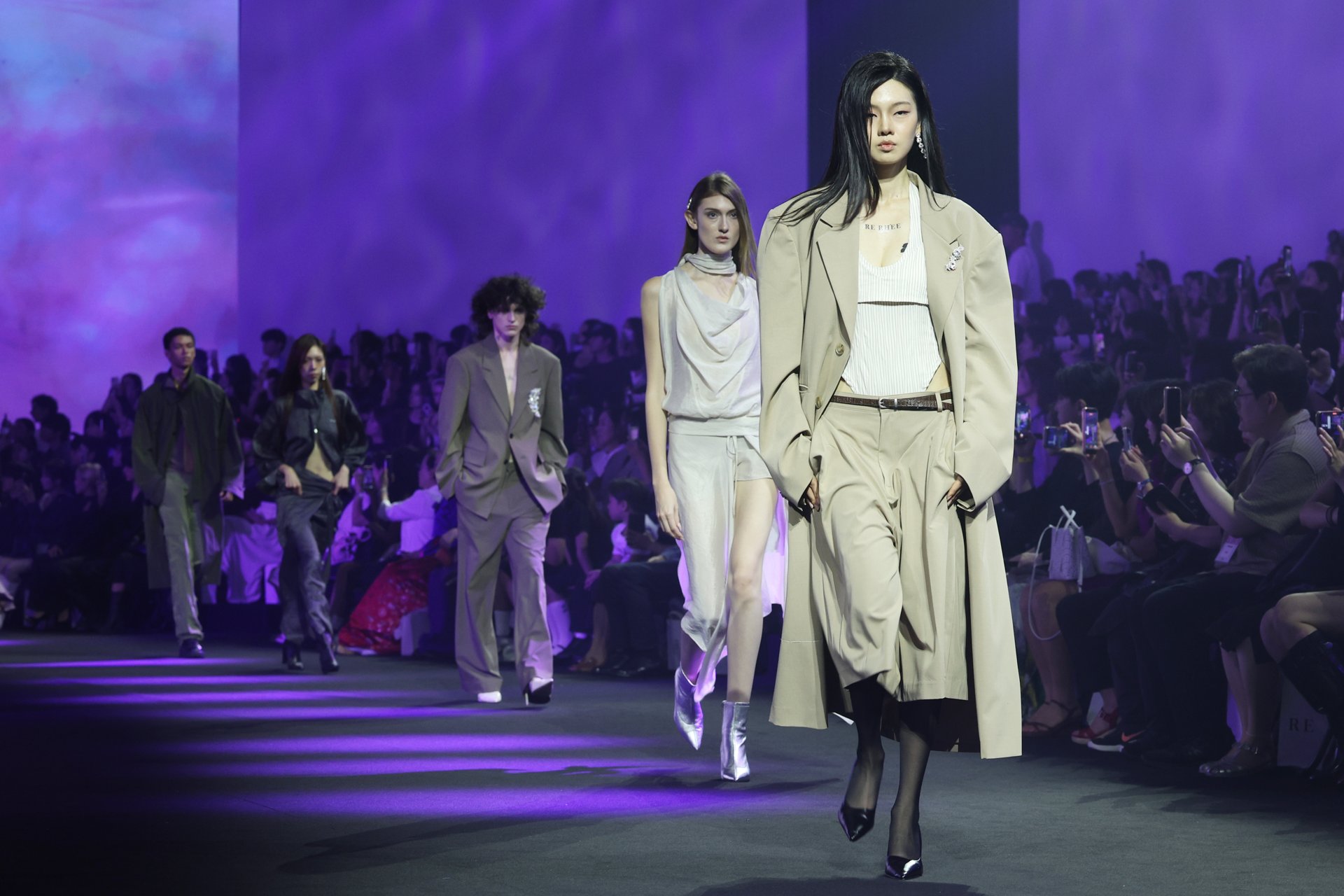
Fit decides whether a trench works as a system piece. It must close comfortably over your thickest planned mid layer without pulling, and it must look right open, because open is how it will spend most of its life. In the Korean styling of the coat, the belt is rarely buckled tight; it is knotted loosely, tied behind, or left to hang, keeping the long line relaxed rather than tailored. Length does the visual work instead: a coat that falls below the knee creates the continuous vertical that makes wide trousers, long skirts and relaxed denim read as one considered outfit. Our guide to streetwear jackets covers the shorter alternatives, but for the in-between months the long coat is the anchor.
The light jacket is the trench’s partner, not its understudy. Cropped and waist-length jackets — denim, blouson, light leather, overshirts worn as outerwear — change the proportion completely, putting the emphasis at the waist and letting long bottoms run uninterrupted below. They suit the warmer halves of the transitional seasons, the days when a trench would be carried more than worn. The rule for choosing between the two each morning is simple: if the day’s coldest hour needs a coat’s coverage, take the trench; if only the evening needs a layer, take the jacket and carry it. Readers building from the menswear side will find the same two-piece logic throughout our Korean streetwear for men guide, where the light jacket does even more of the daily work.
What neither outer layer should ever be is a winter coat worn hopefully. The long padded coat that owns the coldest months — the subject of our Korean streetwear winter guide — has no adjustment in it: it is either on and too warm or off and carried like luggage. Transitional outerwear is defined by the opposite quality. It is the layer you can wear open, wear closed, carry over an arm or fold into a tote without the outfit collapsing, and that flexibility, not its warmth rating, is what you are selecting for.
Spring Formulas: Warming Up Without Overheating
Spring transitional dressing runs in one direction: you start the day at your warmest and finish it at your lightest. The morning commute is the cold part, often with a wind that makes the thermometer feel optimistic, so the full system goes on at the door — base, mid and outer. By late morning the outer layer opens; by midday the mid layer comes off or opens; by the warmest hour some days need only the base and the trousers doing the work. The formulas below are built for that arc. Each one names its layers in order, so you can see exactly which piece moves at which point in the day.
The season’s signature formula is the trench over a sweatshirt over a tee, worn with wide-leg jeans and clean trainers. The trench runs open from the start, the sweatshirt carries the morning, and the tee — chosen to look finished, not like an undershirt — carries the afternoon once the sweatshirt is tied or bagged. Spring runways keep returning to the same coat because it solves this exact problem; a survey of styling a trench coat for spring notes how the season’s versions ran from classic long cuts to cropped and leather interpretations, all of them lighter in colour and fabrication than winter outerwear. In Seoul styling the classic long version still dominates the street, precisely because its length keeps working after the layers beneath it change.
The second spring formula swaps the trench for the overshirt. A heavy overshirt worn open over a long-sleeve base, with relaxed trousers and a cap, handles the milder half of spring — the April and May days when the swing is smaller and the outer layer’s job is mostly wind and polish. The third formula is the hoodie as outer layer: an oversized hoodie over a tee, worn with a long skirt or wide trousers, for dry days when the temperature range sits in the middle and one honest layer is enough. The styling references for all three are gathered in our streetwear inspiration library, and the palette discipline behind them — neutrals below, one lighter note on top as the season opens — is the same one described in our streetwear aesthetic guide.
Spring also carries two traps the formulas have to respect. The first is dust and sudden rain: the season’s fine-dust days and fast showers reward the trench’s coverage and punish exposed knitwear, which is one reason the coat stays in rotation even on mild mornings. The second is idol-led styling that assumes a car and a short walk. The influence is real — Dazed on K-pop’s fashion takeover traces how idol styling now shapes what young shoppers wear far beyond Korea — but a photographed outfit only has to survive a photograph. A transitional outfit has to survive a platform, a train, a café and an evening walk, which is why every formula here is tested against the full day rather than the single moment.
Fall Formulas: Cooling Down Without the Bulk
Fall runs the spring system backwards, and that reversal changes which pieces you reach for. September still opens warm, so the day starts light — a tee or long-sleeve base, trousers, and the jacket carried rather than worn. The layer goes on at the point in the evening when the temperature turns, and by October the order flips again within the season: the knit becomes the constant, the light jacket or trench becomes the variable, and a scarf joins the bag as the smallest layer with the largest effect. Dressing well in fall is mostly about respecting that direction of travel. The person who leaves home in the full October outfit at a warm noon is making the spring mistake in reverse.
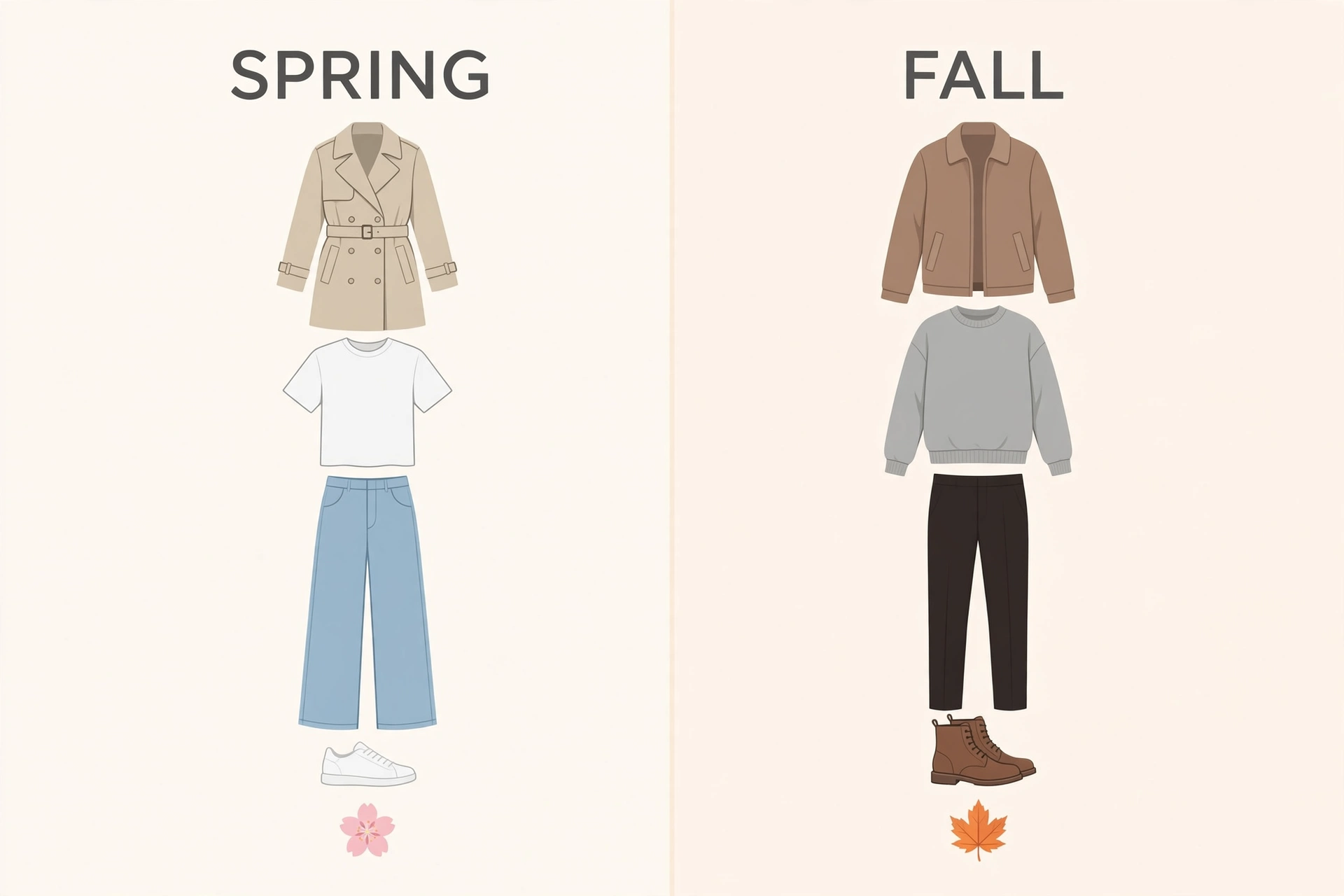
The core fall formula is the fine knit under the light jacket. A thin crew or cardigan in grey, charcoal, brown or black carries the afternoon on its own; the jacket — blouson, denim or a cropped trench — goes over it when the light goes. Underneath, straight or wide trousers in darker denim do the grounding, and the denim rules in our streetwear jeans guide apply unchanged: the hem should meet the shoe cleanly at every stage, because a trouser that only works with one shoe choice will betray you on the day the weather changes your footwear. Boots begin to replace trainers through October, adding the visual weight that darker fall palettes need.
The second fall formula brings the trench back, now over a hoodie. This is the pairing Seoul wears hardest in October: the coat’s long formal line against the hoodie’s softness, the hood itself acting as the finishing layer on cold evenings. Unisex dressing makes the formula easy to share across wardrobes — a point the design culture keeps underlining, as in Hypebae’s profile of Ader Error, the Seoul collective whose oversized, gender-free pieces are designed to be worn by anyone. A trench and hoodie bought without a gendered fit in mind tend to layer better, because the volume is distributed rather than tailored to one silhouette.
Colour is fall’s other adjustment. Spring lightens the palette from the top down; fall deepens it from the bottom up. Keep the base layers in the same neutral family you wore all spring, shift the trousers and denim darker first, then let the outer layer follow — beige trench to brown or black jacket, white trainers to darker shoes — and the wardrobe transitions without a single new formula. The pieces themselves barely change. That continuity is the economic point of the system, and it is why the essentials list in the final section of this guide is so short.
One Layer On, One Layer Off: Dressing Through the Day
The formulas only work if the mechanics of changing them are planned before you leave home. A removed layer has to go somewhere: tied at the waist, folded into a tote, or carried over the coat. Decide which at the door, because a sweatshirt carried in the hand for six hours is a sweatshirt you will stop wearing by the second week. Seoul’s commuter culture quietly standardised the answers — the crossbody bag sized for a folded knit, the tote that takes the trench at noon, the cardigan that never fully comes off. Build the carrying method into the outfit and the system survives real life; leave it to chance and the system survives until the first warm afternoon.
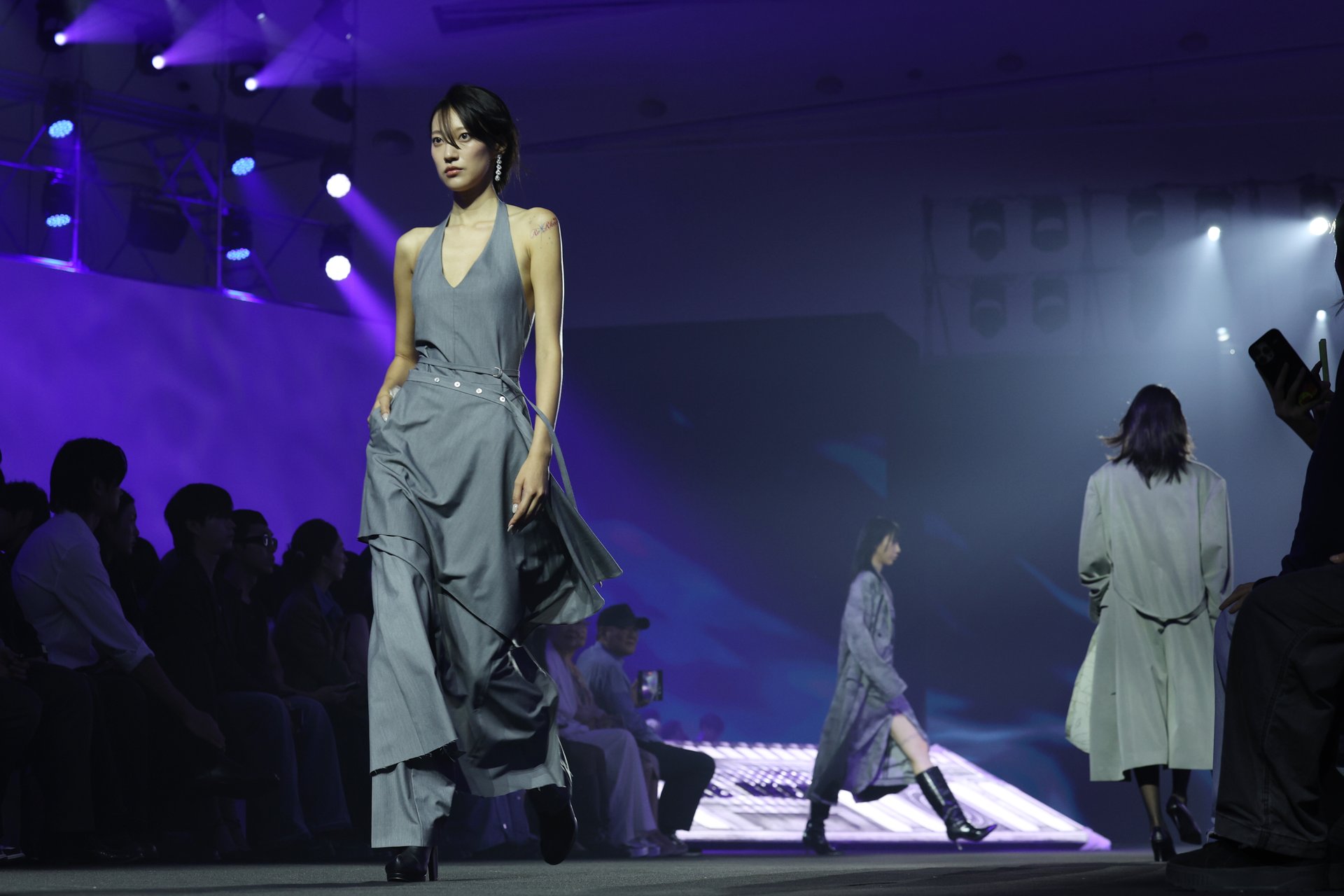
The city’s fashion week shows the mechanics at civic scale. The Seoul Fashion Week landmarks announcement describes the event spreading between Dongdaemun Design Plaza and Lotte World Tower, turning the city itself into the venue — which means a crowd dressing for hours outdoors, in transitional months, in outfits that have to hold from a morning queue to an evening show. Look at what that crowd wears and the pattern is this guide in miniature: long light coats, removable knits, nothing that cannot be adjusted standing up.
Two habits separate people who find transitional dressing easy from people who find it annoying. The first is checking the day’s low, not its high, before choosing the outer layer: the low is the hour you will be outside walking, while the high usually arrives when you are indoors or in motion. The second is treating the finishing pieces — cap, scarf, bag — as layers in their own right. A scarf in the bag is worth half a knit; a cap changes how a windy morning feels more than a heavier base would. The women-focused version of these habits, including how the formulas adjust across different bodies and dress codes, is worked through in our guide to Korean street style for women, and readers who want the same thinking translated for a more polished wardrobe will find it in the Gangnam USA bridge in this post’s link card.
Building a Small Transitional Wardrobe
A transitional wardrobe is small because the system does the work that extra clothes do in other seasons. The full kit is shorter than most people expect: three bases that look finished alone, two mid layers that carry well, one trench, one light jacket, two bottoms that work with both outer layers, two pairs of shoes, and a scarf and cap as travelling finishers. That is roughly a dozen pieces producing two seasons of distinct outfits, because every piece combines with every other and each day’s configuration changes with the weather. Our streetwear essentials list covers the year-round core; the transitional kit is that core with its outerwear swapped for the light, adjustable kind.
The market behind these pieces is worth understanding before you buy. Korean domestic platforms built their scale on exactly this category of everyday, layerable clothing, and the Musinsa newsroom announcements describe a retail culture organised around young shoppers buying streetwear as daily dress rather than occasion wear — which is why the pieces are cut for layering, priced for rotation and restocked at transitional speed. The brands shaping the look internationally, surveyed in Highsnobiety’s Seoul brands round-up, grew from the same street-level logic: oversized blazers, jersey hoodies and reworked outerwear designed to be worn daily and combined freely.
Buy in the order the system uses the pieces. The trench or light jacket comes first, because it is worn most and seen most; buy it to fit over your thickest mid layer and in the neutral that matches the shoes you already own. Mid layers come second, chosen for how they carry as much as how they wear. Bases come last and cheapest, because they are replaced most often and seen in the briefest window of the day. Follow that order and the wardrobe builds itself across one spring and one fall, each season’s purchases tested by real weather before the next is made — which is, in the end, how the Seoul street built the style in the first place: one adjustable layer at a time.
Our View
Our view is that transitional dressing is where Korean street style proves it is a method rather than a look. Anyone can dress for a stable season; dressing for a ten-degree swing, a heated train and an evening wind, in an outfit that stays coherent at every stage, takes a system — and systems can be learned, copied and kept. Master the three layers, give the trench and the light jacket their proper jobs, and plan where the removed layer goes, and spring and fall stop being the awkward months between wardrobes. They become the months your wardrobe works hardest and looks best doing it.
Dress for the whole day, not the hour you leave the house. One layer you can remove is worth three you have to endure.
— Brian Ka
Frequently Asked Questions
What is the best outer layer for spring and fall in Korean street style?
The trench coat, because it blocks wind and light rain while adding almost no insulation of its own, so the layers underneath stay in charge of warmth. A light jacket — denim, blouson or a cropped trench — is the partner piece for the warmer halves of both seasons.
How many layers should a transitional outfit have?
Three: a base that looks finished on its own, a mid layer designed to be removed and carried, and a light outer layer. Three layers give you four working configurations across the day, which is what a ten-degree temperature swing actually demands.
What is the difference between spring and fall formulas?
Direction. Spring outfits start fully layered in the cold morning and shed pieces as the day warms; fall outfits start light and add pieces as the evening cools. The garments are largely the same — only the order of travel, and gradually the palette, changes.
Can I use a hoodie as a transitional layer?
Yes, in two roles. As a mid layer it sits under a trench or jacket and comes off at midday; as an outer layer on mild, dry days it works over a tee. Choose one that looks deliberate worn alone, because at some point in the day it will be the top layer.
How do I stop layered outfits looking bulky?
Keep volume in one layer at a time and let the others sit closer. A relaxed trench over a fine knit and a clean base reads as a long line, not a pile; bulk appears when the base, mid and outer all compete at the same weight. A defined point — a hem, a waist, a firm shoe — keeps the stack reading as an outfit.
Questions About Building Your Wardrobe?
Tell us which formula you are trying, what is not working, and where you live — proportion advice is always specific to the outfit and the day it has to survive.
Sources
- V&A — Hallyu! The Korean Wave exhibition
- V&A — The Burberry Trench: Crafting an Icon
- Korea Travel Note — Seoul weather by month (KMA climate normals)
- Gentleman’s Gazette — Layering in Transitional Seasons
- Coveteur — How to Style a Trench Coat for Spring
- Musinsa — Newsroom
- Seoul Metropolitan Government — Seoul Fashion Week marks 25 years
- Seoul Metropolitan Government — Seoul Fashion Week landmarks
- Highsnobiety — Seoul Fashion Brands
- Hypebae — Ader Error, Korean design collective
- Dazed — K-pop and Korean fashion
- Korea JoongAng Daily — Seoul fashion history